Static electricity has been known since ancient times. More than 2000 years ago, Thales found that a piece of amber rubbed on silk could pick up small pieces of paper. The real understanding of the phenomenon came much later, with the discovery of the electron in the 20th century and the idea of electrical charge.
In flooring, static electricity became especially relevant once polymer materials started being used widely in footwear, furnishings, and floor coverings, including carpets. People walking on such floor coverings often experience shocks when they touch a metal doorknob, metal equipment or furniture, or even another person. It may be a small nuisance at home, but in some environments it can also create real problems.
Why Does Carpet Produce Static Electricity?
All matter is made of atoms that contain equal numbers of positive and negative charges. When those charges become unbalanced, they generate a static charge. What causes that imbalance can vary, but in the case of carpet, it is often due to two materials meeting and rubbing together.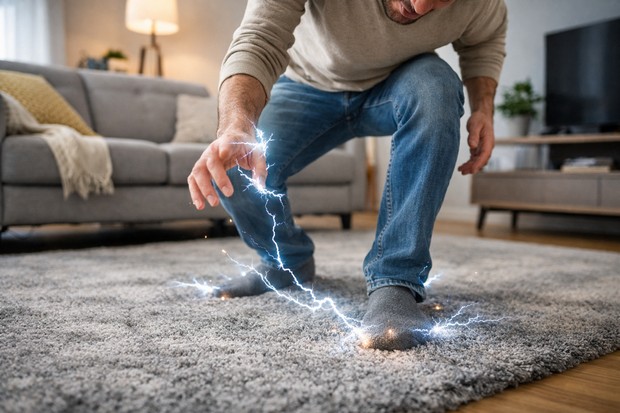
Some common examples are walking across carpet, most often with socks on, or rubbing your hand or body on the carpet. The friction between the two materials creates the static charge. Carpet is unique in the sense that it can generate and hold on to static electrical energy for days and even weeks, unlike metals, which usually do not retain it for long.
Some of the common fibers in carpet, such as wool, nylon, silk, cotton, acrylic, viscose, polyester, ramie, and acetate, can generate and hold static energy. Static often builds more quickly during the winter, when the air is colder and drier and there is less moisture to help dissipate the charge.
What Makes Some Carpets More Static-Prone?
Static electricity is affected by several variables, notably the type of carpet fibers and cushion, the type of shoes you are wearing, how you walk on it, and the amount of moisture in the air. In general, nylon carpeting will generate significantly more electricity than polyester or wool. Some new carpets have special fiber blends or treatments built into them that are intended to reduce static electricity.
Humidity is very important because moisture in carpet fibers helps dissipate electrical charge. In other words, carpeting in a room with very dry air will not contain much moisture in its fibers. As a result, it will be more likely to generate static electricity.
This is one reason static shocks are more common in dry indoor spaces, especially in winter. Even in homes and offices where carpets are treated to reduce charge build-up, most people still experience shocks from time to time. Sensitivity to shocks varies from person to person, and some people notice them much sooner than others.
What Are the Risks of Static Electricity in Carpets?
Most people have experienced shocks from static electricity after walking on carpets or exiting vehicles. While the shock is usually brief, static electricity can do more than just surprise you. As well as being unpleasant for people, it can damage microprocessor-based equipment and interfere with sensitive electronic systems.
In hospitals and laboratories, there is also the risk of static triggering explosions when flammable anesthetics or solvents are present. In many new commercial buildings, architects specify the use of low-static carpets to avoid these problems and reduce electrostatic build-up.
Uncontrolled static charges are responsible for numerous problems in modern life. In the textile industry, static is responsible for the clinging, tangling, and breaking of synthetic fibers. It can also act like a natural magnet, attracting dirt and dust to carpet coatings and fiber surfaces, which makes the carpet look dirty faster.
At its worst, electrostatic discharge can cause fire hazards in areas where flammable substances are used. Electronic and computer industries are especially vulnerable because static discharge can damage components in ways that are not always visible right away. That is why static electricity is not only a comfort issue, but also a safety and reliability issue.
How to Reduce Static Electricity in Carpets
Electrostatic voltages on the body can theoretically be controlled in two main ways. First, the charge generated can sometimes be controlled by the choice of materials or by surface treatment. Second, the voltage built up can be controlled by using lower resistance materials.
In practice, the most effective approach usually combines material choice, humidity control, and basic maintenance. No single fix works in every setting, so the best solution depends on the room, the carpet type, and how the space is used.
a) Choose the Right Carpet Materials
In principle, the choice of material can directly affect charge generation in contact with shoe sole materials according to the triboelectric series. Unfortunately, shoe sole materials are quite variable in their electrostatic properties and position in the triboelectric series. The materials used can range from polyurethane, rubber, PVC, or EVA to leather, and most of these materials are highly insulating.
Unless they are specifically designed for static control applications, footwear is rarely made with static electricity performance in mind. A floor material selected to minimise charging against one shoe sole material could show high charge generation against another. Even so, a floor material from the middle of the triboelectric series, such as wood or rubber, may give less charging in general than one from the extremes, such as glass.
b) Use Conductive Fibers for Long-Term Control
There are two main technologies used to control static electricity, conductive fibres and topical finishes. Conductive fibres provide a long-term solution to the problem of static charge build-up. Topical finishes tend to give a temporary solution, and may not be effective in low atmospheric humidity.
Conductive fibres are mainly carbon based, although stainless steel and silver-coated fibres have also been used. Silver-coated fibres also have the advantage of being antimicrobial, which can be useful in health care environments and schools, and may help reduce unpleasant odours from carpets.
Carbon conductive fibres may have the conductive material incorporated as one or more stripes on the outside of the fibre, or buried within the fibre core. The percentage of conductive fibre required may be quite low, even just a small amount. The conductive fibres may be incorporated into the pile, the primary backing, or both. For applications where a low resistance to ground is required, the secondary backing may also include some form of static protection.
In bitumen or vinyl-backed carpeting, this usually takes the form of carbon black added to the backing compound. Conductive fibres reduce static charge build-up not just by lowering resistivity, but also by supporting corona discharge, which can help neutralize nearby charges.
c) Apply Topical Finishes
Topical finishes contain ionic or cationic surfactants or quaternary ammonium compounds, and may be applied to pile and backing yarns during manufacture or to finished carpets before they leave the factory. They may also be applied to carpets after installation.
In general, topical finishes are used mainly to control nuisance effects of static electricity. For more critical applications, such as computer rooms or electronics manufacturing and handling areas, conductive fibres are usually the better choice.
These finishes can help, but they are not permanent. They may wear off over time, and they may be less effective in very dry indoor conditions. If you use a spray-on anti-static agent, it is worth choosing one that will not leave the carpet sticky or attract extra dirt.
d) Control Humidity in the Room
Adding moisture to the air with a humidifier can help reduce static problems. If enough moisture is added, it can make a big difference because the carpet fibers will not hold charge as easily. That said, too much moisture can create condensation problems, so the goal is balance rather than excess.
This simple step is often one of the easiest ways to improve comfort in homes, offices, and other indoor spaces. It is especially useful in winter, when heating systems tend to dry out the air.
e) Keep the Carpet Clean
Soil can also generate static in carpets and even attract more soil into the carpet fibers. Basically, the static is helping to make the carpet dirty. Static can create a need for more frequent carpet cleaning and may also damage the carpet at the same time.
The soil in the carpet can rub against the fibers, which slowly thins the carpet. In addition, the electrical discharge can damage the carpet fiber, and it can especially affect synthetic carpets. Regular vacuuming and proper cleaning help reduce this cycle of dirt, friction, and charge build-up.
f) Choose Footwear and Flooring Wisely
The type of shoes you wear makes a real difference. Rubber-soled shoes, leather soles, and other common materials can all interact differently with carpet. If static is a recurring issue in a workplace, school, or technical space, it helps to consider the entire system, not just the carpet itself.
In some environments, grounded conductive materials make static much easier to manage because the charge can dissipate instead of building up on the body or the floor surface. That is why flooring design matters so much in laboratories, electronics areas, and other sensitive spaces.
Future Trends in Static Control for Carpets
With the continuing use of polymeric materials in carpets, shoe soles, and furnishing materials, static electricity can be expected to remain a source of discomfort and risk in working and domestic environments. It will continue to disrupt or damage electronic equipment, and in some places it will still be a concern where flammable materials are present.
Electrostatic control will keep being important in processes where damage to components or ignition of flammable materials is a concern. Static build-up on personnel or equipment can only be reduced and controlled if designers and manufacturers build static-reduction technologies into the design and specification of future materials.
Although techniques are already available to carpet manufacturers, the development of new materials, new treatments, and more cost-effective solutions would certainly help. The goal is simple: reduce static without sacrificing comfort, durability, or appearance.
Conclusion
Static electricity in carpets is common, but it does not have to be a constant problem. The charge is usually caused by friction, dry air, and the interaction between carpet fibers and footwear. It can lead to annoying shocks, dirt attraction, carpet wear, and in some settings, serious safety risks.
The good news is that static electricity can be controlled. Choosing the right carpet, using conductive fibres or topical finishes, managing indoor humidity, and keeping carpets clean all make a difference. For homes and workplaces alike, the right approach can make carpet more comfortable, safer, and easier to maintain.