Why Carpets Need Functional Finishes
With the rapid liberalisation and globalisation of the world economy, “Value-Added Product” has become the buzzword across every competitive industry. Unless any product is characterised by value addition, it is impossible to survive in this highly cost-sensitive and quality-conscious competitive world market. To acquire this edge, product innovation is required which triggers the purchasing impulse of the enlightened customer of today. It is here that Research and Development efforts become imperative to present a huge spectrum of value-added carpets with functional finishes with world-class quality at the most competitive rates.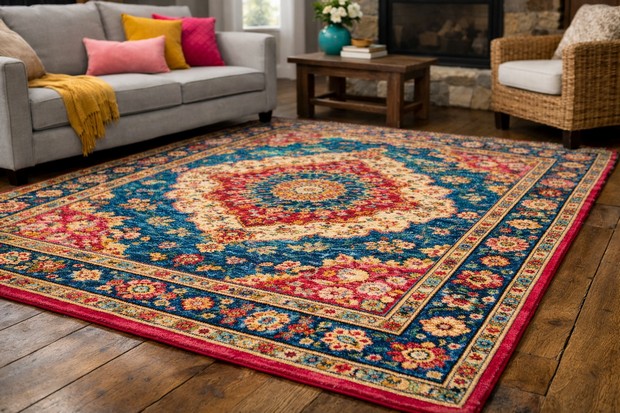
Today the customer is fully aware of what he or she wants and as it is indeed a customer-centric market, a range of value-added carpets finished with specialty functional effects are developed to satisfy the specific needs of the customer. In larger traffic areas such as lobbies of hotels or living rooms in a home setting, one needs a carpet which is robust, abrasion resistant, and made of strong synthetic fibres such as nylon, polyester, polypropylene, acrylics, or their blends. Not only are these man-made fibre-based carpets relatively economical in cost, but they are also easier to maintain and can be obtained with different specialty effects and finishes. A very good resistance to water and oil-based stains is expected from carpets used in dining or play areas wherein food serving is frequently done and spillage possibility is quite high.
Best Carpet Fibers Explained
Selection of fibres for carpets is done taking into consideration their properties such as strength, abrasion resistance, thermal and electrical conductivity, static charge development tendency, hydrophilicity or hydrophobicity, resistance to microorganisms, insect repellency, stain resistance, and flame resistance. Among the natural fibres, wool, the most preferred, with inherent flame retardancy and resilience, is susceptible to moths and felting. Nylon 6 and Nylon 6,6 can be used for carpets where brilliant colours are needed with good durability, and these fibres have excellent recovery and resiliency. Polyester has good abrasion resistance and durability, is hydrophobic and stain resistant, and is well suited for carpets because of its exceptional performance properties. Polypropylene, also a strong and abrasion-resistant fibre, can be used as a relatively inexpensive option for carpets with shorter piles. The modern carpet business is mainly dominated by wool/nylon 80:20 blends, whereas pure wool carpets, being the most expensive, are used in a minor proportion.
The first and foremost aspect of any carpet is its aesthetic appearance, because carpets are used for ornamentation of floors and walls in modern houses, hotel rooms, and lobbies. Then follow their special functional finishes that are unique for certain special applications. Today’s carpets are required to support the hectic lifestyle of their owner as well as withstand accidental mishaps without causing serious damage. Value-added carpets thus have to offer all those advantages which can make a person’s life more cozy, comfortable, and genuinely easy to maintain. In complex home or office situations, multiple specialty effects are expected in a single carpet: soil resistance, stain resistance, antistatic, flame resistance, and many more, all delivered in a cost-competitive way.
Fire-Resistant Carpet Finishes
Important elements with respect to flammable materials are combustibility, ignitability, flame spread, and heat release. Secondary effects are smoke development, toxicity, and corrosiveness of gases. All these are important factors in the development of suitable flame-retardant systems for particular carpet substrates. Conventional flame retardants for cellulosic or ligno-cellulosic materials, such as those containing nitrogen or phosphorus components, decompose on burning at lower temperatures than the corresponding untreated materials, and they also have greater char residues than untreated cellulose.
How Flame Retardants Work
Combustion is an exothermic process which requires heat, oxygen, and a suitable fuel. Combustion is a self-catalysing process which will continue until oxygen, heat, or fuel is consumed. Horrocks suggests that the fibre material undergoes combustion in different stages while evolving different gases and chemical substances. After receiving heat or ignition, the fibre undergoes pyrolysis, which evolves liquid condensates, tars, non-flammable gases, and char. A flame retardant can work in such a fashion that it may reduce volatile and flammable gas formation and promote char formation. The second stage is the release of flammable gases, followed by the oxidation stage assisted by available oxygen, giving away CO₂, CO, and H₂O. A flame retardant inhibiting oxygen access to the flame, or able to increase the ignition temperature of gaseous fuels, will generally be effective. The final stage is the generation of heat and light which further radiates out.
In the case of cellulosic fibres such as cotton and jute, formation of levoglucosan is an important thermal degradation mechanism. Levoglucosan and its volatile pyrolysis products are highly flammable and have the greatest share of combustion in cellulosic fibres. Flame retardants for cellulose possess a capacity to inhibit the formation of levoglucosan. Crosslinking and esterification of cellulose polymer chains with phosphoric acid reduce the formation of levoglucosan, catalyse the dehydration and carbonisation of cellulose, and thus act as effective flame retardants. The presence of nitrogen also plays a significant role through providing a synergistic effect with phosphorus.
Types of Flame Retardants
Non-durable flame retardants are those materials that wash readily with plain water. Ammonium sulphate and the mixture of boric acid and borax are effective non-durable flame retardants for cotton fibres. Mono- or diammonium phosphate, ammonium sulphamate, and ammonium bromide are known commercial products in this category.
Semidurable flame retardants are somehow resistant to water soaking or leaching, but generally not to laundering. Backcoating with phosphorus-containing formulations is one approach to provide semidurable flame retardancy. Phosphorus-containing coatings form a barrier of foamed char when the textile is exposed to fire, such as ammonium polyphosphate, pentaerythritol, melamine, and binder formulations.
The most successful and effective durable flame-retardant systems of cellulosic textile are based on phosphorus and nitrogen-containing compounds. The most important commercial product with more than 50 years of history is THPC. It reacts with urea, forming an insoluble crosslinking net on cellulose by a pad, dry, and cure process. The other successful commercial durable flame retardant is Pyrovatex CP, which is applied with a methylolated melamine resin in the presence of phosphoric acid. The problems of formaldehyde release in these products led to investigation of formaldehyde-free flame retardants. Polycarboxylic acids such as butanetetracarboxylic acid (BTCA), citric acid, and maleic acid have been applied, and among all, the best overall results have been achieved with BTCA, which delivers effective flame retardancy with minimal impact on fabric strength.
Flame Retardancy Testing
The burning behaviour of control and treated samples is evaluated by standard methods. For LOI analysis, an ignition time of 30 s is maintained as per ASTM D2863. In horizontal flammability tests, the flame time and propagation rate are measured as per FMVSS302N standard. In vertical flammability tests, different parameters are measured as per ASTM D635. Radiant heat test measures the amount of heat radiated through the specimen, evaluated by ASTM F1939.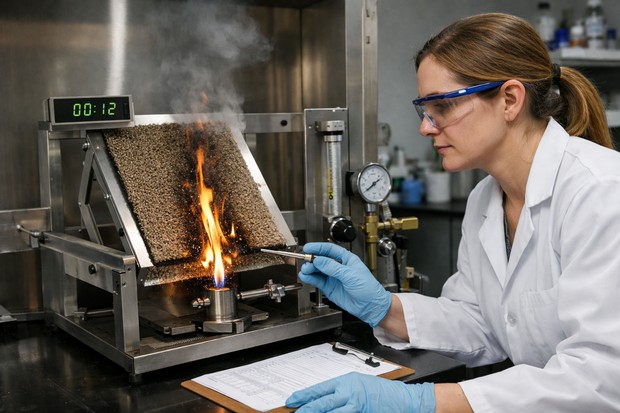
Soil-Release Carpet Finishes
To make carpet products more sustainable and customer focused, soil-release finishing processes have become popular for value addition. Chemical finishes that permit relatively easy removal of soils with ordinary laundering are the demand of the emerging market. These finishes are necessary because hydrophobic fibres and resins have very low water absorbency. It accomplishes the result of making the fibre more absorbent and hydrophilic, thus permitting better wettability for improved soil removal. Both natural and synthetic fibres attract dirt and get soiled, but synthetic fibres attract soil to a greater extent than natural fibres.
How Soil-Release Works
Soiling occurs mainly by three types of mechanisms: mechanical adhesion, adhesion by electrical forces, or redeposition of soil during washing. In the case of mechanical adhesion, soil particles get entrapped in the interstices of fabric or through capillary spaces of the fibres and get mechanically bound. In the case of adhesion by electrical forces, it occurs mainly due to synthetic fibre surfaces acquiring electrical charges that attract soil from air. Often, during laundering of polyester and nylon materials, released soil of an oleophilic nature redeposits if the detergent does not contain anti-depositing agents.
To enhance the soil-release properties of such fabrics, special finishes have been developed. Finishes that are hydrophilic with low adhesion to soil under washing conditions improve the particulate soil release. For polyester-based textile, the soil-release finish used consists of a mixture of fluorochemical soil-release agent, an adhesive binder consisting of an acrylic emulsion, and a crosslinking agent, preferably containing reactive aldehyde sites such as melamine formaldehyde. Oleophobic treatments use fluorocarbons which are oil repellent, soil resistant, and release soil easily from textile materials. Copolymers of ethyl acrylate with acrylic acid are used for soil-release finishes, which confer hydrophilic character to the fibre surface, prevent soil redeposition during washing, and reduce the accumulation of static charges, thereby reducing attraction of dust from the air.
Future of Soil-Release Tech
The next generation of carpets is likely to incorporate nanotechnology. Nanoscale structures on the fibres make them super soil release. Recent work has shown that soil release can even be incorporated into yarn finishes. This will greatly help carpet manufacturers as their work becomes much easier if they use soil-release finished yarns of polyester, nylon, and wool from the very beginning of the production process.
Stain-Resistant Carpet Finishes
During the last few decades, the concept of easy care has grown in the carpet field. Consumer demands for easy-to-maintain carpet substrates have given birth to repellent finishes. The main aim of repellent finishes is that no drop of liquid should spread on the carpet and wet its surface. The drop of liquid should stand on the surface and get easily rolled off. Such a requirement can only be met if the interaction between the fibre surface and the liquid could be greatly suppressed.
This repellence can be improved by reducing the free energy on the fibre surface. The drop will not spread on the fibre surface if its cohesive forces are greater than the adhesive forces between the fibre surface and the liquid drop. Hence, to lower the surface energy of the material, various low-surface-energy compounds are used for finishing or coating the fibre materials.
Top Carpet Repellent Finishes
Paraffin wax-based repellents are the most traditional repellent finish. They provide only water repellence and are the cheapest among all repellents. They provide good water repellence but are not durable to washing. One can use these finishes on carpets by padding or spraying, followed by drying.
Silicone-based water repellents have a characteristic structure of alternating silicon and oxygen atoms in the molecular chains. Silicones have a wide range of applications in the textile industry such as defoamers, softeners, and water repellents. Linear polydimethylsiloxane is used for the water-repellent finish in textiles and carpets of various fibre types.
Fluorocarbon-based compounds with perfluoroalkyl groups are widely used to modify carpets and impart resistance to water, oils, and stains. These compounds form films around the fibre and impart repellence by lowering the critical surface tensions of fibre surfaces, hence reducing adhesion and limiting absorption of aqueous or oily substances. Many liquids used in day-to-day life such as curry, coffee, and tea with a potential of staining carpets can be repelled by using such finishes. However, in spite of good performance properties, perfluorinated compounds are bio-accumulative and have very hazardous effects on human health. Hence, there has been increasing research to substitute fluorocarbon-based repellents with safer and equally effective alternatives.
Nano finishing agents represent a significant development in the field of repellent textiles. Inspired from the lotus leaf, which constitutes a nanohierarchical surface on which wax is deposited, the term superhydrophobicity has evolved. Nanoparticles of SiO₂ and TiO₂ have been proposed by researchers to create surface roughness on textile. These nanoparticles were further modified by various low-surface-energy compounds to deliver outstanding and durable stain protection.
Testing Repellent Finishes
AATCC 22 (Spray Test) is designed for evaluating water-repellent performance of textiles, with ratings given from 0 to 100. AATCC 118 evaluates the oil repellency of fluorocarbon-treated textiles using a series of hydrocarbon drops with varying surface tensions. AATCC 175 (Stain Resistance: Pile Floor Coverings) comprises the application of artificial stain on treated carpets, allowing it to dry for 24 hours, followed by washing and rating of residual staining as per a standard scale.
Antistatic Carpet Finishes
Static electricity is the major problem mainly with hydrophobic synthetic fibres used in carpets. Consumers have faced problems of small electricity shocks while walking on carpets. This is mainly due to carpet surfaces coming in contact with shoe soles and being charged due to friction. The generated and accumulated charges will stay on the carpet surface and generate small shocks. The dust in the air has a tendency to adhere to statically charged carpet piles and causes soiling problems. Static discharges may also harm electronic equipment. To overcome this problem of static charge development, antistatic functionalisation of the fibre surfaces becomes highly essential.
How Antistatic Finishes Work
Most finishing agents expected to work as antistatic agents are supposed to suppress the generation of static charge on the fibre surface when they come in contact with or undergo friction with surfaces of different materials. Antistatic agents have hydrophobic and hydrophilic groups in their molecular structure. The hydrophilic part orients itself towards the air and promotes the absorption of moisture, which is highly conductive, resulting in the dissipation of static charge, and hence a lot of possible soiling is avoided.
Non-durable antistatic agents are applied on substrates which do not need frequent laundering, making them particularly well suited for carpets. The basic chemistry of these compounds indicates that they are esters of phosphoric acid, alkyl phosphates, and ethoxylated secondary alcohols. Durable antistatic agents are useful for substrates needing frequent laundering. These are polymers basically with hydrophilic groups which help for dissipation of static charge and are derivatives of polyglycols. AATCC Test Method 134 measures the resultant voltage of a person wearing shoes with standard soles as they walk across a carpet, with the maximum voltage after 30 to 60 seconds recorded.
Antimicrobial Carpet Finishes
Carpets are very widely used in many different institutions such as hospitals, offices, schools, and airports, as well as in domestic settings. However, while fulfilling these requirements, carpets can serve as prominent hosts for the growth of microorganisms. The growth of microorganisms is favoured by the pile structure of carpets which entraps soil, dander, food particles, drink drops, and pet excrements, which serve as nutrients for microorganisms. In a humid and warm environment, microorganisms can grow very rapidly and when they secrete certain enzymes, cause degradation of the fibres, discolouration of products, cross-contamination, foul smell, and sometimes even rashes to users when they come in contact with bare skin. Hence, the use of antimicrobial finishing agents is very essential.
Best Antimicrobial Agents
Quaternary ammonium compounds (QACs) have a long alkyl chain and a number of cationic ammonium groups. The negatively charged cell membrane of the microbes gets attached with cationic ammonium groups and forms a surfactant-microbe complex. This process hinders the basic functions of the microbe and causes a block in cell multiplication. The quaternary ammonium groups retain the antibacterial activity as long as they are attached to the fibre surface.
Silver tops the list as the most widely used antimicrobial agent in textiles as it is non-toxic and non-carcinogenic and effective against a broad spectrum of bacteria including E. coli. Copper, zinc, and cobalt have also been used for antimicrobial finishing of textiles.
Triclosan blocks lipid biosynthesis and consequently inhibits microbial growth. Being similar in structure to disperse dyes and because of its smaller molecular size, it can be applied on polyester and nylon fibres before or after dyeing.
Natural antimicrobial agents are also being increasingly explored as eco-friendly alternatives. Antimicrobial property of chitosan obtained from shrimp shells is well known due to its polycationic nature. Many natural dyes have also been reported to have inherent antimicrobial properties and are successfully applied onto textile substrates. These natural agents offer effective microbial control without the environmental burden of conventional synthetic treatments. AATCC 174 is exclusively set for antimicrobial activity assessment of carpets and is recommended under the General Services Administration specification.
Insect-Repellent Carpet Finishes
Wool and other animal fibres such as cashmere contain keratin in their chemical structure. There are certain insects such as clothes moths, carpet beetles, and fur beetles which eat up these keratin-containing fibres in their larval stage. Along with this, dust mites start living in carpets and cause allergy, asthma, and neurodermitis. It is therefore a requirement to keep these insects away from carpets to maintain a healthy indoor environment.
Insect resistance finishing chemicals can act either in the digestive system of the larvae during the keratin digesting process or can harm the nervous system of the insect. Digestion affecting chemicals are mostly species specific and cause less environmental hazard. Chlorphenylids, sulcofenuron, and flucofenuron come under this category. Nerve-poisoning chemicals are effective over a broad spectrum of species but degrade more rapidly and are less durable. Permethrin and hexahydropyrimidine are common examples, and a combination of these two has been specifically developed to remedy the individual limitations of each compound. AATCC Test Method 24 gives the standard methods for evaluating insect-resistant finished fabric.
Carpet Softening Finishes
Softener finish, as the name suggests, is a type of finishing agent which imparts softness to a textile material. It is one of the most important tactile improvements that can be imparted to carpet products. The present day softeners also have to be durable, antistatic, provide useful moisture regulation properties, and be abrasion resistant.
How Carpet Softeners Work
Almost all the fibres in water generate a negative zeta potential. The hydrophobic part of the softener properly orients onto the fabric surface. Thus, the hydrocarbon tail oriented outward has a low energy surface which reduces friction and improves softness. Cationic softeners have good exhaustion properties, are durable to washing, and also improve other properties such as tear strength, abrasion resistance, and antistatic property of synthetic fibres. Silicone softeners impart softness due to their soft and flexible film formation tendency on the surface of the fibre, making them particularly well suited for premium carpet applications. Non-ionic softeners have almost no substantivity for fibres and are generally applied by padding method. Anionic softeners are primarily used as lubricants for yarns or fibres which also offer softness and pliability. When it comes to softness testing of carpets, it depends more on the finish carried by individual yarns used in piles, and subjective assessment of softness using a panel of judges comes in handy.
Aroma Finishes of Carpet
Fragrance finishing of textiles is the process where the value of the product is enhanced by adding some fragrance to it. Aromatherapy also has a wide range of clinical applications and has been shown to be effective for the treatments of depression and anxiety. Nowadays, microcapsules containing the fragrant substances as a core material are applied on textile substrates. Encapsulated aromas in microcapsules need special binders to get them adhered to the fabric substrates to obtain slow release of aroma with greater durability.
How Microencapsulation Works
Microencapsulation provides a means of packaging, separating, and storing solid and liquid aromatic materials at a microscopic scale for a later release under controlled conditions. As the fragrance compound and the essential oil are volatile substances, the microencapsulation technique comes in handy. The storage life of a volatile compound can be increased markedly by microencapsulating. Using a low-temperature polymer binder, these microcapsules are attached to the surface of the textile for getting an aroma finish, and their durability to washing is also meaningfully enhanced.
Microcapsules have a core which contains the fragrant compound or essential oil and is covered with a shell material which could be permeable, semipermeable, or impermeable. The fragrant material is released by rupturing the shell due to abrasion, or melting, or dissolution. There are three basic mechanisms through which the capsules release the content: diffusion, wherein core fragrant material diffuses out through a permeable shell; enzymatic digestion, wherein shell wall material is disintegrated due to attack by enzymes releasing fragrance; and surface leaching, wherein shell material dissolves in chemicals and fragrance is released.
Premium-quality carpets have been prepared by applying different aroma finishes such as mimosa, jasmine, rosemary, citrus, and vanilla. The sedative effect of textiles finished with lavender, lemon, chamomile, rose, and jasmine has been widely acknowledged, adding a genuine therapeutic quality to everyday living spaces. Eco-friendly products with microencapsulated fragrance are creating a positive perception of new carpets and opening new market opportunities throughout the world.
Future of Carpet Finishing
Flame-retardant carpets are the need of today. Further research is required to make carpets nonflammable as well as ones which will not produce thick smoke on burning under intense fire, for thousands of people die due to suffocation during fire. Hence, a lot of eco-friendly but effective fire retardants need to be innovated for carpet finishing.
It is time fluorochemical-based soil-resistant finishes are also substituted by still safer soil-release agents, and in future, research will be directed towards innovating such chemical finishes. Nanotechnology-based finishing formulations are being looked at as the new-generation finishes for care and protection of carpets from stains. The effect of superhydrophobicity is being investigated for this purpose.
Increasing importance for finishing of carpets with safe antibacterial agents is going to be an important aspect of future carpet finishing. Insect repellence will also be more important from the point of view of protein-based fibres such as wool and silk used in carpets. Mosquito-repellent finishes are also in the offing and are going to gain increasing importance in carpet finishing. Such repellents have been prepared and embedded in polypropylene fibres and are found to be quite effective for a sustained period. Use of such polypropylene fibres containing mosquito repellants in carpet construction will surely deliver a durable mosquito-repellent effect, contributing to a healthier and safer home environment.
Finishing with aroma is one more novel method of giving a competitive edge to carpet products. If carpets are going to have pleasant aromas and fragrances, their acceptability will surely increase. Further research in using chemical and natural oil-based aromas is required so that this novel approach in carpet finishing is well accepted and helps in creating a more positive and therapeutic home atmosphere.
Conclusion
Carpets are going to become an integral part of modern day lifestyle, as consumers today not only value their functional properties but also take a piece of carpet as an ornamentation product and a symbol of their style statement. Depending on specific usage of the areas in which carpets are laid, in addition to the selection of right kind of fibres and designs, various specialty functional finishes are going to be used on such carpets, which will impart multifunctional properties such as antibacterial protection, flame retardance, soil release, and stain resistance. Most recently, carpets with aroma finishes and mosquito-repellent finishes are also finding increasing acceptance. Functional finishing of carpet is indeed the most powerful and commercially significant tool of value addition in the modern global carpet industry, and manufacturers who invest in innovative, eco-friendly, and durable finishing technologies will be best positioned to lead this rapidly evolving market.
References
[1] Goswami, K. K. (Ed.). (2018). Advances in Carpet Manufacture, 2nd Edition. Woodhead Publishing.
[2] Roy Choudhury, A. K. (2017). Principles of Textile Finishing (1st ed.). Woodhead Publishing.
[3] Heywood, D. (Ed.). (2003). Textile Finishing. Society of Dyers and Colourists.
[4] Rouette, H.-K. (2001). Encyclopedia of Textile Finishing (1st ed.). Woodhead Publishing.
[5] Horrocks, A. R., & Anand, S. C. (Eds.). (2016). Handbook of Technical Textiles (2nd ed., Vol. 1). Woodhead Publishing.