Introduction
Architectural doors serve a wide range of general and specialized purposes in both residential and commercial buildings. They are commonly used to separate interior spaces such as rooms and closets primarily for privacy, convenience, security, and safety reasons. Doors also secure passages between a building’s interior and exterior, playing a critical role in safety and climate control. Understanding the different types of doors and their associated hardware can help homeowners, architects, and builders make more informed decisions. Whether you are renovating a home, designing a new building, or simply replacing an old door, knowing your options is the first step toward making the right choice.
What Are the Different Types of Doors?
Doors come in many shapes, styles, and configurations, each designed to serve a specific purpose. From simple interior doors to heavy-duty security entrances, the variety available today reflects centuries of architectural evolution. Below is a comprehensive breakdown of the most common doors types you will encounter in residential and commercial settings, along with what makes each one unique.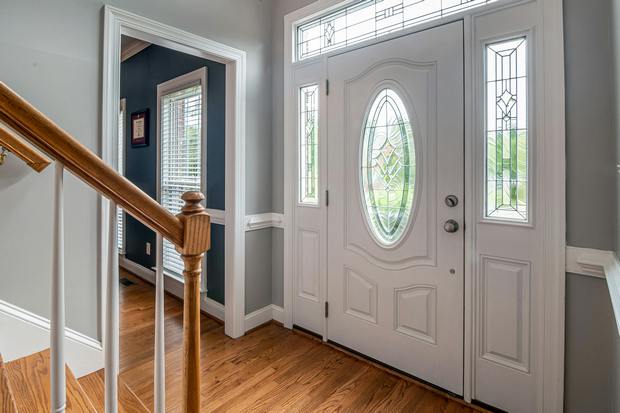
Trap Door
A trap door is a door that is oriented horizontally within a floor or ceiling, rather than vertically like a standard door. It is typically accessed via a ladder and is commonly found in attics, basements, and utility spaces.
Blast-Proof Doors
Blast-proof doors are specially constructed to allow access to a structure while also providing robust protection from the force of explosions. They are widely used in military facilities, industrial sites, and high-security buildings where explosive hazards are a concern.
Garden Door
A garden door is any door that opens directly to a garden or backyard. The term is often used specifically to describe double French doors installed in place of a sliding glass door. In this configuration, a garden door offers the significant advantage of a very large opening, making it ideal for moving large objects in and out with ease.
Pet Door
Also known as a doggy door or cat flap, a pet door is a small opening built into a larger door to allow pets to enter and exit freely without the main door needing to be opened. It may be simply covered by a rubber flap, or it may be a more structured door hinged at the top that the pet can push through. Pet doors can also be mounted within a sliding glass door as a new, either permanent or temporary, panel. Some pet doors are unidirectional, only allowing pets to exit, while others are electronic, permitting entry only to pets equipped with a special electronic tag.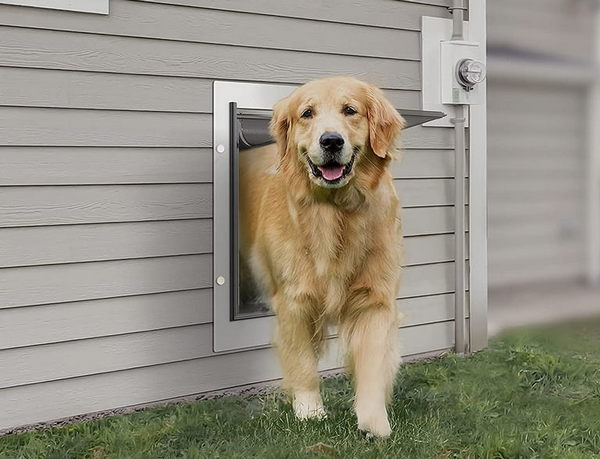
Dutch Door
Also known as a stable door, a Dutch door is uniquely divided in half horizontally, allowing the top and bottom halves to operate independently. Traditionally, the top half could be opened to allow a horse or other animal to be fed, while the bottom half remained closed to keep the animal securely inside. Today, Dutch doors are also popular in homes, particularly in kitchens and nurseries, where ventilation and supervision are both priorities.
Saloon Doors
Saloon doors are a pair of lightweight swing doors most often found in public bars and are especially associated with the American West. Also known as café doors, they typically use bi-directional spring hinges that automatically close the door regardless of which direction it is pushed open. Saloon doors that extend only from knee-level to chest-level are commonly known as batwing doors, leaving the upper and lower portions of the doorway open.
Blind Door
A blind door is a door designed with no visible trim or operable components. It is carefully crafted to blend seamlessly with the adjacent wall in all finishes, making it visually indistinguishable from the surrounding surface and essentially functioning as a disguised door. Blind doors are often used in high-end interior design to maintain a clean, uninterrupted aesthetic.
Barn Door
A barn door is a door originally characteristic of agricultural barn buildings. Because barns are typically large structures, these doors are subsequently built to a considerable size to accommodate the movement of livestock, vehicles, and large equipment. In recent years, barn doors have become a popular interior design trend, often used on sliding hardware tracks within modern homes.
French Door
Also called a French window, a French door features multiple windows, referred to as “lights,” set into it spanning the full length of the door. Traditional French doors are assembled from individual small pieces of glass held together by mullions, and are known as true divided lite French doors. For exterior applications, French doors made with double-pane glass are used to improve insulation and may feature a decorative grille embedded between the panes. Alternatively, the decorative grille may be superimposed on top of a single pane of glass for a similar visual effect at a lower cost.
Louvered Door
A louvered door features fixed or movable wooden fins, commonly called slats or louvers, which permit open ventilation while still preserving privacy and preventing the passage of light to the interior. Because they are relatively weak structures, louvered doors are most commonly used for wardrobes and drying rooms, where good ventilation is more important than security. A very similar structure is also widely used to form window shutters in warm and humid climates.
Flush Door
A flush door is a completely smooth door with a flat, featureless surface, typically constructed with plywood or medium-density fibreboard fixed over a light timber frame. The hollow interior is often filled with a cardboard core material for added structural stability. Flush doors are most commonly used in the interior of a dwelling, although slightly more substantial versions are occasionally used as exterior doors, particularly in hotels and other buildings containing many independent units.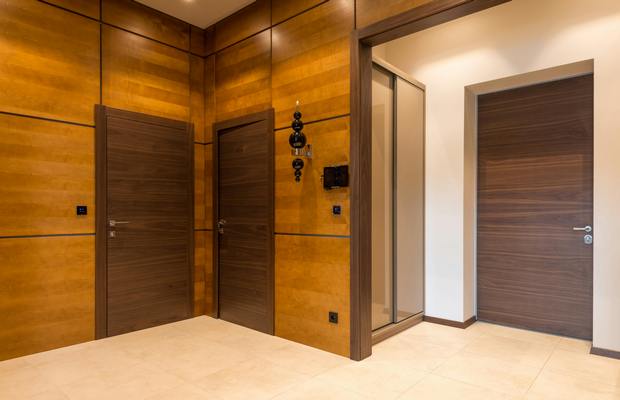
Bi-Fold Door
A bi-fold door is a door unit consisting of several sections that fold in hinged pairs. Wood is the most common material, though bi-fold doors may also be manufactured in metal or glass. While most commonly made for closets, bi-fold doors may also be used as dividing units between rooms, offering a space-saving alternative to traditional swing doors.
Swing Door
A swing door features special hinges that allow it to open either outwards or inwards, and is usually spring-loaded to keep it automatically closed when not in use. The direction, or “handing,” of a swing door is always determined from the secure side of the door and can be categorized as follows:
- Right-Hand Hinge (RHH): The hinges are on the right side and the door opens inward.
- Left-Hand Reverse (LHR): Standing inside, the hinges are on the right and the knob is on the left, with the door swinging outward.
- Right-Hand Reverse (RHR): Standing inside, the hinges are on the left and the knob is on the right, with the door swinging outward.
Bypass Door
A bypass door unit consists of two or more door sections that slide in either direction along parallel overhead tracks, passing past each other along a single axis. This design eliminates the need for swing clearance, making bypass doors ideal for tight spaces. They are most commonly used in closets, allowing access to one side of the closet at a time. When viewed from the front, the panels in a bypass unit overlap slightly to eliminate any visible gap between them.
Revolving Door
A revolving door typically features four wings or leaves suspended on a central shaft, rotating in one direction around a vertical axis. The door may be motorized or pushed manually using push bars. One of its key advantages is that people can enter and exit a building simultaneously, significantly reducing air exchange between indoors and outdoors and therefore helping to reduce heating and air conditioning costs. Revolving doors are also widely regarded as a symbol of prestige and glamour, and it is not unusual for neighboring buildings to install their own revolving doors in response to a rival building acquiring one.
Butterfly Door
Also named after its two distinctive “wings,” a butterfly door consists of a double-wide panel with its rotation axle positioned in the center, effectively creating two separate openings when the door is in use. Butterfly doors are designed to rotate open in one direction, usually counterclockwise, and rotate closed in the opposite direction. The door is intentionally not equipped with handles, making it a push-only door for safety reasons. If it could open in both directions, someone approaching one side might be unexpectedly struck by someone opening the other side simultaneously.
Butterfly doors are particularly popular in public transit stations due to their high capacity and their ability to remain open when traffic flows in both directions simultaneously. They are especially well-suited to underground subway stations, where they perform well under pressure. Their heavy construction ensures that air currents generated by moving trains apply force to both wings equally, effectively keeping the door shut under normal conditions.
Door Hardware and Components Explained
Choosing the right door is only part of the equation. The hardware and structural components that support, secure, and operate a door are just as important. From hinges and handles to locks and strike plates, understanding door hardware helps ensure that your door performs reliably, safely, and efficiently for years to come. Understanding these elements ensures that different doors types perform reliably over time.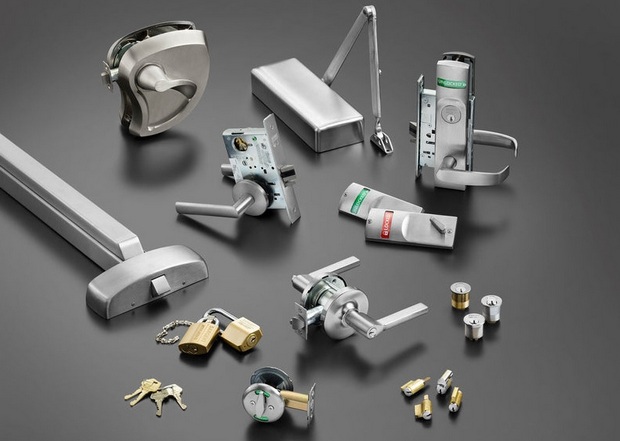
Key Parts of a Door Frame
When framed in wood for a snug-fitting door installation, a doorway typically consists of two vertical jambs on either side, a lintel or head jamb at the top, and sometimes a threshold at the bottom. The key structural and decorative components of a doorway include:
- Lintel: A horizontal beam positioned above the door that supports the weight of the wall above it.
- Jambs: The vertical posts that form the sides of the door frame, where the hinges are mounted and with which the bolt interacts when the door is closed.
- Sill: A horizontal beam located below the door that anchors and supports the frame.
- Doorstop: A thin slat built inside the frame to prevent a door from swinging through too far when closed, which might otherwise damage or break the hinges.
- Architrave: The decorative molding that outlines a door frame, sometimes called an archivolt when the door is arched. In North America, it is commonly referred to as door casing or brick mold.
Essential Door Hardware You Need to Know
Beyond the structural frame, a range of hardware items contribute to the function, security, and convenience of any door.
Door Closer
A door closer is a mechanical device that automatically closes a door that has been left open, helping to maintain security, fire safety, and climate control within a building.
Hinges
Hinges are the pivoting mechanical components that attach the door to the frame and allow it to swing open and closed. The type and number of hinges used depend on the weight and size of the door.
Door Handle
Doors generally have at least one fixed handle, usually accompanied by a latch. A typical handle set is composed of the exterior handle, escutcheon, an independent deadbolt, and the interior package, which may be a knob or lever. On some doors, the latch is incorporated into a hinged handle that releases when pulled.
Door Lock Types and How They Work
A lock is a security device that prevents access by those without a key or combination, generally by preventing one or more latches from being operated. It is often accompanied by an escutcheon, and some doors, particularly older ones, will also feature a visible keyhole.
Two general types of locksets are available for doors: cylindrical and mortise locks. A cylindrical lock fits into a large hole bored into the face of the door, while a mortise lockset fits into a rectangular pocket cut into the edge of the door. Exterior doors may use either cylindrical or mortise locking mechanisms, while interior doors typically use cylindrical locks, although some older homes may still feature interior mortise locks.
- Exterior cylindrical locking mechanisms are operated by a key inserted into the exterior handle or door knob, with the interior knob operated by either a turn button or a key.
- Exterior mortise locking mechanisms typically incorporate an integrated deadbolt, so that turning the key from the outside simultaneously releases both the knob and the deadbolt.
For enhanced security, exterior doors should be protected by a deadbolt with a throw of at least one to two inches.
Strike Plate
A strike plate is a reinforced metal plate with a hole or recess designed to receive a bolt. When used with a latch bolt, it typically includes a small ramped area that guides the bolt inward as the door is being closed. Strike plates are also available as electric versions, which allow the door to be opened remotely even when the mechanical lock is engaged.
Latch Bolt
A latch bolt features an angled surface that acts as a ramp, automatically pushing the bolt inward as the door closes. This practical mechanism allows a door to be closed securely without requiring the user to manually operate the handle, making it one of the most widely used door hardware components in everyday use.
Conclusion
Doors are far more than simple entry and exit points. They are functional, structural, and aesthetic elements that shape how a space looks, feels, and performs. From rustic barn doors to advanced security entrances, different doors types serve different needs. At the same time, the hardware behind these types of doors ensures durability, safety, and efficiency. Whether you are building, renovating, or simply upgrading, understanding these elements helps you make smarter, more confident choices for any project.
References
[1] Babu, V. R., & Sundaresan, S. (2018). Home furnishing. CRC Press.
[2] Corcuera, A. (Ed.). (2006). Door & Window Design (Illustrated ed.). TeNeues Publishing.
[3] Wilcox, B. (2009). Doors (Illustrated ed.). Firefly Books.
[4] Feuer, K. (Ed.). (2007). Door Design (Illustrated ed.). DAAB Publishing.
[5] Rao, R., & Singh, S. (2024). Doors and Door Types. In Habitats: Holistic Approaches to Building, Interiors and Technical Systems (1st ed.). Noble Science Press.
[6] Neufert, E. (2012). Architects’ Data (4th ed.). Wiley-Blackwell.
[7] Tobias, S. (2015). Illustrated Guide to Door Hardware: Design, Specification, Selection (1st ed.). John Wiley & Sons.