Introduction
Carpets are a key component of home textiles, providing not just comfort underfoot but also aesthetic value and insulation for living spaces. Carpets are more than just decorative pieces; they provide comfort, warmth, and functionality in both residential and commercial spaces. They have evolved from primitive floor coverings to highly sophisticated designs, playing an essential role in interior flooring solutions around the world. In this article I will discuss history and evolution of carpets, role in residential and commercial flooring.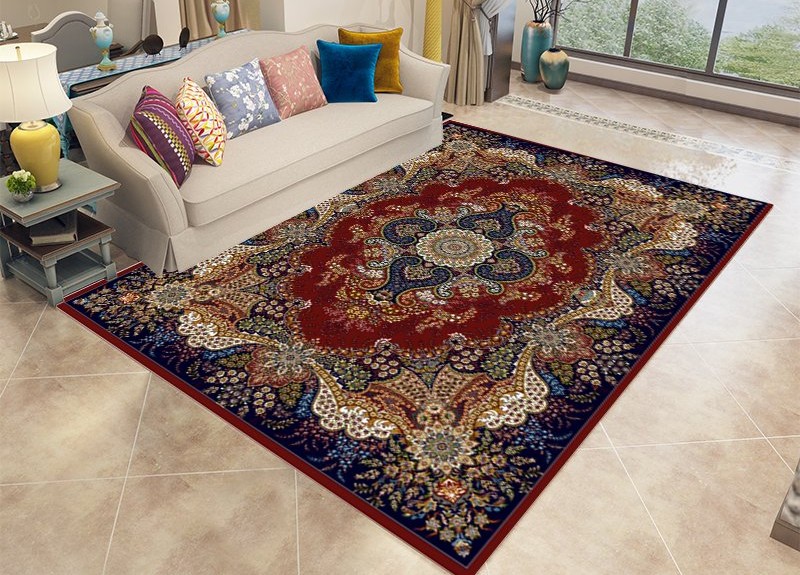
History and Evolution of Carpets
Historically, the first floor coverings were probably simple animal skins used for insulation and the earliest floor coverings of textile construction were probably crudely woven textiles made from natural rushes or grasses. Inevitably, the human desire arose to produce floor coverings with a soft pile of sheep or goat wool to simulate the warmth and comfort of natural animal skins. Inevitably, no physical traces of these early floor coverings remain today.
The oldest known existing carpet is now to be found in the State Hermitage Museum in St Petersburg, Russia, having been carefully excavated from a preserved tomb in Southern Siberia and is approximately 2400 years old. It is a hand-crafted pile rug of fine construction with about 3600 tufts/dm², indicating highly advanced ancient weaving skills.
Role of Carpets in Modern Floor Coverings
Residential Use of Carpets
Carpets for residential use are manufactured throughout the world with particularly important production centres in the USA and Western Europe. Important centres of carpet manufacture are steadily emerging in the Indian sub-continent and in China due to growing demand and competitive labour costs. The products made in each of these centres have evolved in different ways and display distinct characteristics of design, fibre selection, and style.
In general terms, US carpets often have a durable pile of polyamide in patterned and textured loop pile constructions, polyester in longer cut-pile styles referred to as ‘Saxonys’, and more budget-conscious constructions with polypropylene pile for cost efficiency. Western Europe makes a wide proliferation of tight, low pile constructions with polypropylene as the dominant fibre and polyamide for the better end of the market, offering improved resilience and performance.
UK manufacturers, however, retain a more traditional approach with wool remaining the dominant pile fibre, usually in relatively luxurious cut-pile styles preferred for comfort and quality. At present, the most characteristic UK carpet style is a hard-twist cut-pile plain carpet with a wool-rich pile fibre blend designed for durability and aesthetic appeal.
In the UK, which has historically had a large woven carpet manufacturing capacity, heavily patterned carpet styles have dominated for many years and indeed there has been a continuous desire to develop less labour-intensive, higher-speed manufacturing methods for these complex styles. Recent trends, influenced by large volumes of less expensive tufted carpets imported largely from Belgium and Holland, and through lifestyle programmes and articles in the media, have seen the former dominance of the patterned carpet largely disappear in favour of plainer styles which are favoured for modern living spaces.
Although the media sometimes suggest that patterned carpets are making a commercial comeback, this has not yet significantly affected actual manufacturing patterns, highlighting a discrepancy between trend reports and production data.
Commercial Use of Carpets
Carpets intended for commercial use are often subjected to much greater concentrations of traffic and need to withstand this continuous heavy wear. Commercial use is varied and can include offices, retail premises, hotels and leisure centres, casinos, theatres and airports across different service sectors.
Carpets for offices, particularly modern open-plan offices and for some larger retail premises, feature hard-wearing dense low loop-pile constructions usually with polyamide pile for enhanced durability. Carpet tiles have become especially popular in commercial buildings due to their modularity, ease of installation, and replacement when needed.
Carpet tiles, frequently available in 50 cm square or 45.7 cm (18 inches) square formats, lend themselves particularly to large multi-floor installations in office complexes. They are easier to transport and handle on multiple floors and allow for flexible design layouts in commercial spaces. Of particular importance is the ease with which the tiles, packed into easily handled boxes, can be transported to upper floors by lifts or staircases. The original carpet tiles were of a simple felt face layer bonded to the tile backing for structural support. Styles have developed from these through needled floor coverings, plain loop-pile tufted, plain cut-pile tufted and even patterned constructions, at each stage gaining in style, luxury and sophistication to meet evolving market demands.
The carpet tile is a composite material composed of a textile use surface bonded to a tile backing which must have the basic important properties of dimensional stability, and the ability to lie flat on the floor without doming at the centre or the curling up of tile edges during long-term use. Modern installation techniques focus on broadloom or monolithic layouts where joints are nearly invisible and alignment is precise, improving overall aesthetics. Installation of early tiles gained added interest by adopting what is called chequer-board installation, where the manufacturing direction (always denoted by an arrow printed or embossed on the back of each tile) is laid at right-angles to the adjacent tile to create visual contrast. This not only changed the surface aspect of the entire installation but also disguised (through emphasis) the tile edges effectively.
With more sophisticated and luxurious styles, this simple or utilitarian effect was less desirable and the requirement arose for a uniform appearance with joints between adjacent tiles as invisible as possible for improved aesthetics. This demanded carefully cut tiles and was more easily achieved with denser carpet constructions and cut-pile styles for precise alignment.
In recent years sophisticated designs in loop-pile constructions have enabled tiles to be installed without regard for alignment of manufacturing direction and which do not show colour variations from pile shading under varied lighting conditions.
Patterned carpet tiles must be either totally random or carefully engineered to fit design repeats into the tile dimension accurately. Advanced methods include using woven surfaces or printed designs exactly registered to the tile dimension, allowing for corporate logos or complex patterns without fraying or misalignment. Simple tufted carpet designs achieved with stitch displacement devices appeared initially attractive but the failure of the design repeat dimension, often quite small, to fit exactly into the tile dimension created an effect, colloquially known as ‘zippering’, to occur at tile edges which may be more or less acceptable to the end user depending on aesthetic preference. Sophisticated larger repeat designs, sometimes achieved using a woven carpet use surface, or a printed design exactly registered to the tile dimension were inevitably introduced to overcome such issues. These included corporate logos which could be inset into plain or lightly patterned areas for branding applications. The modularity of tiles enables large logo installations by carefully combining different colored shapes, offering high design flexibility.
For the hotel, theatre and airport markets the heavily patterned woven carpet remains important on a global scale for performance and appearance. The property of heavily patterned carpets to disguise the inevitable effects of concentrated wear and soiling is extremely important for these end uses and the use of wool-rich pile significantly reduces dangers resulting from burns and scorches from dropped cigarettes because of its natural flame-resistant properties.
Conclusion
Carpets play an important role in both residential and commercial flooring. In residential spaces, they enhance comfort, warmth, and safety while adding aesthetic appeal. In commercial environments, carpets provide durability, acoustic control, and branding opportunities, while carpet tiles allow modular design and easy maintenance. Their versatility, durability, and design adaptability make them an indispensable element of flooring in homes, offices, hotels, and public spaces around the world.