What Are Rugs?
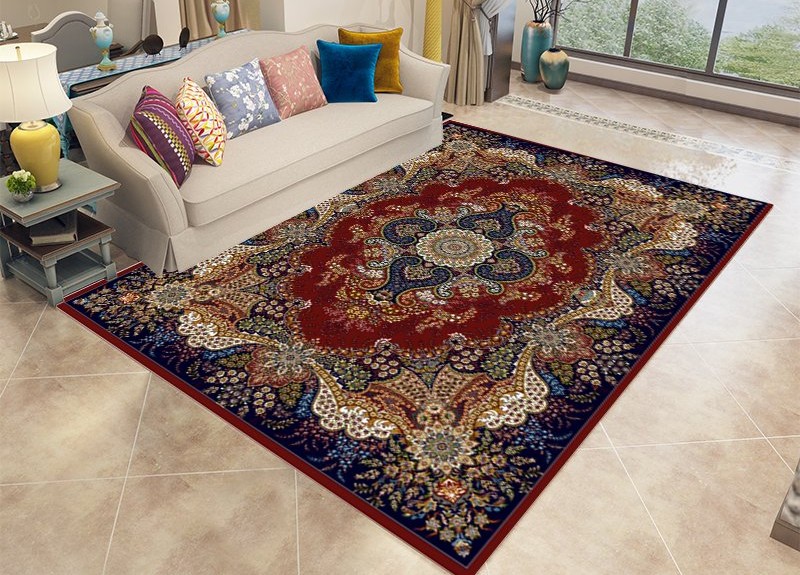
Rugs are textile floor coverings made from woven, knotted, or tufted fibers, designed to enhance comfort, warmth, and visual appeal in interior spaces. Different types of rugs produced today comes from almost every part of the world, and each type has a distinctive character. From the intricate patterning of Oriental rugs to contemporary geometric designs, the choice depends on personal preference, interior décor, price, and aesthetic qualities. Understanding the types of rugs available helps in selecting the most suitable option for both function and style.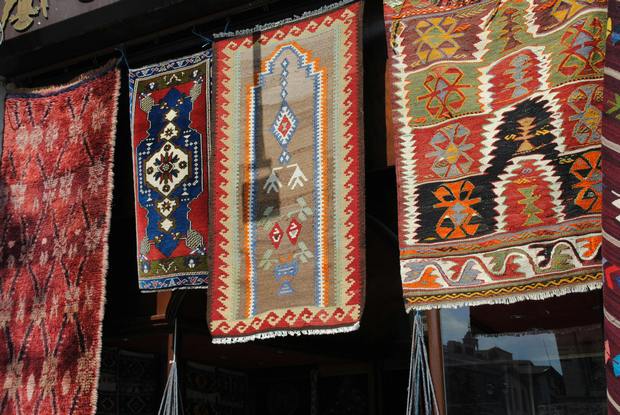
What Are Oriental Rugs?
Among the many types of rugs, Oriental rugs hold a special place due to their craftsmanship, history, and cultural value. The traditional Oriental rug is one of the most valued floor coverings in interior design. Persian rugs, woven in Iran, are among the best known, but they are only one category within the broader Oriental tradition. In general, an Oriental rug is a hand-made rug of natural fibers, most commonly wool or silk, with a pile woven on a warp-and-weft foundation and produced in regions such as the Near East, Middle East, Central and South Asia, China, and parts of the Balkans.
There are many quality variations among these rugs, with fiber quality, intricacy of design, and knot density playing the most important roles. The degree of detail, the number of colors in the pattern, and the number of knots per square inch all make the product more labor-intensive and therefore contribute to its price.
Although Oriental rug making continues today, its ancient roots are evident in the Pazyryk carpet, dated to the 5th or 4th century BCE and preserved in the Hermitage Museum in St. Petersburg, Russia. Today, rugs of this tradition are woven in Iran, India, Pakistan, China, Turkey, Afghanistan, and other regions.
The designs in Oriental rugs are not merely arrangements of pattern and color but are often chosen for harmony and symbolic meaning, although interpretations vary by region and tradition. Yellow is often associated with royalty; blue with truth or protection; white with purity and the holy life; orange with devotion; and rose with wisdom. The serpent may represent desire, the lion and dog victory or strength, the phoenix good tidings, the stork longevity, and the fish domestic and marital tranquility.
How oriental rugs are made
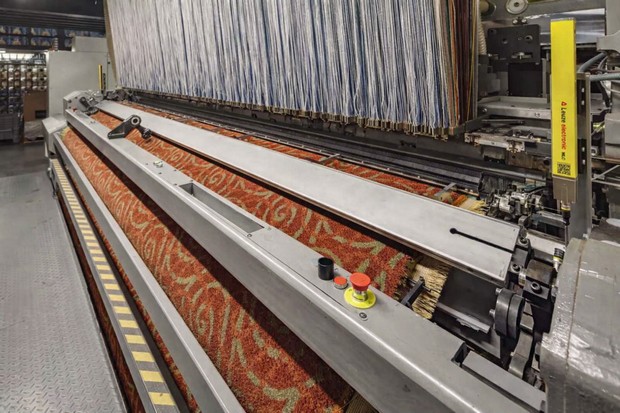
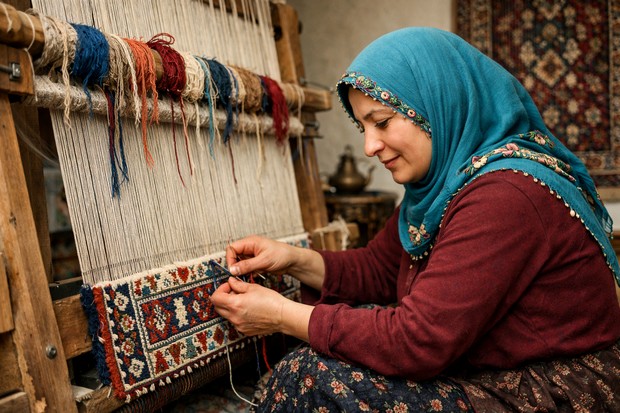
The initial stage is the design of the rug. Once the design is completed, the loom is set up with the vertical threads, or warps, in place. Next, the horizontal threads, called wefts, are inserted. The interlacing of these yarns, together with the pile knots, ultimately produces the rug. The design must be followed carefully so that the final product corresponds to the original drawing. Details such as the size of the loom, the materials, the dimensions, and the range of colors must be determined before weaving begins. The actual drawing, called the cartoon, is usually set out on graph paper, with each square representing a single knot.
Types of oriental rugs
Overall, rugs from the regions mentioned above are classified as Oriental rugs, but they include a variety of styles. Among the principal types are kilims and dhurries, along with several other traditional forms.
- Kilims: These flat-woven wool rugs are produced mainly in Iran, India, China, Pakistan, Romania, Turkey, and Afghanistan. They are sometimes reversible.
- Dhurries: These flat-woven rugs are produced primarily in India, most often in cotton, though wool and silk examples also exist.
- Anatolians: This generic name refers to rugs from the high plains of central Turkey.
- Braila rugs: Romanian rugs of very fine woven quality are often grouped under this name.
- Druggets: These pileless rugs are associated with India and parts of the Balkan region.
- Gördes rugs: This classic Turkish style, often seen in prayer rugs, typically features a narrow border and stylized floral forms.
How to care for oriental rugs
Oriental rugs are durable and, with minimal care, can last for many years. Regardless of the types of rugs, proper care is essential for durability. The following professional recommendations help preserve their appearance and service life:
Vacuuming should be done on a regular basis, at least every two weeks, to remove grit.
Professional cleaning should be done every three to five years, depending on the amount of evident soil. The process should be handled by an expert cleaner who specializes in Oriental rugs, and not the standard carpet cleaners that come to the home to clean wall-to-wall carpet.
Spills should be attended to before the stain sets. Excess dirt should first be removed by scraping, and excess liquid should be blotted with a paper towel or clean cloth. A professional Oriental rug cleaner should be contacted for the exact type of cleaning agent to use.
Padding should be used under the rug because it helps protect the rug from wear and also prevents slipping and wrinkling. Turning the carpet 180° every year will help even out the rug’s exposure to traffic and sunlight.
Popular Rugs by Region
Different regions of the world have developed unique traditions, contributing to the diversity of types of rugs seen in modern interiors.
Persian rugs
These rugs have been the most popular of the Oriental rugs. They are outstanding for expert workmanship, subtle coloring, and finer design. Their often small, stylized designs are based on natural forms such as flowers, trees, vines, birds, rivers, and clouds, and the rugs are usually covered with a profusion of these graceful motifs. Oriental rugs are often identified by the cities and provinces in which they are made. Some examples include:
- Feraghan—small stylized flowers in rows on a deep blue ground.
- Isfahan—an intricate all-over design on a deep red background.
- Kerman—light grounds of cream, rose, or blue with designs in other pastel shades.
- Sarabad—palm-leaf motifs on a rose or blue background.
- Sarouk (Saruk)—dark reds and blues with floral designs in lighter colors.
Turkish rugs
These are generally bolder in design than Persian rugs. Patterns consist of more highly stylized floral and geometric forms. Pinks, tulips, and hyacinths are favored motifs. The color range is often less varied and softer than that of Persian rugs, but it is not as limited as that of Caucasian rugs. In smaller sizes, often used as prayer rugs by Muslim owners, the design includes a mihrab, or niche, which is oriented toward Mecca. Among Turkish rugs are the Anatolian, Bergama, Gördes, and Yürük types.
Caucasian rugs
These rugs are made by groups living in the mountainous isthmus between the Black and Caspian Seas. They are even bolder in design and color than Turkish rugs. Among the motifs are geometric forms of animals and human figures, snow-crystal patterns, eight-pointed stars, crosses, and hooks, which are combined into mosaic-like effects. These are worked in brilliant yellows, blues, greens, and reds, often with black accents.
Turkoman rugs
These rugs are made by tribal groups in Central Asia and are usually a rich, dark red with a short cut pile. The design motifs are mainly simple geometric forms, especially repeated tribal medallions, rather than naturalistic imagery. The best-known example is the Bokhara or Bukhara rug. Others come from Afghanistan, Beluchistan, Samarkand, and Turkestan.
Chinese rugs
Chinese rugs of the 17th and 18th centuries are especially admired, and later examples show a wide range of quality and design. Traditional Chinese rugs often feature dragons, clouds, waves, trellises, flowers, and birds, commonly in blue on light grounds. The borders are usually narrow, and the central medallions or small spaced motifs are often symbolic. Soft yellow, gold, cream, and apricot are favored colors. In more recent production, one-tone and textured rugs have also become popular.
Indian rugs
These rugs vary considerably from one part of India to another, and their designs have been influenced by the country’s textiles, sculpture, and architecture. Indian rugs display great variety in color, texture, and construction. Numdahs, which are felted rugs, are frequently made of wool or other animal fibers and are often embroidered with scenic and floral designs in bright colors.
English antique rugs
These are generally more subdued and conservative. Floral emblems placed almost formally in separate squares of green, crimson, rose, and gold are associated with the Georgian era; bouquets of cabbage roses on light or dark grounds typify the Victorian period; and classicism is revived in the arabesques, swags, and urns of the Adam and Regency periods.
Early American rugs
These are unpretentious but colorful. Hooked rugs, braided rag rugs, and embroidered rugs colored with homemade dyes are an important part of American craft and decorative heritage.
Other Types of Rugs
In addition to Oriental rugs, numerous other types of rugs are used in both residential and commercial interiors. They may be hand-made or machine-made in many parts of the world. The range varies considerably in style, fiber, construction, pattern, and price. The following examples are representative rather than exhaustive.
Rya rugs
This deep-pile rug was first introduced in Scandinavia. Rya rugs were originally woven on a loom, but in later years many were produced on a canvas foundation, where the yarns were knotted with a latch hook. They are rich in texture and are often colored individually to meet the design requirements of the interiors in which they are placed.
Flokati rugs
Flokati rugs are shag rugs made in Greece of pure wool and are now available in a range of colors, although traditional examples are often in natural wool tones. They are used primarily as accents in many parts of the home, especially bedrooms and casual living spaces, because of the warmth they provide.
These hand-woven rugs have been made in Greece for centuries. They were once an essential item for Greek shepherds, who used the woven wool for clothing, bedding, and floor coverings. In recent years, Flokati rugs have been used in casual and contemporary settings and to provide a Mediterranean look. They are cozy and richly textured, with a pile that may be 3 or 4 inches long. One practical advantage is that some smaller or lighter versions can be washed in commercial-size washing machines, provided that the manufacturer’s care instructions allow it.
Southwestern rugs
The vast majority of Southwestern-style rugs are produced in the American Southwest, especially New Mexico, and feature designs inspired by Navajo weaving. They are used primarily as enhancements in rustic interiors and regionally themed settings.
Zapotec rugs
Hand-loomed of 100 percent wool, Zapotec rugs are produced in Oaxaca, Mexico. They are often one-of-a-kind products that feature traditional Mexican and Zapotec patterns, sometimes with broader Mesoamerican influences. Many are finished with fringed ends, and sizes range from small accent rugs to much larger formats.
Navajo rugs
The Navajo Nation, including areas of New Mexico and Arizona, is one of the principal regions in which Navajo rugs are created. They are hand-woven by Navajo weavers and feature Native American designs. The Storm Pattern probably originated in the early 1900s. In Navajo tradition, the central element is often interpreted as the place of emergence, the forms in the four corners as the four sacred mountains, and the lines as lightning or rain, carrying blessings back and forth between the mountains and bestowing harmony on the weaver and the household.
Rugs inspired by fine art
Motifs associated with many renowned artists have been translated into rugs of all sizes. The work of artists such as Andy Warhol and Pablo Picasso has inspired a wide variety of contemporary rug designs, including abstract and figurative compositions. Such rugs are produced in several countries, including Belgium, and are often made of high-quality wool, including New Zealand wool.
Braided rugs
The yarns are braided in a manner similar to hair braiding. The braids are then sewn adjacent to one another to form oval or round rugs.
Braided rugs are composed of fibers or yarns that are tightly braided and joined to create a durable surface. They are thick, colorful, and hard-wearing and are sold with or without backing; unbacked versions need a non-slip pad if used on smooth surfaces. Most braided rugs are reversible, so they can be turned over if one side becomes soiled.
There are 100% natural wool varieties, as well as cotton, nylon, polypropylene, chenille, polyester, and acrylic versions. Many rugs are made from a combination of materials, such as nylon/cotton, nylon/chenille, or wool/nylon, with each fiber contributing different properties. These blends are used to achieve a desired appearance and improve durability
Conclusion
Rugs reflect a wide range of cultural traditions, materials, designs, and methods of construction. From Oriental and Persian rugs to regional and contemporary types, each category has distinct visual and functional qualities. Understanding their origins, characteristics, and care requirements helps in selecting rugs that suit both aesthetic and practical needs. With proper maintenance, quality rugs can remain durable, attractive, and valuable for many years.
References
[1] Babu, V. R., & Sundaresan, S. (2018). Home furnishing. CRC Press.
[2] Stone, P. F. (2013). Oriental Rugs: An Illustrated Lexicon of Motifs, Materials, and Origins.
[3] Bennett, I. (1998). Oriental Rugs: Volume 1, Caucasian.
[4] Bennett, I. (1996). Oriental Rugs: Volume 2, Persian.
[5] Eiland, M., Jr., & Eiland, M. E. (1998). Oriental Carpets: A Complete Guide.
[6] Black, D. M., & Judd, J. M. (2012). The Color of Wool: A History of Natural Hue in the American West.
[7] Gans-Ruedin, E. (1984). Splendor of the Oriental Rug.