Introduction
Carpet performance begins in the yarn. Fibre type, spinning system, twist level, and finishing treatments collectively shape how a carpet withstands traffic, cleaning, and time. Carpet yarn manufacturing therefore sits at the core of carpet performance, linking material science with industrial processing. Machine made tufted carpets often rely on BCF yarns for process efficiency and uniformity, while handmade rugs favour spun wool for bulk and surface character. Each material choice carries trade offs. This article examines carpet yarn manufacturing from fibre selection to quality control, highlighting the technical decisions that ultimately influence durability, appearance retention, and service behaviour.
Carpet Yarn Manufacturing and Engineering
There are several types of carpet yarns available depending on their end uses. In carpet yarn manufacturing, the choice between filament and spun yarns depends largely on the production method and performance expectations. The machine-made tufted carpet industry uses both filament and spun yarns. Especially, filament yarns are used by the tufted carpet industry. For the handmade rug sector, filament yarns are not used. This sector uses only spun yarn and is mostly of natural fibres such as wool, silk, and jute.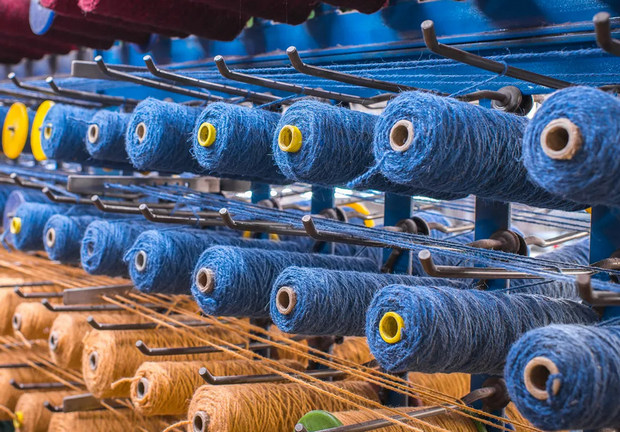
1. Filament Yarns
In modern carpet yarn manufacturing, BCF yarns are preferred by the machine-made carpet industry due to short production (no spinning), no fibre shedding in carpet, large packages, no yarn joins which increase tufting efficiency, and good evenness and uniformity. BCF yarns are normally texturised by two techniques:
Hot-fluid technique
Stuffer-box technique
The two-step process is flexible, allowing the production of various yarn types. However, the trend is towards using a single-step system. Machinery is suitable for all carpet fibres (Nylon 66, Nylon 6, and polypropylene). Direct spinning lacks flexibility and is not used in carpet yarn manufacturing.
2. BCF Polypropylene
BCF polypropylene yarns are manufactured by spin–draw–texturing. Within carpet yarn manufacturing, polypropylene yarns are valued for being chemically inactive. This property has advantages and disadvantages depending on the end use.
Polypropylene fibre is gaining market share from nylon due to low cost, improved technology, and performance. This shift has influenced material selection strategies in carpet yarn manufacturing, particularly in cost-sensitive market segments.
3. BCF Polyester
Polyester is generally used in the carpet industry in the form of staple fibres. BCF polyester is produced through a single-step draw–texturing unit. Polyester is not normally used as a pile yarn in carpet yarn manufacturing due to performance considerations under load.
4. BCF Nylon
BCF nylon yarns are the most popular filament yarn for the carpet industry. In carpet yarn manufacturing, these yarns are generally produced in 650–5400 dtex, while the filament decitex varies in the range of 11–30, allowing adaptation to different pile constructions and performance requirements.
5. Wool Yarn Manufacturing
The world produces about 400 million kg of carpet-grade wool. Carpet wool yarn production is about 400 million kg. Synthetic BCF yarn production is 2113 billion kg and staple fibre production of all types is 1500 billion kg, of which wool and wool blends account for about 0.4 billion kg.
Although smaller in volume, wool remains significant in carpet yarn manufacturing due to its natural resilience and appearance retention. Wool gives carpets an overall smooth appearance. Wool carpets have better cleanability than other fibres and maintain appearance for a longer period. It is therefore desirable to discuss in detail the manufacturing and engineering of wool carpet yarns within the broader framework of carpet yarn manufacturing.
Yarns produced by the established spinning systems (woollen and semi-worsted) require detailed consideration because they are widely accepted in the carpet and rug sector. Particular requirements include strength, uniformity, and extensibility for tufting and woollen spun yarns.
To engineer a carpet-grade yarn in carpet yarn manufacturing, three components are essential to optimise cost and quality:
- Wool selection and blending
- Spinning and twisting
- Yarn finishing
These criteria are supplemented by other quality requirements necessary for producing suitable carpet yarn.
Since wool fibre is the major component, yarn cost depends on wool quality. Overspecifying wool increases cost, whereas underspecifying affects yarn and carpet quality. The carpet and rug industries often adjust quality and cost by blending different types of wool. The following factors should be considered when selecting wool for carpet yarn manufacturing:
- Fibre length after carding
- Base colour
- Mean fibre diameter
- Loose wool bulk
- Vegetable matter content
- Medullation
Spinning in Carpet Yarn Manufacturing
The three spinning systems used to supply yarn are:
- Woollen system of spinning
- Semi-worsted system of spinning
- Worsted system of spinning
Spinning is a central stage in carpet yarn manufacturing. For carpets and rugs, the recommended system is woollen spinning; semi-worsted yarns are also used to some extent. Worsted yarns are mainly used in the apparel sector for fabrics and garments worn next to the skin. They are not suitable for pile carpets due to insufficient resiliency.
Although semi-worsted yarns are often considered superior, the carpet industry, particularly the handmade rug sector, prefers woollen spun yarn. Semi-worsted yarns were introduced in the mid-1980s, whereas woollen spun yarns remain classical and reliable materials in carpet yarn manufacturing for carpets and rugs.
The difference between woollen and semi-worsted systems lies in the intermediate gilling process, which parallelises fibres and increases orientation.
Typical yarn counts are 1 to 8 Nm in the woollen system and 2 to 11 Nm in the semi-worsted system.
Coarse counts favour woollen yarns, whereas finer gauges favour semi-worsted yarns. Woollen yarns are more susceptible to fibre loss due to higher short fibre content and inadequate latex treatment. Fibre shredding, caused by short kempy fibres and inferior latexing, is a persistent quality problem in carpet yarn manufacturing and can only be minimised by proper fibre selection.
A. Pre-Spinning Yarn Finishing
1. Scouring
Raw wool contains grease, dirt, dung, and vegetable impurities. These are removed by washing with a suitable non-ionic detergent; this process is called scouring. Temperature and detergent concentration must be maintained as specified.
Scouring is carried out in a continuous tape scour. The process generates greasy effluents that require proper treatment. Wool with high grease content is processed to extract lanolin, a raw material for the cosmetic industry. The scoured wool is dried to about 8–10% moisture content before entering subsequent stages of carpet yarn manufacturing.
2. Oiling
Scoured wool is blended and oiled as a processing aid to:
- Prevent electrostatic charge generation
- Reduce fibre-to-metal friction
- Reduce fibre-to-fibre friction
- Enhance fibre cohesion
After conditioning, the blend is stored near the cards as part of the preparatory steps in carpet yarn manufacturing.
3. Carding
Woollen carding:
- Removes impurities
- Mixes fibres
- Forms a uniform web
- Divides the web into slubbings of required weight
A burr-crushing machine may be used. The fibre web is split into slubbings and consolidated between aprons.
4. Spooling
The slubbings are wound onto spools by surface drive. The quality of woollen carpet yarn in carpet yarn manufacturing depends on the quality of the carded sliver. Therefore, emphasis must be given to the carding process.
B. Ring Spinning
Condenser spools prepared earlier are mounted on the top of the spinning frame on positively driven take-off drums, and the slubbings are directed to the drafting point. A false twist is required to provide strength and control drafting.
Levelling of the yarn is achieved by drafting against twist. Real twist is inserted into the yarn by means of a collapsed-balloon ring system. The operation is centrally controlled by a microprocessor, reflecting the mechanised precision typical of modern carpet yarn manufacturing.
C. Twisting
Two yarns are plied together to produce heavier carpet yarns. Once twisted, the yarns are wound and reeled for wet processing, which is the next important step in carpet yarn manufacturing.
D. Post-Spinning Yarn Finishing
1. Yarn Scouring
Yarns not made from scoured wool and yarns containing residual oil are scoured in a continuous tape scouring machine. A non-ionic detergent is used.
Yarns made from unscoured wool can also be effectively scoured in yarn form using a tape scouring machine. Normally, sodium bisulphite is used as a scouring additive. This process also thermosets the yarn. The method for determining the pH value of water extract of wool is IWTO–3–1986.
2. Twist Setting
In cut pile carpets, it is preferable to set the pile yarn to obtain a pinpoint effect in the final carpet; otherwise, the surface becomes fuzzy due to untwisting of the pile yarn.
Two setting methods are used:
- Chemical setting: done using the tape scouring machine
- Thermosetting/heat setting: carried out in an autoclave
The degree of set achieved depends on the process parameters. Chemical treatment is often applied along with yarn setting in carpet yarn manufacturing.
3. Mothproofing
Wool carpet yarns and carpets are susceptible to moth damage. Therefore, mothproofing treatment is carried out in a dye bath or during scouring. Various mothproofing chemicals are available. The appropriate chemical depends on the process adopted; for example, Eulan U3, Eulan Asept, or Mittin LP are used during scouring.
Synthetic pyrethroids are associated with fewer environmental concerns than many conventional mothproofing agents.
Chemical analysis is recommended as a routine quality control tool for insect resistance in carpet yarn manufacturing because it is economical, rapid, and convenient compared to biological testing.
4. Static Control
Static control in wool carpet yarn is achieved by incorporating conductive fibres in the blend (e.g., 0.2% Bekinox). Disperstat W, manufactured by Stephenson Brothers, can be exhausted onto the carpet yarn in a dyeing machine. The product is generally applied after hank dyeing or stock dyeing.
Other methods include using appropriate spinning lubricants and spray systems.
Static electricity generation (KB-max) should meet the TWC pass level of 2.5 according to Test Method 259, ensuring compliance within carpet yarn manufacturing standards.
5. Flame Resistance
Wool carpets are naturally ignition resistant and do not normally spread flame. However, carpets for aircraft or furnishings must meet stringent flammability specifications. In such cases, flame-resistant treatment is applied during dyeing as part of specialised carpet yarn manufacturing processes.
Woolmark Zirpro treatment is commonly applied to wool carpet yarns in exhausted dye baths or at other manufacturing stages to meet strict flammability requirements, especially for airline carpets. The product must pass the American Tablet Test.
6. Anti-Soil / Anti-Stain
Soiling of woollen carpets is related to carpet colour. Light, dark, and bright colours are more susceptible to soiling. Fibre type influences soil retention and visibility. Wool performs favourably in vacuum cleaning compared to other fibres.
Wool carpets made from clean scoured yarns show better resistance to soiling. Treatment with fluorocarbon improves soil resistance. Silicone treatment increases stain resistance but is not recommended for wool as it may increase soiling.
Delustred wool (Fernplus EP), based on treatment with white pigments, may provide improved soil resistance.
The method for determining petroleum ether extractable matter in wool yarns and certain wool blends is Draft TM–61–2001.
Carpet Yarn Testing and Quality Control
The primary raw material for manufacturing carpets and rugs is yarn. Carpet quality depends on yarn quality, which in turn depends on the quality of wool fibre used. These criteria are interlinked. Strict quality control, process control, and online inspection are recommended to ensure appropriate raw materials in carpet yarn manufacturing.
The major fibre properties to be evaluated are:
- Fibre diameter
- Fibre staple length
- Crimp percentage
- Dyeability
The properties to be evaluated for wool-based yarn are:
- Count
- Ply
- Non-wool fibre content (%)
- Residual grease content (%)
- Average fibre length
- Twist per inch
- Vegetable matter content
Each of these parameters significantly influences yarn properties. Individually and collectively, they determine the final performance of carpets and rugs manufactured through carpet yarn manufacturing processes.
Conclusion
Carpet yarn engineering is a sequence of measured compromises within carpet yarn manufacturing. Fibre selection affects resilience and dye response; spinning determines bulk and cohesion; finishing modifies behaviour under use. No single system is universally superior. Performance depends on how well materials, process parameters, and quality control align with the intended application. Consistency across production often matters more than isolated peak values. Understanding these interdependencies clarifies how carpet yarn manufacturing governs the long-term durability and appearance of carpets and rugs.
References
[1] Goswami, K. K. (Ed.). (2017). Advances in Carpet Manufacture (2nd ed.). Woodhead Publishing.
[2] Lawrence, C. A. (Ed.). (2010). Advances in Yarn Spinning Technology. Woodhead Publishing.
[3] McNeil, S. J., & McGregor, B. A. (Eds.). (2007). Wool: Science and Technology. Woodhead Publishing.
[4] Gupta, V. B., & Kothari, V. K. (1997). Manufactured Fibre Technology. Chapman & Hall.
[5] Collier, B. J., & Epps, H. H. (1999). Textile Testing and Analysis. Prentice Hall.
[6] Horrocks, A. R., & Anand, S. C. (Eds.). (2000). Handbook of Technical Textiles. Woodhead Publishing.
[7] Kiron, M. I. (2021c, November 16). Carpet types, properties, manufacturing, uses and maintenance. Textile Learner. https://textilelearner.net/carpet-types-properties-manufacturing/