Introduction
The carpet/rug industry uses a wide variety of synthetic and natural fibres for pile yarns. The difference between a carpet fibre and an apparel fibre primarily lies in the diameter of the fibre. In the case of wool, carpet fibres are generally broader than apparel fibres. This difference in diameter is not merely dimensional; it directly influences bending rigidity, compressional recovery, and long-term surface appearance under foot traffic. The principal carpet/rug pile fibres in use are nylon, polypropylene, and wool, which together represent the most important fibres used in carpets manufacturing, whereas the leading apparel fibres, cotton and polyester, are used in the carpet industry mostly as backing materials. However, polyester is in huge demand in the rug industry for making innovative rugs. Its growing acceptance appears linked not only to cost positioning but also to shifting consumer preference toward softer hand and decorative sheen in contemporary interiors.
While natural fibres are used in rug making, synthetic fibres are used mostly for machine-made tufted carpets. Polypropylene is unique in its characteristics and is widely used for both pile and backing of carpets. This dual functionality has practical manufacturing implications, as it simplifies material compatibility during thermal bonding and finishing. The selection of fibres used in carpets therefore depends on both performance expectations and manufacturing efficiency.
Types, Structure and Properties of Fibres Used in Carpet Manufacturing
A. Synthetic Fibre
Synthetic materials constitute a major category of fibres used in carpets manufacturing, particularly in large-scale machine-made production.
1. Nylon
Nylon is a polyamide manufactured from aliphatic monomers, whereas in a polyamide at least 85% of the amide linkages are combined with an aromatic group, which is known as aramid. The two polyamide fibres that have become important commodity fibres are Nylon 6 and Nylon 66; both are based on aliphatic chains. Although chemically similar, their polymerization routes result in subtle differences in crystallinity and thermal behaviour, which may influence processing conditions.
Two different techniques are used by manufacturers of carpet nylon fibres. Nylon 66 is produced by polycondensation of adipic acid and hexamethylenediamine, and Nylon 6, developed in Germany, is made by self-condensation of caprolactam.
Both fibres have excellent recovery, which makes them very suitable for pile yarns in rugs and carpets, as the resiliency of the fibres is appropriate for such applications. Resiliency is the most important characteristic of a carpet fibre, as it gives a spring-back action, making the carpet fibres in the pile stand straight. In high-traffic installations, this recovery behaviour largely determines how quickly visible matting develops. For this reason, nylon remains one of the most preferred fibres used in carpets for heavy-duty residential and commercial applications.
Nylon fibres are generally available in filament and staple forms. Filament yarns are normally used to make loop-pile machine-made tufted carpets for medium- to heavy-duty areas. Extreme care must be taken during dyeing of nylon filament yarns, as there is no opportunity for blending, and uniformity must be maintained. Any shade variation tends to be immediately perceptible in continuous filament constructions.
Different carpet products require different specifications; therefore, while selecting a fibre, one must have knowledge of quality criteria and other specifications to choose the right fibre. Staple length, fibre micron, and lustre are three important factors to be considered while selecting the appropriate fibre. End-use conditions, particularly load intensity and maintenance practices, should also guide such decisions.
2. Acrylic Fibres
Acrylic fibres are made from acrylonitrile as one of the major monomers among vinyl monomers. Pure polyacrylonitrile fibre is practically undyeable and hence is not used either in apparel or in interior textiles. Dyeable acrylic fibre is made by copolymerisation of acrylonitrile with other monomers containing sulphonic or carboxylic acid groups. Acrylic fibre normally contains about 85% acrylonitrile monomers by weight, whereas fibres containing 50% to 85% acrylonitrile are known as modacrylic fibres. The incorporation of comonomers introduces dye sites, but it may also influence thermal sensitivity during processing.
Although acrylic fibre has been used in making carpets for a long time, it has relatively low resiliency and is not very suitable for carpet piles. This limitation becomes apparent in compressed areas where recovery is slower compared with nylon.
The spinning processes most commonly used to produce acrylic fibres are wet and dry spinning. Acrylic fibres cannot be produced by melt spinning, as they degrade when heated near the melting point.
In the wet spinning process, the spinning dope is extruded through a multiple-hole spinnerette into a coagulation bath containing a liquid in which the solvent is soluble but not the polymer. The jets of dope quickly coagulate into solid filaments. The filaments are continuously removed from the spin bath, washed to remove solvent, and then subjected to drawing, drying, crimping, and annealing.
In the dry spinning process, the dope is extruded through the spinnerette into a tower where uncoagulated filaments come in contact with an inert gas heated above the solvent boiling point. The solvent evaporates and the filaments solidify as they pass down the column. The filaments are continuously removed, washed to remove solvent, and processed similarly to wet-spun fibre. Both wet- and dry-spun acrylic fibres are used in the carpet industry. Choice of method often depends on desired cross-sectional shape and production economics.
Acrylic fibre has naturally high elasticity, easy dyeability, voluminosity, ease of washing, resistance to pilling, and good light and colour fastness, making the fibre suitable for carpet piles. Even so, performance in demanding floor applications may remain conditional on construction parameters.
3. Polypropylene
Polypropylene fibre was historically made for manufacturing carpet backing; over the years, it has also been used as a pile material in lower-price grades of tufted carpets. Polypropylene is important for outdoor carpets, as it has very high light fastness. It is commonly blended with other fibres; 50/50 wool/polypropylene blends are popular. Such blends may balance cost with aesthetic warmth associated with wool.
Polypropylene fibre does not have the same resiliency as nylon. This weakness may be compensated by increasing the pile density of the carpet. The monomer is a by-product of the petroleum industry. The handle of polypropylene makes it a competitor to wool, although there are significant differences in price. Polypropylene fibre has low specific gravity, which enables better cover compared to other fibres. It is water resistant, making it resistant to waterborne stains. Its hydrophobic nature, however, can make dyeing more complex and often requires solution-dye techniques.
Polypropylene does not absorb water and is therefore suitable for AstroTurf and other open areas.
There are three types of polypropylene pile yarns used in the carpet industry: filament yarn, spun yarn from staple fibre, and split filament yarn for sports areas.
Polypropylene fibre is rapidly gaining market share over nylon due to its low cost, improved technology, and performance. Market shifts may also reflect sensitivity to raw material price fluctuations in petrochemical supply chains.
4. Polyester
Polyester fibre has relatively low resiliency compared with nylon and other fibres; for this reason, it is less preferred as a carpet fibre. Polyester is also difficult to dye; dyeing must be carried out under pressure or with the aid of carriers. The poor resilience is sometimes compensated by using higher pile heights. Such compensation, while visually effective, may not fully prevent long-term flattening under sustained load.
The positive attributes of polyester for carpets are outstanding retention of set, resistance to aqueous stains, and softness of handle. In terms of pricing, polyester is positioned between polypropylene and nylon. Staple polyester fibres are more commonly used than filament yarns in the carpet industry.
Polyester fibres produce soft carpet constructions. The softness of handle, coupled with easy washability, has led to widespread use in bath sets. Softness and lustre have also been used in handloom products. These aesthetic qualities often drive decorative segments of the market rather than heavy-duty installations.
Polyester carpet fibres are normally around 15 μm, with trilobal cross-section, bright or semi-dull appearance, and staple lengths suitable for processing in a semi-worsted yarn-processing system.
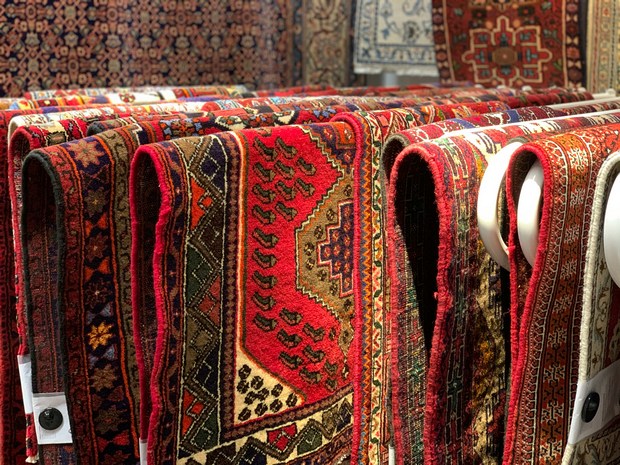
Carpet fairs often feature handmade rugs with extensive polyester usage, particularly for decoration and value addition. These rugs are fashion-led items. Polyester fibres are also used for good-quality carpet backing. Its dimensional stability under moderate humidity conditions supports this application.
B. Natural Fibres
Natural materials continue to hold significance among fibres used in carpets making, especially in premium and traditional segments.
1. Wool
Wool is a natural fibre and is often described as nature’s wonder fibre. The complexity of its chemical structure is evident from the fact that nature has created this fibre to protect human beings from cold. That protective function, evolved over millennia, partly explains its thermal insulation and moisture-buffering behaviour in interior spaces. From a macromolecular perspective, wool is a composite fibre with both fibrils and a matrix consisting of polypeptides.
Wool contains alpha-keratin (a protein with alpha helix structure). This helical arrangement contributes to extensibility and recovery, properties central to carpet performance.
Wool is primarily of two types: wool for apparel use, which is 23 μm and below, and wool of 24 μm and above, which is generally used in interior textiles, including carpets and rugs. The broader diameter in carpet grades increases stiffness, which may reduce excessive bending under compression.
A vast quantity (about 400 million kg) of wool is used in carpet manufacturing throughout the world. Much of this wool is used in the traditional woven carpet industry, including Axminster, Wilton, and tufted carpets, both loop and cut pile. The hand-knotted rug/carpet industry is also a major consumer of wool. Tufted carpet production in the world is probably the largest consumer of carpet-grade wool. Such consumption patterns suggest that machine-based production now outweighs artisanal sectors in volume, though not necessarily in perceived value.
The selection of the right type and quality of wool is an extremely important criterion in determining the quality and price of the final product. Overspecification increases cost, whereas underspecification deteriorates yarn quality and, in turn, the quality of rugs and machine-made carpets. The selection of the appropriate raw wool requires expertise, and various quality aspects of the fibre must be considered before making a decision. Balancing performance expectations with economic constraints remains a persistent challenge for manufacturers.
Globally, Australia and South Africa are known for apparel wool production, while New Zealand produces excellent broader micron wool suitable for carpet yarns. New Zealand produces about 130 million kg of carpet-grade wool and is the largest supplier of carpet wool in the world. Other countries such as the UK, China, Commonwealth of Independent States (CIS), India, Iran, and Turkey also produce carpet-grade wool. Some of these are of acceptable quality, while others are mostly ungraded and non-specified wool. Variability in grading systems may partly account for differences in consistency across international supply chains.
Chemical and Physical Structure of Wool
Wool is animal hair and is a protein fibre with a polyamide polymer made up of 20 amino acids, with keratin arranged in a helical structure. The morphological structure of wool fibre is extremely complex. This complexity is not merely structural; it influences dye uptake, tensile response, and felting tendency.
Of all animal fibres, wool contains a large amount of grease, which is difficult to remove and is of complex composition. Wool consists of spindle-shaped cortical cells surrounded by cuticle cells that overlap like tiles on a roof. The ratchet-like surface structure is typical of wool and is responsible for its felting properties. Under mechanical agitation, this scale structure promotes irreversible fibre migration.
The crimp in wool fibre is due to the asymmetric distribution of orthocortical and paracortical cells, which differ in structure. Crimp frequency may vary across breeds, affecting bulk and compressional resilience.
Wool fibre is naturally fire resistant. Its relatively high nitrogen and moisture content contribute to this behaviour.
Wool Quality and Its Significance
To predict the processing performance of wool and wool blends in a normal processing plant, the following quality criteria are important to achieve the desired goal of producing good carpet yarn:
- Mean fibre diameter
- Fibre length after carding
- Bulk
- Medullation
- Base colour
- Vegetable matter contamination
The importance of the above criteria does not follow a standard sequence. The relative importance of each criterion depends on the type of product being manufactured. A tightly woven Axminster carpet may prioritise uniformity differently than a hand-knotted rug intended for decorative use.
- Mean Fibre Diameter: Fibre diameter is a crucial quality criterion, as yarn quality depends directly on the number of fibres in the cross-section. The finer the fibre, the higher the cost, and consequently, the finer and more expensive the yarn. The micron value, which is the unit of fineness of fibre, is closely linked to wool trading. Small shifts in average micron can influence not only handle but also spinning efficiency. New Zealand wool with an average diameter of 27–37 μm is ideally placed in the micron range for making good carpet yarns and rugs. Within this band, performance appears to balance durability and processability.
- Fibre Length After Carding: Staple length is an important quality criterion. Generally, longer wools are used for semi-worsted spinning, while shorter wools are used for woollen spinning. For semi-worsted spinning, the average fibre length of scoured wool should not be less than 3 inches. In woollen spinning, shorter fibres are more common, with a minimum fibre length of about 1.5 inches. Wools with appropriate length, diameter, and colour are considered superior carpet wools and command higher prices. Short fibre content, if excessive, may increase yarn irregularity and reduce tensile strength.
- Bulk: The bulk of loose wool is essentially a measure of fibre crimp. Fibre bulk can also be considered an inverse measure of lustre, since crimpy wool tends to be matte, while straight wool appears lustrous. Bulky wool spins well and produces bulky yarn. This bulk property contributes to resiliency, as there is a strong correlation between wool bulk and carpet compressibility. New Zealand crossbred wool typically has an average bulk of 19–22 cm³/g. Indian wool types such as Bikaner Chokla and Magra provide good resiliency. Higher bulk may improve cushioning effect underfoot, though it can alter surface reflectance.
- Medullation: Most wool fibres consist of a core of spindle-shaped cortical cells surrounded by an outer sheath called the cuticle. In some fibres, there may be an inner core of medulla cells. The hollow medullated cells reflect light, making such fibres, especially kemps, appear opaque and chalky. Chinese wools generally contain fewer kemp fibres, whereas some Indian breeds, Scottish Blackface, and certain Spanish wools are more medullated and kempy. Excessive medullation may complicate dye uniformity in solid shades.
- Base Colour: Medullation significantly affects dyeing and colouration. Highly medullated wools tend to dye to a paler shade than non-medullated wool due to internal light reflection in the hollow fibres. It is advisable not to blend wools with widely differing colouration properties, as this may create problems in producing plain carpets. Even slight tonal inconsistency can become visually amplified across large floor areas.
- Vegetable Matter Contamination: According to international standards, New Zealand wool contains very little vegetable matter, usually less than 1%. Indian wools and some Chinese and Russian wools may contain higher levels of vegetable impurities. Higher contamination can increase scouring loss and processing time.
2. Silk Fibre
Silk fibre is also a protein fibre; unlike wool, it is a straight-chain protein, fibroin, coated with sericin. The protein in natural silk is composed of amino acids similar in number to those in wool. Chemically, natural silk is represented as C₁₅H₂₃O₆N₅. Its smooth surface morphology contrasts sharply with wool’s scaly structure.
In interior textiles, silk is used for making high-quality hand-knotted carpets, such as those produced in Kashmir (India) and Iran. These silk carpets are exquisite, with very low pile heights of 3–5 mm. They are often used as wall hangings rather than floor coverings. Such limited pile height reduces abrasion tolerance under foot traffic.
The misuse of artificial silk in place of pure silk has negatively affected consumer confidence. However, initiatives such as the ‘Silk Mark of India’ have addressed this issue. Certification systems may partly restore trust in high-value niche segments.
You may also like: Role of Carpets in Residential and Commercial Flooring
3. Jute Fibre
Jute is a bast fibre obtained from plants of the genus Corchorus, a herbaceous annual grown mainly in hot, damp regions of Asia. India and Bangladesh are major producers of jute. Its lignocellulosic composition influences stiffness and biodegradability.
A few years ago, jute was the most important carpet backing fibre for both woven and tufted carpets due to its biodegradability. Over time, its leading position has been replaced by synthetic fibres such as polypropylene in machine-made carpets and cotton in hand-tufted carpets. Durability under humid conditions may have contributed to this shift.
Other major uses of jute include bags, sacks, and bales, many of which have also been replaced by polypropylene. Woollenised or treated jute fibre is used as pile material in woven rugs and carpets. Such products are generally considered inferior quality and cater to the lower end of the market. Performance limitations are often reflected in reduced lifespan under mechanical wear.
4. Cotton Fibre
Cotton fibre has several uses in the durry carpet industry. Due to very low resiliency, it is unsuitable for pile carpets or rugs but is used in bath mats. Its absorbency makes it practical in moisture-prone settings.
Hand-knotted and hand-tufted rugs require large quantities of cotton material. In hand-knotted rugs, the warp threads on which knots are made are typically cotton. In hand-tufted rugs, the base fabric for tufting is also made of cotton, along with secondary and tertiary backings. Dimensional stability of the warp is particularly important during knotting.
Cotton fibre grows inside the seed pods of plants belonging to the Gossypium family. When mature, the seed pods burst, revealing fine fibres attached to the seeds. The fibres are separated from the seeds by a process called ginning. The micronaire values of different cottons range from 10 to 32 microns. Variation within this range can influence spinning behaviour and tensile properties in backing applications.
Conclusion
The performance of a carpet depends largely on the characteristics of the fibres used and the way those fibres interact with manufacturing processes and end-use conditions. Synthetic fibres such as nylon, polypropylene, and polyester dominate many modern carpets because they offer resilience, moisture resistance, or cost advantages. Natural fibres, particularly wool, continue to hold value for their compressional recovery, comfort, and traditional appeal. Supporting materials like cotton and jute contribute mainly to structural elements such as backing and warp. Taken together, fibre selection appears to involve a balance between technical performance, processing requirements, and market expectations rather than reliance on any single material.
You may also like: Before You Buy Carpet: 7 Properties That Really Matter
References
[1] Goswami, K. K. (2018). Advances in Carpet Manufacture (2nd ed.). Woodhead Publishing.
[2] Chaudhuri, S. K. (2010). Structure and properties of carpet fibres and yarns. In K. K. Goswami (Ed.), Advances in Carpet Manufacture. Woodhead Publishing.
[3] Adanur, S. (2001). Handbook of Weaving. CRC Press.
[4] Adanur, S. (1995). Wellington Sears Handbook of Industrial Textiles. CRC Press.
[5] Morton, W. E., & Hearle, J. W. S. (2008). Physical Properties of Textile Fibres (4th ed.). Woodhead Publishing.
[6] Collier, B. J., & Tortora, P. G. (2016). Understanding Textiles (7th ed.). Pearson.
[7] Sinclair, R. (2014). Textiles and Fashion: Materials, Design and Technology. Woodhead Publishing.
[8] Kadolph, S. J. (2010). Textiles (11th ed.). Pearson Education.
[9] Cook, J. G. (1984). Handbook of Textile Fibres: Natural Fibres. Woodhead Publishing.
[10] Cook, J. G. (1984). Handbook of Textile Fibres: Man-Made Fibres. Woodhead Publishing.