Introduction
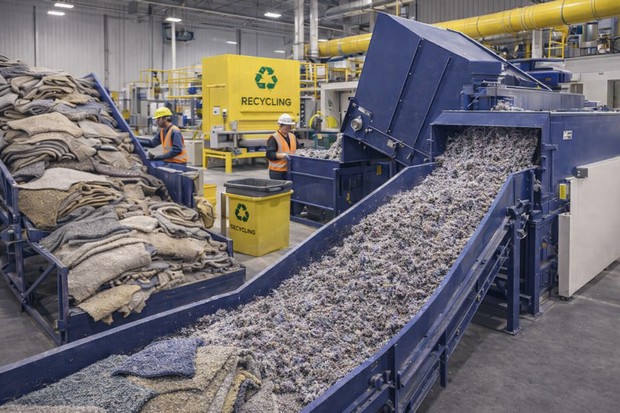
Carpet manufacturing methods influence not only appearance and texture but also durability, cost, and suitability for specific applications. Carpets are generally produced using either woven or non‑woven processes, each based on different structural principles and production techniques. Woven systems such as Wilton and Axminster interlace warp and weft yarns to create stable, patterned structures. Non‑woven methods, especially tufting and needling, form the surface pile through mechanical insertion or fibre entanglement. A clear understanding of carpet manufacturing methods is essential when assessing performance, manufacturing efficiency, and appropriate end use. Understanding how carpets are made is also key to addressing what happens at the end of their life. The production method directly affects how difficult or easy it is to recycle carpet waste, a challenge that is growing in scale across both the UK and global markets.
Methods of Carpet Manufacturing / Construction
A. Woven Carpets
1. Wilton
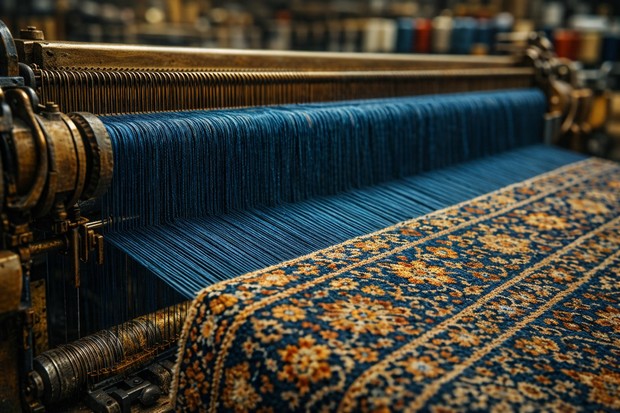
Wilton carpets are defined by a pile yarn woven as part of the warp system. This traditional carpet manufacturing method relies on pile wires to form loops or cut-pile surfaces, with modern looms now using electronic jacquards and rapier weft insertion. When required to form the pile, this yarn is lifted above the backing weave during weaving. On single-face Wilton looms, the pile is usually formed over pile wires, flat metal strips positioned in the weft direction, which remain the standard method of pile formation. The size of the wire determines the pile height.
The wires are inserted from the right-hand side of the loom as the back pick is introduced, typically with two or three picks per pile row contained within one shed of the chain warps. Several pile wires are woven into the structure at any time. The wire furthest from the fell is withdrawn and reinserted to form the next row, allowing continuous reuse throughout production. The left-hand ends of the wires may be plain to produce loop-pile (Brussels) carpet, or fitted with replaceable blades to cut the loops and create cut-pile surfaces.
Traditionally, Wilton looms used jacquards capable of selecting from five pile warp yarns, known as frames, within each pile column. Simpler looms equipped with cam and lever mechanisms are still used for plain designs. In plain constructions, pile warp yarn may be supplied from a beam, while multi-frame carpets draw pile yarn from a creel. Modern jacquard systems are now almost entirely electronic, and punched cards have largely disappeared from new machinery.
Modern Wilton looms commonly operate in face-to-face mode, weaving two carpets simultaneously. The carpets are formed one above the other, with the pile yarn passing between them. A knife moves across the width of the loom to cut the pile and separate the two carpets into individual lengths. Weft insertion is carried out using flexible rapiers, enabling significantly higher speeds than older shuttle-based systems, which are now found mainly on older equipment.
Single-face looms typically have a pitch of 8 per inch (31.5/dm), traditionally expressed as 216 per 27 inches. Finer looms operating at 9.5 per inch (37.4/dm), or 256 per 27 inches, are still in use for specific constructions such as the 3-shot weave. The 216 pitch looms generally produce 2-shot weaves using woollen spun yarns, while the 256 pitch looms use finer semi-worsted yarns. Tuft densities between 870 and 1650 per dm² remain common for commercial Wilton carpets.
Face-to-face looms for rugs and carpet tiles often operate at pitches of 350 or 500 per metre and can achieve densities exceeding 3000 tufts per dm². Such densities are associated with high-quality woven products used in premium interiors.
2. Axminster
Axminster weaving is used to produce patterned carpets with a wider colour range than Wilton constructions. Although three Axminster variants exist, the gripper jacquard system remains the dominant method. Unlike patterned Wilton carpets, where unused pile yarn remains in the backing, Axminster inserts only the selected pile yarn into the structure, row by row.
3. Gripper Jacquard
In the gripper jacquard system, pile yarn is supplied from a creel positioned above the loom. The jacquard commonly controls eight colour frames, although 12-frame systems are now widely used. Yarn ends are fed into carriers, one for each dent in the reed.
Across the loom width, a set of grippers—one per carrier—moves upward to grip the selected yarn ends. The yarn is drawn through, cut to length, and secured into the ground weave by weft insertion. Rigid rapier systems introduce three double-stranded weft shots per pile row. Projectile insertion has seen limited use and is rarely specified today.
Most gripper jacquard looms operate at a pitch of 7 per inch (27.6/dm), though pitches of 31.5 and 35.4 per dm are also used. Tuft densities typically range from about 650 to 1240 tufts per dm², reflecting common contract-grade specifications.
4. Spool Axminster
The spool Axminster process can produce designs with a very large number of colours within a single repeat. However, the system is labour intensive and now used mainly in specialist or heritage production.
Standard spool looms operate at 27.6/dm and produce tuft densities between 430 and 980 per dm², depending on construction. A small number of looms operating at 37.4/dm can reach densities of around 1470 tufts per dm². Although niche, this method retains unique design flexibility.
5. Modern Loom Developments
Recent developments in gripper jacquard looms include electronic jacquard control, replacing traditional punched card systems. Improvements in carrier movement and weft insertion have increased production speeds. Rapier systems now dominate, while projectile insertion is less common. These changes have improved efficiency without altering the fundamental weaving principles. Beyond the loom itself, modern carpet-weaving mills increasingly rely on software-driven automation to manage design preparation, machine scheduling, and creel control. Our article on carpet weaving automation covering CAD/CAM, networking, and Smart Creel explains how these systems work together in a production environment.
6. Textile Floor Coverings Without Pile
Flat woven carpets have gained renewed interest, particularly for commercial interiors. Limited production now takes place in the UK as well as mainland Europe. These constructions do not have a traditional pile. Instead, the surface consists of thicker warp yarns that float across the fabric face, creating a low-profile structure suitable for heavy traffic areas.
B. Non-Woven Carpets
1. Tufted Carpets
Tufted carpets developed from mechanised candlewick production in Dalton, Georgia, USA, during the mid‑twentieth century. Today, Tufting is the dominant global carpet manufacturing method.
A tufting machine includes yarn feed rollers, guide bars, a row of needles across the machine width, and hooks positioned below the backing fabric. As the needles penetrate the backing, loops are formed and held by the hooks to create the pile.
Modern machines use servo-driven yarn feed systems that allow precise control of pile height. Individually controlled needles can insert or skip stitches, enabling detailed pattern formation. Patterned designs may also be applied using digital dye injection printing, which is widely used for custom and short production runs.
Tufted carpets require more finishing than woven products. A latex back-coating anchors the tufts to the primary backing. Because the structure has limited stability after tufting, a heavier pre-coat and often a secondary backing are applied to improve strength and dimensional stability. Hot-melt adhesives are commonly used, and thermoplastic or polyurethane backing systems are increasingly applied in specific sectors. These finishes improve handling and simplify installation.
2. Needled Floor Coverings
Needled floor coverings provide an alternative to traditional felt carpets. Instead of relying on wool’s natural felting properties, thick fibre webs are mechanically entangled using barbed needles. This process creates a dense, felt-like structure.
Basic constructions consist of one or more fibre layers, with or without a carrier fabric. The structure is stabilised through latex back-coating or full impregnation. Surface effects are achieved by blending fibres of different colours.
By adjusting needle size, stroke length, and needle board layout, manufacturers can create ribbed textures, loop effects, or longer pile surfaces resembling cut-pile velvet.
3. Other Methods
Fusion bonding has long been discussed as an alternative carpet manufacturing method. In practice, its use remains limited to specialised applications and small production volumes.
Warp knitting has also been explored for carpet production. Although pile fabrics can be produced, the method is mainly used for technical and automotive flooring rather than mainstream broadloom carpets.
Conclusion
Carpet manufacturing includes a range of systems, from traditional woven techniques to highly mechanised tufted and needled methods. Woven carpets provide strong structural integrity and detailed pattern control, while tufted and non‑woven carpets offer speed, flexibility, and cost efficiency. Each method represents a balance between performance, production demands, and intended use. Understanding these carpet construction methods supports better decisions in design specification, manufacturing planning, and product selection.
References
[1] Goswami, K. K. (Ed.). (2018). Advances in Carpet Manufacture, 2nd Edition. Woodhead Publishing.
[2] Kiron, M. I. (2021b, November 16). Carpet types, properties, manufacturing, uses and maintenance. Textile Learner. https://textilelearner.net/carpet-types-properties-manufacturing/
[3] Horrocks, A. R., & Anand, S. C. (2000). Handbook of Technical Textiles. Woodhead Publishing.
[4] Kadolph, S. J. (2010). Textiles (11th ed.). Pearson Education.
[5] Kothari, V. K. (2006). Textile Floor Coverings. Woodhead Publishing.
[6] Hearle, J. W. S., & Morton, W. E. (2008). Physical Properties of Textile Fibres (4th ed.). Woodhead Publishing.
[7] Spencer, D. J. (2001). Knitting Technology (3rd ed.). Woodhead Publishing.
[8] Wilson, J. (1979). Carpet Manufacture. Textile Institute.
[9] Wilson, J. (1995). Handbook of Carpet Manufacture. Textile Institute / Woodhead Publishing.
[10] Sinclair, R. (Ed.). (2014). Textiles and Fashion: Materials, Design and Technology. Woodhead Publishing.
[11] Adanur, S. (2001). Handbook of Weaving. CRC Press.