Introduction
For a long time, high production and high speed were the main factors in new developments in the carpet weaving industry. Recently, flexibility has also become important. Carpet weavers want to produce different styles and change quickly from one type to another. Flexibility in carpet weaving technology is now as important as productivity.
Developments in raw materials support this trend. New dyeing methods, chemicals, and treatments improve yarn quality and increase the range of raw materials.
Improvements in carpet-weaving machines are also important. This article explains the latest developments in machine-made carpets. In the face-to-face weaving technique, there is a growing trend toward carpets with higher reed density and more colours. It is now possible to weave carpets with 700 reed dents per meter and eight colour frames. Efforts have also been made to improve the backside of carpets and to produce carpets with a back similar to a hand-knotted carpet, without visible warp yarns.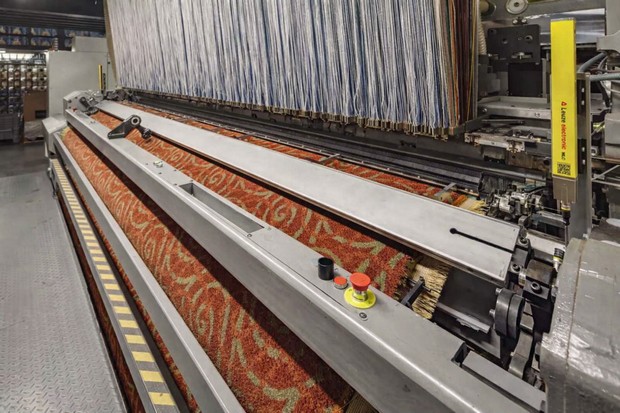
There is also a growing trend in carpet weaving technology to produce carpets with relief, high-low effects, high pile or shaggy effects, and combinations of cut pile, loop pile, and flat weave effects. Designers want to create carpets freely without limitations. A major development in Axminster weaving is the first high-speed Axminster machine with 16 colour frames.
To manage the increasing variety of qualities, modern carpet-weaving mills use special network systems designed for carpet production.
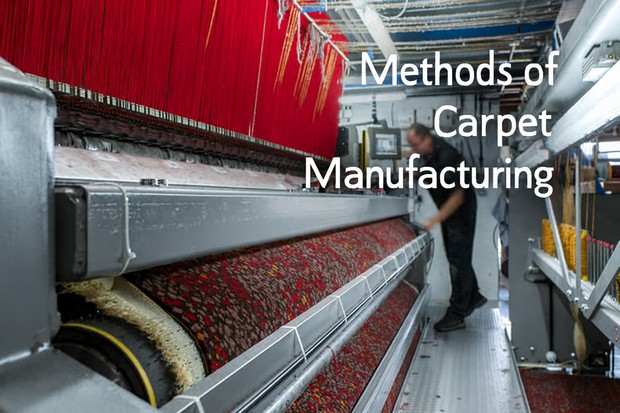
In this article, I will explain the modern carpet weaving technology used in the textile industry, including the latest machines, weaving methods, and innovations that allow manufacturers to produce high-quality carpets with greater speed, flexibility, and design freedom.
Face-to-Face Carpet Weaving
In modern carpet weaving technology, the face-to-face technique is widely used. In this method, two identical carpets are woven at the same time. Two ground fabrics are woven one above the other and connected by pile yarns. The fabric is cut in the middle on the weaving machine to produce two carpets: a top and a bottom carpet.
By using dummy fillings and lancets, loops can be woven into both carpets. In this way, a three-dimensional fabric is formed: a two-dimensional ground fabric with pile tufts and/or loops standing upright on it.
1. Double Rapier Weaving for Cut-Pile Carpets
Applications
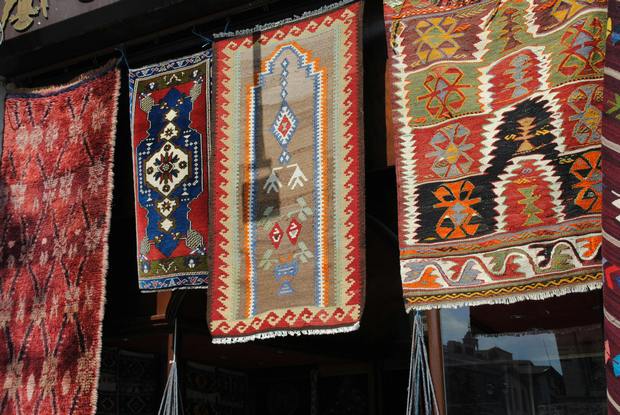
Cut-pile carpets are the most well-known type of carpets. They are mainly defined by their design, number of colours, and number of points (reed density × pick density). Both traditional and modern carpets and area rugs are produced using this technique.
Reed density usually ranges from 160 dents per meter up to 500 or even 700 dents per meter for high-quality carpets. The number of colours typically varies between 5 and 8, although carpets with 10 to 14 colours can also be made.
The main products made with the double rapier face-to-face technique are area rugs. Common pile materials include polypropylene (BCF, heat-set, or CF), acrylic, wool, and viscose.
Weaving Technique
In the double rapier method, two rapiers insert fillings at the same time into two sheds—one for the top carpet and one for the bottom carpet. A pile tuft is formed every two fillings. This structure is known as 1/2 V.
The 1/2 V structure can be woven so the design is visible on the back (mainly for area rugs) or not visible on the back (mainly for wall-to-wall carpets). Different ground weave structures can be used depending on the required density.
Pile yarns that do not appear on the surface are called dead pile yarns. These are woven partly into the top carpet and partly into the bottom carpet. Earlier, such yarns floated on the back and were removed later. Incorporating them into the structure offers several advantages:
- The top and bottom carpets are identical in quality.
- No extra finishing step is required.
- No yarn is wasted.
- The added pile weight can increase carpet weight or allow adjustments in pick density for higher production efficiency.
In single rapier weaving (1/1 V), one alternating filling is inserted into the top and bottom carpets. A pile tuft is formed with every filling. This method is suitable for producing very dense carpets.
A newer structure, 1 + 1/2 V, combines features of both 1/1 V and 1/2 V. The dead pile yarns are fully integrated inside the carpet, providing strong pile fixation and a clean backside. It also allows high pile row densities and quick changes in weave structure without stopping the machine.
Relief carpets can be produced by combining cut pile areas with flat weave effects. The same technique can also create carpets with only flat weave designs.
Weaving Machine
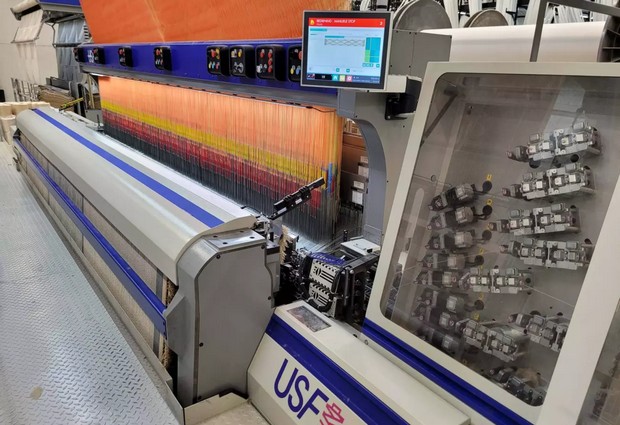
The Carpet and Rug Pioneer CRP92 represents a modern generation of face-to-face carpet-weaving machines. It offers high production, flexibility, and low maintenance. Its design allows easy access to yarns and machine parts.
A microprocessor-based control system allows operators to adjust speed, pick density, and other settings while monitoring production.
Two sets of rigid rapiers insert the fillings. The system ensures smooth transfer of the filling across the shed, with reduced friction and controlled temperature. A precision cutting mechanism and strong reed beat-up help produce a clean backside and good pile appearance.
Modern machines use advanced control systems such as servomotors and electronic Jacquard mechanisms. These allow programmable heddle motion, quick pattern changes, and reliable design formation. The selection system is simple and durable, ensuring consistent performance even in dusty conditions.
Pile yarns are arranged in layers to improve weaving efficiency and produce a cleaner back, especially when working with yarns like wool or acrylic.
For single rapier structures, alternating fillings are inserted into the top and bottom carpets. A rapier switch-off system allows only one rapier to operate per cycle, improving efficiency and reducing unnecessary movement.
2. Triple Rapier Weaving for Cut-Pile Carpets
Applications
Like double rapier carpets, triple rapier carpets are mainly produced as area rugs. This technique is generally used for high-end carpets.
Recent developments by Van de Wiele allow carpets to be woven with a backside similar to hand-knotted carpets. These carpets have no visible warp yarns on the back and are characterized by high reed density.
Weaving Technique
The triple rapier weaving technique was developed and patented by Van de Wiele in Belgium. This machine can insert up to three fillings per cycle while forming a shed for both the top and bottom carpets.
The most common triple rapier weave structures are:
- 2/3 V– Three fillings are inserted per cycle. In one cycle, two fillings go into the top shed and one into the bottom; in the next cycle, the sequence is reversed. A pile tuft is formed around two fillings. Sometimes a thinner middle filling is used to improve pile surface and fixation. This structure increases production compared to older three-shot systems using two rapiers.
- 2/2 V– Two fillings are inserted per cycle: in one cycle into the top shed and in the next into the bottom shed. A pile tuft is formed around two fillings.
- 1 + 2/3 V– A pile tuft is formed alternately around two fillings and one filling. The incorporated pile yarns lie in a separate layer, and each pile tuft reaches the back of the carpet. This ensures strong fixation and a clear backside.
These weave structures can be produced with different ground weaves depending on pick density. Special cam systems allow switching between structures without stopping the machine. With three rapiers, incorporated pile yarns remain stable, reducing extra pile yarn and improving weaving efficiency.
A key goal of machine-made carpets has always been to match the look of hand-knotted carpets. One of the main features of hand-knotted carpets is a clean backside without visible ground warp yarns.
To achieve this, Van de Wiele developed the hand look weave structure. It is produced on a three rapier machine with a filling selector and programmable filling scissors. With its 1/2 V structure, pile fixation is strong and designs can be woven in ratio 1, meaning one design line creates one pile row. This allows sharper and more detailed designs. Both the front and back of the carpet show a clear, sharp pattern.
Weaving Machine
The Carpet and Rug Pioneer CRP93 is the three rapier version of the CRP92. The main difference is the three rapier system, allowing up to three fillings to be inserted per machine cycle.
The Hand Look eXplorer HLX93 is another three rapier machine designed to produce carpets with a hand-knotted appearance. It includes a filling selector and an adapted weaving cycle to achieve the hand-look structure.
3. Triple Rapier Weaving for Cut and Loop Pile Carpets
Applications
Growing market demand for carpets with high-low effects has led to the development of new weave structures.
Carpets with a cut-loop structure can create, at any point in the design, one of the following effects without limitation:
- Cut pile
- Soft loop pile (over one or more picks)
- Flat weave
This flexibility allows designers to produce highly creative surface effects.
Weaving Technique
The most efficient way to produce cut-loop carpets is with a face-to-face weaving machine equipped with three rapiers.
The bottom rapier inserts fillings for the bottom carpet, while the top rapier inserts fillings for the top carpet. The middle rapier inserts thin “dummy” fillings between lancets. Loops are formed around these dummy fillings and may float over one or more picks. Afterward, the dummy fillings are cut and removed from both sides.
Cut pile is formed in the usual face-to-face method, where a knife cuts the working pile between the top and bottom carpets. Traditional single, double, and three-shot weave structures can also be used.
You may also like: Fibres Used in Carpets: Types, Structure and Properties
Attempts were made to produce cut-loop carpets with two rapiers, but this method could not produce two identical carpets and resulted in high waste and low productivity. Therefore, it was not accepted by the industry.
Weaving Machine
The Universal Cut Loop Pioneer UCP93 is a three-rapier carpet weaving machine equipped with a 4-position open shed Multihook Jacquard system. It uses two lancets placed above one another per reed dent.
The 4-position Jacquard system allows the pile yarn to take four positions in each pick:
- Bottom
- Between bottom and middle rapier
- Between middle and top rapier
- Fully at the top
The bottom rapier inserts the filling for the back of the bottom carpet, and the top rapier inserts the filling for the top carpet. The middle rapier alternately inserts thin false fillings to support loop formation. These false fillings are cut and removed during weaving.
Because the pile yarn can move between positions, the machine can produce cut pile, loop pile, and flat weave effects in both carpets. The incorporated pile yarn remains stable during weaving, resulting in:
- A cleaner backside
- Fewer incorporated pile yarns
- Fewer yarn breaks
- Higher weaving efficiency
The UCP93 runs smoothly and at industrial speeds—much faster than wire weaving machines—even with heat-sensitive yarns like polypropylene. Pile yarns such as polyamide, polypropylene, acrylic, and wool can be used.
If the lancets are removed and thicker fillings are inserted by the middle rapier, a sisal look weave structure can be produced. This creates relief effects and can combine different filling colours and thicknesses. Sisal-look carpets are used for both indoor and outdoor applications.
The machine can also produce reversible (recto-verso) carpets, where the design is visible on both sides. Two reversible carpets can be woven simultaneously.
Overall, the Universal Cut Loop Pioneer UCP93 is a highly versatile and productive carpet-weaving machine due to its three-rapier system, special lancets, and advanced Jacquard control.
The Universal Shaggy Loop Pioneer USP93 can produce high-pile carpets in both cut and loop pile, with large pile heights and strong pile fixation.
4. Double Rapier Weaving for Long Pile Carpets
Applications
Long pile or shaggy rugs are becoming increasingly popular. These carpets, also known as Berber or Tibetan carpets, are characterized by:
- Long pile height
- Coarse reed
- Thick pile yarns (wool, acrylic, polypropylene, etc.)
- Few colours
- Simple designs
They are mainly used as area rugs in living rooms and bedrooms. Bathroom rugs with cotton pile yarn are also common.
A recent application is woven synthetic grass, which features strong pile fixation, straight pile, and a water-permeable ground structure.
Weaving Technique
One of the main challenges in long pile carpets is strong pile fixation. Because of the long pile height, yarns can be pulled out more easily.
To prevent this, a W-structure is commonly used. This structure improves pile anchoring. V and W structures can also be combined to create areas with different pile densities and special effects.
Weaving Machine
The Shaggy Rug Pioneer SRP92, developed by Van de Wiele, is a double rapier machine designed for long pile carpets. It uses special lancets that allow pile heights up to 70 mm per carpet. The pile yarn enters the machine centrally to reduce stress on the harness and Jacquard system.
With polyethylene, polypropylene, or polyamide pile yarns, the machine can also produce artificial grass, including logos or field markings when required.
5. Triple Rapier Weaving for Sisal Look Carpets
Applications
Sisal look carpets reflect the growing demand for natural colours and natural-style products. They usually feature shades such as beige, brown, black, and white.
Although the pile surface is mostly made of polypropylene, it resembles natural sisal. The structured surface is created by pile yarns floating over one or more thick fillings, producing a relief effect.
Additional colour effects can be achieved using a filling selector with up to three colours. Sisal look carpets are suitable for both area rugs and wall-to-wall carpets, for indoor and outdoor use.
Weaving Technique
Sisal look carpets are woven on a three rapier machine using a method similar to face-to-face weaving. However, the top and bottom fabrics are not connected, and no cutting is required.
Three rapiers insert fillings at the same time:
- The top rapier inserts a filling for the top carpet backing.
- The bottom rapier inserts a filling for the bottom carpet backing.
- The middle rapier inserts a thick filling alternately into the top and bottom carpets.
The pile yarn floats over these thick fillings, creating the relief structure. This patented three rapier weave structure produces the sisal look effect.
Weaving Machine
The Sisal Look Pioneer SLP93 is a three rapier machine developed specifically for sisal look carpets. It is based on the CRP93, with adapted cam settings for this special weave structure.
When equipped with a servo-driven filling selector on the middle rapier, additional colour variations can be created.
Since the top and bottom carpets are independent, completely different designs can be woven simultaneously. This offers flexible production planning—for example, wall-to-wall carpet in the top layer and area rugs in the bottom layer. Logos and company names can be woven without mirror effect.
The Carpet and Loop Pioneer CLP91 can also produce sisal look carpets in single-face construction.
Axminster Weaving
Applications
Axminster carpets are traditionally used in the contract market, such as hotels, cruise ships, and casinos. Pile yarns are typically wool, nylon, or wool/nylon blends. Texts and logos can easily be woven.
With the development of new high-speed Axminster machines, the use of Axminster carpets for area rugs is increasing. Heat-set polypropylene yarn can also be used.
Axminster carpets usually have a reed density of about 7 DPI (around 275 dents per meter) and can use up to 16 colour frames.
Weaving Technique
In the Axminster method, a single-face carpet is woven with ground yarns and fillings. Jacquard carriers present the selected pile yarn in each reed dent, and grippers insert it into the fabric.
Only the visible pile yarn is used—no pile yarn is incorporated inside the structure.
Axminster carpets can be woven through or not through to the back, using double or three-shot structures. Up to 16 colours can be included in one carpet.
Weaving Machine
The Master in Axminster MAX91 is a high-speed machine designed specifically for Axminster carpet production. It has a strong frame and stable ground structure.
Pile yarn presentation is controlled by stepper motors, allowing up to 16 colours. The cutting motion is servo-driven to ensure precise cutting while controlling heat.
The gripper is lightweight and suitable for both thick and thin yarns. Fillings (jute, polypropylene, or cotton) are inserted by a flexible rapier system.
Sensors detect missing pile ends, reducing defects and improving quality. All controls—including machine settings and Jacquard functions—are integrated into a user-friendly touch-screen system that can be connected to a network.
Wire Wilton and Loop Pile Weaving
a) Wire Wilton Weaving
Applications
Wire Wilton carpets are high-quality carpets mainly used for wall-to-wall applications in both contract and residential markets. They can have loop pile, cut pile, or a combination of both.
Pile materials are usually wool, nylon, or blends. Texts and logos can be woven. The technique ensures an even pile appearance across the full width of the carpet.
Weaving Technique
Wire Wilton is one of the oldest carpet weaving methods. Loops are formed over metal wires inserted into the pile shed. When the wires are removed, the pile remains as loops. If the wire includes a knife, the loops are cut to form cut pile.
Various effects are possible, including woven through or not through structures, high-low effects, and different ground weaves.
Weaving Machine
The Advanced Wire Master AWM51 is a modern wire weaving machine. Flexible rapiers insert the fillings, and a controlled wire motion ensures stable insertion and extraction.
Sensors monitor wire handling to maintain carpet quality. Speed can be adjusted as required. An electronic Jacquard system allows different designs and pile structures with up to five colour frames.
b) Loop Pile Weaving
Applications
Loop pile carpets have a wide range of uses.
They can be used for decorative area rugs with soft short or long loops and high-low effects. They are also widely used for wall-to-wall carpets in both residential and contract markets.
A recent application is aircraft carpet, made entirely with loop pile in wool.
Weaving Technique
Loop pile weaving is a modern high-speed method. High-low effects, different loop heights, names, and logos can be created through electronic Jacquard control.
Loop pile carpets are woven on a double rapier machine. The bottom rapier inserts fillings for the ground structure, while the top rapier inserts dummy fillings above gauges every two picks. The gauges determine loop height.
Pile yarns form loops around these dummy fillings. The dummy fillings are then cut and removed during weaving.
Since no metal wires are used, production speed can be much higher than wire Wilton machines. Heat-sensitive yarns such as polypropylene, polyamide, acrylic, cotton, and wool can be used.
Weaving Machine
The Carpet Loop Pile Pioneer CLP91 is a double rapier machine designed for loop pile weaving with lancets and dummy fillings. It is based on the face-to-face machine design but adapted for loop pile production.
It includes a rapier switch-off system, a single take-up system, and an electronic Jacquard for various weave structures.
The machine can also be equipped with a dobby system and servo-driven pile delivery. When gauges are removed, it can produce sisal look carpets as well.
Conclusion
Carpet weaving technology has shifted from a narrow focus on speed toward a more complex balance of flexibility, precision, and design freedom. Different types of carpet weaving technology such as rapier, face-to-face, Axminster, Wilton, and loop pile are used for different market needs from high-density area rugs to contract flooring. Some developments, particularly hand-look structures, suggest machines are closing the aesthetic gap with hand-knotted carpets. Yet productivity still shapes every decision. In practice, success seems to depend less on one technique and more on how intelligently these systems are applied.
References
[1] Wilson, J. (1979). Carpet Manufacture. London: The Textile Institute.
[2] Goswami, K. K. (Ed.). (2017). Advances in Carpet Manufacture (2nd ed.). Woodhead Publishing.
[3] Kolanjikombil, M. (2017). Woven Carpet Structure and Design. Cambridge: Woodhead Publishing.
[4] Adanur, S. (2001). Handbook of Weaving. Boca Raton: CRC Press.
[5] Adanur, S. (Ed.). (2005). Handbook of Textile Technology. Boca Raton: CRC Press.
[6] Gong, R. H., & Wright, R. M. (Eds.). (2002). Fancy Yarns: Their Manufacture and Application. Woodhead Publishing.
[7] Textile Institute. (1985). Carpet and Rug Production. Manchester: The Textile Institute.