Introduction
Labelling of home textiles is an important aspect of product communication, as it provides required information to distributors, buyers, and consumers about the product. Understanding home textile labelling requirements is essential for ensuring compliance in international markets. However, labelling requirements generally do not apply until products are ready for sale to consumers. Home textile labels normally include dimensions, fibre content, care instructions, country of origin, and manufacturer identification. Different law labels and flammability tags may also be attached, depending on the product. In this article I will discuss the labelling of different home textile products for the US and EU markets, with a focus on key home textile labelling requirements.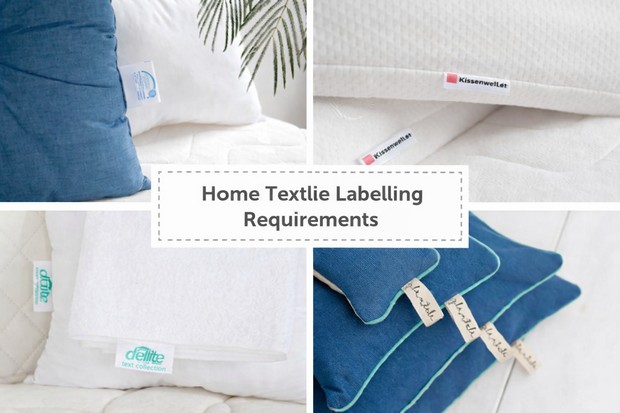
Labelling Requirements for Home Textiles in the USA
All textile fibre products imported into the United States must be stamped, tagged, labelled, or otherwise marked with the information required by the Textile Fiber Products Identification Act. These home textile labelling requirements are strictly enforced to protect consumers and ensure transparency.
The product must be labelled to show its fibre content. The generic fibre names and percentages by weight of each constituent fibre must be listed in descending order of predominance. If the product is made from one fibre, the label may use the word “All” instead of “100%”; for example, “100% Wool” or “All Wool.” The disclosure requirement applies only to fibres contained in yarns, fabrics, apparel, and household textile products. If part of the product is made from a non-fibrous material such as plastic, glass, wood, paint, metal, or leather, that material is generally not included in the fibre content declaration. There is no need to disclose the contents of zippers, buttons, beads, sequins, leather patches, painted designs, or other parts not made from fibre, yarn, or fabric.
In general, only fibres that comprise five percent or more of the total fibre weight are included on the label. Fibres present at less than five percent should be disclosed as “other fiber” or “other fibers,” as appropriate, rather than by their generic name or fibre trademark, unless the fibre has a functional significance that must be identified. However, ornamentation is exempt from fibre content disclosure when it does not exceed five percent of the product’s fibre weight. “Ornamentation” refers to fibres or yarns that impart a visibly discernible pattern or design to a yarn or fabric. In such cases, the other fibre content is disclosed without regard to the ornamentation, and the label includes the statement “Exclusive of Ornamentation.” If the ornamentation exceeds five percent of the fibre weight, its fibre content must be disclosed as a separate section.
If ornamentation, decorative trim, or a decorative pattern or design exceeds both (1) 15 percent of the surface area of the product and (2) 5 percent of the fibre weight of the fabric, its fibre content must be disclosed. If it is either (1) less than 15 percent of the surface area or (2) less than 5 percent of the fibre weight, its content need not be disclosed, provided the label states “exclusive of decoration” or “exclusive of ornamentation.” If linings, interlinings, fillings, or paddings are used only for structural purposes, disclosure of their fibre content is not required, although it may be stated voluntarily. If linings, interlinings, fillings, or paddings are incorporated for warmth, including metallic-coated textile linings or fillings containing any amount of wool, their fibre content must be disclosed as a sectional disclosure.
There is a three percent tolerance for fibre content claims on labels in the case of blends. Deviations greater than three percent constitute mislabelling unless the company can show that the deviation resulted from unavoidable manufacturing variation despite the exercise of due care. No tolerance is allowed if the label states that a product contains only one fibre.
Care instructions appropriate to the nature of the home textile product are also required on the label. These instructions may apply to products such as curtains, cushions, chair pads, floor rugs, throws, blankets, quilts, pillows, pillow protectors, mattress protectors, table linen, kitchen accessories, bed linen, comforters, coverlets, towels, shower curtains, and bathmats.
The name of the manufacturer, or the name or registered identification number issued by the Federal Trade Commission of one or more persons marketing or handling the textile fibre product, is a mandatory label requirement. A word trademark used as a house mark and registered with the United States Patent and Trademark Office may appear on labels in place of the otherwise required name, provided the owner furnishes a copy of the registration to the Federal Trade Commission before use.
The name of the country of origin where the product was processed or manufactured must appear on the label in English. Abbreviations such as USA or Great Britain, and spellings close to the English version, such as Italie for Italy or Brasil for Brazil, may be used if they clearly and unmistakably identify the country. The abbreviations “CAN” and “MEX” for Canada and Mexico are acceptable under FTC rules, but may not satisfy US Customs requirements. If more than one country is named on the label, phrases describing the specific processing carried out in each country are usually necessary to convey the required information clearly to the consumer.
Other points to note in home textile labelling requirements are as follows: a label should show the identity of the commodity, the name and place of business of the manufacturer, packer, or distributor, and the net quantity of contents, including weight in pounds, linear measure in yards or feet, or area in square yards or square feet, as applicable. The net quantity declaration should appear conspicuously and be easily legible, in distinct contrast with other matter on the package. Labels should also be uniform on similar packages.
Labelling requirements do not apply until products are ready for sale to consumers. Items shipped or delivered in an intermediate stage of production and not yet labelled with the required information must be accompanied by an invoice disclosing the fibre content, country of origin, manufacturer or dealer identity, and the name and address of the person or company issuing the invoice. If manufacture or processing is substantially complete, the products are considered ready for sale to consumers. Even if small details such as hemming are unfinished, the products must be labelled.
Among home textile items, products covered by the labeling requirements include bedding, such as sheets, covers, blankets, comforters, pillows, pillowcases, quilts, bedspreads, and pads, but not outer coverings for mattresses or box springs; curtains and casements; draperies; tablecloths; napkins; doilies; floor coverings such as rugs, carpets, and mats; furniture slipcovers and other furniture covers; afghans and throws; sleeping bags; towels; washcloths; dishcloths; and ironing board covers and pads. However, some home textile items are not covered by these labelling requirements. These include upholstery or mattress stuffing, unless it is reused, in which case the label must state that it contains reused stuffing; outer coverings of upholstered furniture, mattresses, and box springs; carpet or rug backings; and padding or cushions intended for use under carpets, rugs, or other floor coverings.
A label may be the smallest and least expensive component of a company’s product, but it can be critical to that product’s commercial success. An incorrect label can result in suspension of sale or even product recall, making compliance with home textile labelling requirements essential.
Mechanics of Writing Law Labels for Home Textile Products
The content of law labels is governed by the applicable federal or state regulations. The following points explain the mechanics of law labels:
- The kinds, types, and percentages of filling materials used in upholstered furniture and bedding, whether concealed or unconcealed, must be stated on the law label.
- Percentages are to be calculated on the basis of avoirdupois weight of the filling material and listed from the largest proportion to the smallest.
- Labels must be securely fastened and easy to see. They must not be concealed or obstructed from view in any way.
- Law labels must be made of materials that are not easily torn.
- Labels for products made entirely of new materials must be white with black lettering.
- Labels for products containing used materials must be red with black lettering.
- At the top of the label, the following statement must appear: “UNDER PENALTY OF LAW THIS TAG NOT TO BE REMOVED EXCEPT BY THE CONSUMER.”
- When all new material is used in the product, the heading “ALL NEW MATERIAL” must appear on the label.
- When used material is used in the product, the heading “SECONDHAND MATERIAL” or equivalent wording required by the applicable jurisdiction must appear on the label.
- The registry number must be shown.
- The following guaranty statement must appear: “Certification is made by the manufacturer that the materials in this article are described in accordance with law.”
- The finished size of bedding articles such as sleeping bags, mattresses, comforters, mattress pads, box springs, pillows, and similar articles must be shown. Width and length dimensions must be expressed in inches. Decorative pillows are excluded from the size requirement.
- The net weight of filling materials in bedding such as sleeping bags, mattresses, box springs, pads, and similar items must be stated in pounds and ounces.
- The minimum size of law labels is 2 × 3 inches. Labels may be larger when necessary to accommodate the required type size and statements.
- The minimum type size must be 1/8 inch in capital letters.
- All printing must be in English.
- Printing must appear on only one side of the label.
- Labels must not contain advertising or anything that detracts from the required statements.
- No mark, tag, or sticker may cover the required statements.
Labelling Requirements for Home Textiles in the EU
Labelling is intended primarily to convey information to distributors, buyers, and consumers. For household and furnishing textiles, labelling may include information on fabric texture, size, ironing, and washing. These home textile labelling requirements in the EU are structured into three broad categories:
(a) Legislative labelling requirements
Fibre content labelling in the European Union is governed by Regulation (EU) No 1007/2011 on textile fibre names and related marking and labelling. The indications “100%,” “pure,” or “all” may be used only where the textile product consists exclusively of one fibre, subject to very limited tolerated manufacturing impurities. Products composed of multiple fibres must declare their fibre composition using the prescribed textile fibre names. The label must be provided in the language or languages required by the Member State in which the product is marketed.
(b) Market labelling requirements
Size marking may differ between countries and product categories.
Care labelling/washing instructions are widely used in the EU, although care labelling is not harmonized across all textile products by a single EU-wide mandatory rule. In practice, many companies use the internationally recognized GINETEX symbol system or equivalent care symbols. These symbols communicate washing, bleaching, drying, ironing, and professional textile care instructions.
(c) Voluntary labelling requirements
These include country of origin marking, brand name, and other consumer information. In some cases, origin marking may be required under specific national rules or other applicable product legislation.
Conclusion
In both the US and the EU, home textile labelling plays a key role in legal compliance and consumer communication. Labels that clearly state fibre content, care instructions, country of origin, and business identity help products enter the market with fewer risks of disputes, delays, or recalls. Since requirements vary by product type and region, labeling should be treated as an essential part of product development rather than a final formality. Clear and accurate labels not only support compliance but also build transparency, credibility, and consumer trust.
References
[1] Das, S. (2010). Performance of Home Textiles. Woodhead Publishing India.
[2] Kadolph, S. J. (Ed.). (2010). Textiles (11th ed.). Pearson Education.
[3] Joseph, M. L. (1988). Introductory Textile Science (6th ed.). Holt, Rinehart and Winston.
[4] Elsasser, V. H. (2005). Textiles: Concepts and Principles. Fairchild Publications.
[5] Corbman, B. P. (1983). Textiles: Fiber to Fabric (6th ed.). McGraw-Hill.
[6] United States. (1958). Textile Fiber Products Identification Act.
[7] European Union. (2011). Regulation (EU) No 1007/2011 on Textile Fibre Names and Labelling.