Introduction
Carpet weaving is a specialised branch of textile manufacturing that combines design, yarn preparation, weaving technology, finishing, and cost control within a single production system. In a modern carpet-weaving factory, each department must operate with close coordination, because small variations in yarn quality, machine setting, or environmental condition may affect the final appearance of the carpet. The process usually involves preparation, weaving, and finishing, followed by inspection and packing. Design possibilities are wide, yet practical limitations of weave structure and machine performance often influence the final result. For this reason, understanding both technical operation and production management is essential in carpet manufacturing.
Step-by-Step Carpet Weaving Process
A carpet-weaving plant consists of several departments. In general, there are three:
- Preparation
- Weaving
- Finishing
In the preparation department, there are several divisions. One part develops the designs and converts them into machine-readable files; this is the CAD/CAM section. Another part prepares the yarns for the weaving machines. A direct beaming machine winds the ground yarns (mostly cotton/polyester, cotton/viscose, and similar blends) onto beams. In carpet weaving, beaming is generally done on a direct beaming machine rather than on a sectional beaming machine, because it produces firm beams with more uniform tension across the full width, thereby reducing the risk of waves or other widthwise distortions in the carpet.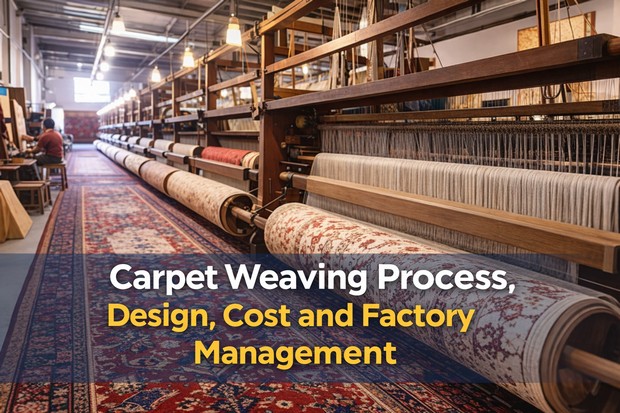
Besides the beaming machine, this department also contains bobbin winders, which generally have two functions. In the case of wool and acrylic, the yarns are mostly supplied on conical bobbins or in hanks. The bobbin winders transfer the yarns from hanks or conical bobbins to cylindrical bobbins suitable for face-to-face weaving. In the case of polypropylene, the yarns are generally extruded on cylindrical bobbins that can be used immediately on the weaving machines. The second function is rewinding residual yarns. During weaving, it is better to change the pile bobbins in the creel before they are completely empty in order to avoid machine stops and to limit excessive tension differences between full and nearly empty bobbins. Bobbin winders can therefore make new full bobbins from several almost empty bobbins so that no raw material is lost.
The next department is the weaving department, where the weaving machines are installed.
The last department is the finishing department, where there are backsizing and shearing machines. The backsizing machine applies a thin layer of adhesive coating to the back of the carpet. The shearing machine performs tip shearing in order to obtain a uniform pile surface. Depending on the type of yarn and the required quality level, the carpet passes one or more shearing heads. In general, low-cost polypropylene qualities pass one head, whereas higher-quality wool carpets may pass three or even more heads. Shearing is not done for 100% loop-pile and sisal-look carpets.
The final step is preparing the carpets for sale. Edging machines or automated lines add fringes or finish the edges, depending on the request of the final customer. This process can also be automated with robotic edging systems that finish all four sides of the carpet.
Finally, the carpets are packed and labelled. They are then ready for sale.
Design Possibilities in Woven Carpet Manufacturing
Designers have considerable freedom in carpet design; however, for some qualities, specific design rules must be taken into account.
The main difference between carpets is, of course, the design. The electronic Jacquard allows virtually any design to be woven, from traditional Persian designs to modern patterns. The number of colours and the number of design points determine the design. The number of design points per square metre is the product of the number of reed dents per metre and the number of design lines per metre in the weft direction. The number of points in a carpet can range from about 80,000 points/m² for economical qualities to more than 3,000,000 points/m² for very fine qualities. For symmetrical carpets, only one-quarter of the carpet is designed.
Besides the creativity of the design, there are several other ways to include special effects in the carpet:
- Using different yarns (BCF polypropylene, heat-set polypropylene, frisé polypropylene, wool, acrylic, viscose, silk, etc.), including different yarns in one carpet and yarns with special effects (metallic, shrink, or contrast-colour effects)
- Combining cut pile with flatweave effects or loops
- Using single, double, and triple loops, or any combination
- Using a weft-selection system to insert different filling colours
- Creating high-low effects with different gauges or wires of different heights etc.
For some weave structures, for example 1/2 V, mix-contours or double points can occur in the carpet when certain design rules are not respected. In a mix-contour, two yarns visually mix with each other at specific colour transitions. In a double point, two yarns make a loop on the back of the carpet at the same time. With modern design-processing software, many of these mix-contours and double points can be avoided, provided that specific rules are followed, such as drawing a double-colour line between two single-colour lines.
Current carpet-design software can also highlight, before weaving, where mix-contours are likely to appear for a given creel set-up and weave structure. It can visualise and simulate many kinds of carpets and effects, such as cut pile, flatweave, and loop pile, before production starts, thereby reducing trial runs, material waste, and second-quality carpets.
Machine Maintenance
Proper maintenance of the machines is a key factor in the smooth running of a carpet-weaving mill, the production of first-quality carpets, and the long service life of the machines and their parts. This section gives some general guidelines for the maintenance of face-to-face machines. These machines are designed for low maintenance and reduced downtime.
A typical machine is equipped with oil-circulation systems for the main gearboxes, including those of the rapier motion, Jacquard drive, direct drive or transmission, spike rolls, and knife motion. An oil-flow detector monitors the oil circulation. Other gearboxes, such as the reed motion, are equipped with bath lubrication. A centralised lubrication system distributes grease to different points. With an automatic lubrication system, a film of lubricant is applied automatically to the rapier toothed racks via the rapier drive socket. The quantity of lubricant, the lubrication period, and the lubrication interval are user-settable.
The HMI (Human-Machine Interface) machine control has counters to indicate when oil and grease must be changed, thereby giving the operator a timely reminder. The quality of the oil and grease has a strong influence on the service life of the parts and on the frequency of oil and grease changes. The change interval differs for the various gearboxes and lubrication points in the machine. Proper maintenance of the oil filters and pressure filters helps maintain oil quality. The machine should also provide easy access to all maintenance points.
A central dust-collecting system connected to the weft (filling) insertion removes abrasive jute dust and lint. This improves the service life of the rapiers, the pile harness, and other machine components that are sensitive to dust.
For efficient operation of the machine, some daily, weekly, and monthly checks have to be made.
Daily:
- Check the knives of the cutting motion
- Measure the pile height of the top and bottom carpet
- Remove dust from accessible areas during weaving, using compressed air only where permitted by safety procedures
- Empty the reservoir of the cleaning system
- Check the rapier rods for dust
- Remove dust from the filters.
Weekly:
- Check the pile and ground stop motions for proper operation
- Clean the grinding stones
- Check the oil level in the pneumatic system for the weft scissors
- Check the cutting rope for wear and tension, and check the clearance of the knife carriage
- Remove dust from non-visible places.
Monthly (or at every beam change):
- Remove, clean, and check the rapiers and rapier wheels.
Every six months:
- Check bolts and nuts for correct torque and tighten if necessary.
These maintenance intervals should be adjusted, where necessary, to machine speed, fibre type, dust load, and the manufacturer’s recommendations.
Raw Materials Used in Carpet Production
The pile yarn can be polypropylene, wool, acrylic, cotton, polyamide, viscose, and other fibres. The pile yarn largely determines the appearance and handle of the carpet, as it is the yarn that is visible and tactile on the front side. The ground yarns, which come from beams, are mainly cotton/polyester or polyester/viscose. The filling is jute, polypropylene, or dimensionally stabilised cotton.
The characteristics of the raw materials are always a compromise between cost and the minimum requirements for efficient operation of the weaving machine. It is, however, extremely important to use good raw materials in order to obtain high weaving efficiency and top-quality carpets. Besides the raw materials, the conditions in the weaving mill, such as humidity, air conditioning, and temperature, must also be respected.
The storage of the yarns and bobbin winding should be under the same climatic conditions as the weaving room, typically about 67% to 73% relative humidity and a temperature of 20 to 25°C, without extreme fluctuations.
For all mentioned yarn specifications, the mean linear irregularity and the numbers of thin places, thick places, and knots should remain within acceptable quality limits, preferably around or better than the 25th percentile of the relevant Uster Statistics, where applicable. Faults resulting from bobbin preparation, such as crossed ends, run-out ends, slack ends, double ends, opening knots, and sticking ends, should not exceed 10% of the total yarn breaks.
Production and Costing in Woven Carpet Industry
In face-to-face weaving, production depends on the number of rapiers inserted simultaneously. For two rapiers entering the shed at the same time, production in square metres per hour for the two-shot weave structure can be calculated as follows:
…2 (rapiers) × speed (rpm) × 60 min/h × weaving width
————————————————————————————– × weaver’s efficiency
………………………..total picks/cm × 100 cm/m
For a common carpet quality with a reed density of 320 dents/m, 6 colour frames, and 5 total picks per centimetre in 1/2 V, or 2.5 pile rows/cm, with polypropylene pile yarn and first-quality raw materials, production on a modern double-rapier face-to-face weaving machine is around 180 m²/h at a weaver’s efficiency of 85%.
For three rapiers entering the sheds at the same time, production in square metres per hour can be calculated as follows:
…3 (rapiers) × speed (rpm) × 60 min/h × weaving width
————————————————————————————- × weaver’s efficiency
…………………….total picks/cm × 100 cm/m
It is obvious that, all other factors being equal, production in the three-shot weave structure 2/3 V, woven with three rapiers, is 50% higher than that of a comparable three-shot weave structure woven on a double-rapier machine.
For a three-shot carpet quality with a reed density of 400 dents/m, 8 colour frames, and 15 total picks per centimetre in 2/3 V, or 5 pile rows/cm, with heat-set polypropylene pile yarn and first-quality raw materials, production on a modern three-rapier face-to-face weaving machine is around 75 m²/h at a weaver’s efficiency of 85%.
The weaver’s efficiency takes into consideration machine stops for yarn breakages and the time needed to repair them. When calculating production per month, another efficiency, called the weaving mill efficiency, should be taken into account. The weaving mill efficiency includes stops for creel changes, beam changes, general machine maintenance, and similar losses.
Production is, of course, a very important factor in calculating the unit cost of a carpet. The most important cost in the total price of a carpet, however, is the raw material. The following list gives an idea of the costs that should be taken into account when calculating the cost per square metre, together with their indicative percentage share in the total cost:
- Raw material: 70–85%
- Machine depreciation (preparation, weaving, and finishing): 6–8%
- Building: 2–4%
- Labour: 8–12%
- Energy: 2–3%
- Overhead: 6–8%.
The raw-material cost is easy to calculate, as it is simply the sum of the cost of each raw-material component (pile, jute, filling, and coating) per square metre.
The machine and building depreciation per square metre is calculated as follows:
……………Machine and building cost + interest for the loan
———————————————————————————————————
…Total production in square metres during the depreciation period
The labour cost per square metre is calculated as follows:
….Total salary cost per month
————————————————–
….Production in m² per month
Market Trends in Woven Carpet Industry
The market for woven carpet remains important, but demand has shifted. Sales of wall-to-wall carpet have declined in many regions as consumers increasingly prefer hard-surface flooring such as stone, wood, laminate, or similar materials. As a consequence, demand for area rugs has strengthened, because many consumers use carpets and rugs to decorate and soften these hard floors.
There is a general tendency toward higher-quality carpets, meaning carpets with higher reed densities, more colours, and higher-quality raw materials such as heat-set polypropylene, acrylic, or wool. Although 320 dents/m qualities still represent a substantial part of the market, investment increasingly targets machines with 6 to 8 colour frames and finer constructions. The quality of a carpet is strongly related to the buying power of the customer. Higher-end carpet qualities with 500 to 700 dents/m and more than 1,000,000 points/m² are gaining market share, especially in premium markets in Europe, the Middle East, and parts of Asia.
Conclusion
The management of a carpet-weaving factory requires balanced control of technology, raw materials, machine maintenance, and production cost. High-quality carpets cannot be produced only by advanced machines; stable yarn quality, correct climatic conditions, and careful supervision are equally important. Production planning must also consider efficiency, waste, and market demand, which may vary depending on region and product type. In many cases, the cost of raw materials dominates the total price, so material selection should be made with both quality and economy in mind. A well-managed weaving plant is therefore the result of technical knowledge, practical experience, and consistent production discipline.
References
[1] Goswami, K. K. (2017). Advances in Carpet Manufacture (2nd ed.). Woodhead Publishing, Elsevier.
[2] Gandhi, K. L. (2019). Woven Textiles: Principles, Technologies and Applications (2nd ed.). Woodhead Publishing.
[3] Gandhi, K. L. (Ed.). (2012). Woven Textiles: Principles, Technologies and Applications. Woodhead Publishing.
[4] Kadolph, S. J. (Ed.). (2010). Textiles (11th ed.). Pearson Education.
[5] Corbman, B. P. (1983). Textiles: Fiber to Fabric (6th ed.). McGraw-Hill.