Introduction
India’s home textiles sector is a rapidly growing segment of the textile industry, supported by strong spinning and weaving capacity, rich design heritage, and expanding domestic and export demand. Rising urbanization, higher disposable incomes, and growth in organized retail and e-commerce have further accelerated market expansion. Major production hubs across India play a vital role in strengthening the country’s global competitiveness in home textiles.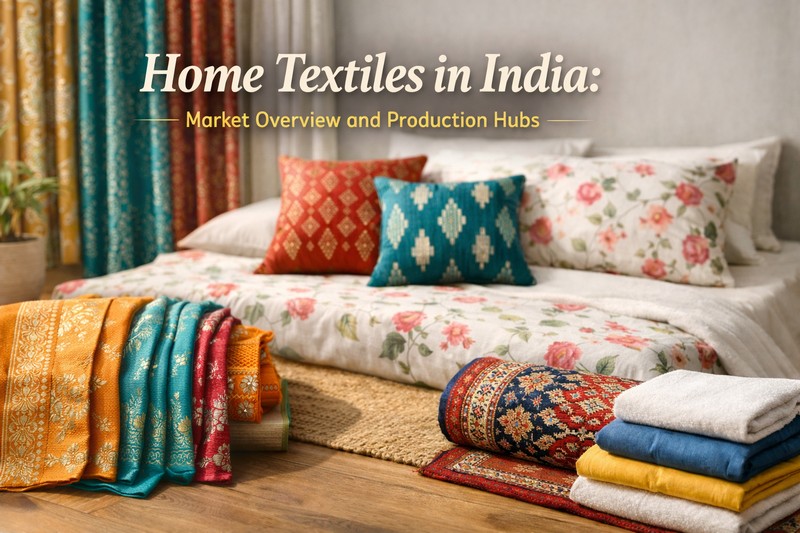
Market Overview of Home Textiles in India
The diverse structure of the Indian textile industry, coupled with its close linkage with its ancient culture and tradition, provides it with the unique capacity to produce premium goods with the help of latest technological inputs and design capability. The home textiles segment in India is growing by leaps and bounds, fueled by rapid urbanization and a lot of young people buying homes. In addition, they have surplus income to buy stylish, lifestyle-oriented products in the market. The future is bright for this section as domestic consumption rises alongside exports.
Indian home textile export industry, in general, is not moving fast enough in terms of product and design leadership. Despite this, a significant fact emerges strongly in comparison with competing nations like China and Pakistan that India’s core strength could essentially be in intricate design and product development. India has a strong traditional base in textiles that provides a unique vocabulary of motifs that beautifully suits the global consumer sensibility. The ability to produce and supply customized small quantities is not only limited to traditional handloom but has now been demonstrated by modernized mills as well.
Product needs for home textiles is governed by economical, political, historical, cultural and seasonal factors. For instance, in India, home is a very important place for social (joint family system) and family get-together events, making it emotionally very important to the customer. Being one of the top manufacturers in spinning and weaving around the world, India has also grown in competition in the value-added home textiles area. The home textile industry is quite widespread in India, spanning across several dedicated clusters.
Major Production Hubs of Home Textiles in India
The home textile industry is quite widespread in India. There are a number of centers in India wherein the production of home textiles has been undertaken since decades. Being one of the top manufacturers in spinning and weaving around the world, India has also grown in competition in home textiles area.
Karur
Karur is a small town in Southern India that specializes in the production of durable home textiles. It is especially known for the production of pillow covers, bedspreads as well as kitchen and table linen. In fact, the table mats from Karur are world famous for their heavy textures. Karur mainly produces cotton home textiles by way of hand looms, while auto-looms and power looms are gradually being accepted. The home textile producers of Karur specialize in certain finishes, such as PVA, starch, and eco-friendly stain repellent finishes. Some producers have begun the use of certified organic cotton and different fabrics such as polyester and silk. On account of large scale production, Karur gets the benefit of reduced costs, though strict pollution control norms remain a challenge.
Panipat
Panipat in the state of Haryana is a major producer of woollen home textile products and serves as the global center for shoddy yarn recycling. The ‘Panja’ durries produced in Panipat are famous all over the world. The easy availability of recycled raw materials and economies of scale are the major factors which have led to the development of Panipat as a major production and export hub. Producers in Panipat have of late started experimenting with synthetic blends using polyester, silk and poly silk.
Cannanore and Chennai
Cannanore, located in South India, is another hub that is well known for the production of traditional handloom home textiles using fabrics such as cotton, viscose, and silk. Producers here are also adding value with the help of intricate embroidery and bead work. Chennai, a metropolitan city, has emerged as a major production and export hub focusing on high-volume orders. Home textile producers in Chennai usually source raw materials from Karur and Erode, to which value addition is undertaken. These producers are able to deliver better quality products within a shorter period of time with the benefit of advanced sewing technology.
Delhi
Delhi, the capital of India, has emerged as one of the major production and export centers, hosting numerous international buying houses. Being a metropolis, it has an efficient infrastructure and easy availability of skilled manpower. Most of the producers in Delhi source their raw material from Panipat to create finished soft furnishings. It does not face the problems that are faced by the other traditional hubs, being one of the largest commercial cities of India. Orient Craft and Trendsetters are among the major players in home textiles in Delhi and its surrounding areas.
Mumbai
Mumbai, the large metropolis and the capital of Maharashtra, is also one of the major production centers, benefiting significantly from its proximity to the Nhava Sheva port. Like Delhi and Chennai, producers in Mumbai also source raw material from places such as Karur and Bengaluru to add value to it. Home textile producers from Mumbai are popular the world over for their unique and innovative design-led products. On account of the high operating costs in Mumbai, several producers have established plants in surrounding areas like Vapi to maintain price competitiveness. The home textile producers in Mumbai have carved out a niche for themselves, particularly in case of luxury bedspreads and bathroom textiles.
Bengaluru
Bengaluru, the capital city of Karnataka, has emerged as a manufacturing and export hub for home textiles, especially in pure silk. Bengaluru is largely engaged in the production of fabric using power looms, which is then sourced to other parts of India for value addition. On account of the high price of pure silk, producers in Bengaluru are now experimenting with blended fabrics such as artificial silk and wool-silk to cater to budget-conscious markets.
Mirzapur, Bhadohi and Jaipur
Mirzapur and Bhadohi are small cities located in Uttar Pradesh, which are globally recognized as the “Carpet Belt” of India. Being small cities, they face infrastructural problems due to which they have not been able to achieve growth to their optimum potential. Jaipur city has also become an important centre, especially for products using traditional techniques like natural dye block printing and appliqué. The lightweight “Jaipuri Razai” (quilt) is a signature product here. Jaipur is a well-known tourist destination, and this has helped largely in the development of Jaipur as a home textile production and export center.
Future Strategy
Looking to the requirements of the US and UK market, many Indian companies are diversifying, integrating sustainable practices in home textiles. There are enormous investments ensuing in this segment supported by government incentives. According to the textile experts, there is huge scope for exports, but only if they can produce the right value-added products. Many companies are going for the basic home products like bed sheets and terry towels, while segments like upholstery and curtains are often ignored. Amid this changing scenario in the international market, Indian manufacturers must draw a proper sub-segment strategy to succeed. In the domestic front, growth of retail chains has increased the demand for private labels and many organised industries are tapping this market potential through e-commerce and own retail chains.
Conclusion
Indian home textiles industry demonstrates strong growth potential supported by established production hubs, skilled labor, and expanding global market opportunities. While challenges such as infrastructure gaps, environmental compliance, and international competition remain, India’s strength lies in design innovation, value addition, sustainability initiatives, and flexible manufacturing. With continued investment in technology, sustainable practices, and product diversification, India is well-positioned to strengthen its leadership in the global home textiles market.
References
[1] Babu, V. R., & Sundaresan, S. (2018). Home furnishing. CRC Press.
[2] Confederation of Indian Textile Industry (CITI). (2022). Indian textile industry overview report.
[3] Das, S. (2010). Performance of home textiles. In Woodhead Publishing Limited eBooks. https://doi.org/10.1533/9780857094032
[4] Export Promotion Council for Handicrafts (EPCH). (2023). Indian home textiles export data.
[5] India Brand Equity Foundation (IBEF). (2023). Textiles and apparel industry in India. https://www.ibef.org
[6] Ministry of Textiles, Government of India. (2023). Annual report 2022–23. New Delhi: Government of India.
[7] Technopak Advisors. (2022). Indian home textile market analysis report.
[8] Fibre2Fashion. (2023). Indian home textile industry insights. https://www.fibre2fashion.com