This curtains and draperies guide covers the essential terms, styles, fabrics, hardware, and measuring methods used in window treatment design. From lightweight sheers and casual tab tops to formal draperies and insulated linings, the right choice depends on function, fabric, and finish.
Curtain Terms You Should Know
- Face fabric: The main fabric that faces the interior of the room. It is the “good” side of the fabric.
- Return: Part of the drapery that goes around the side of a cornice, valance, or drape so it sits flush and at right angles with the wall.
- Head/heading: The top of the curtain. It is often called the heading because heading tape is used to create decorative designs such as French pleats and pencil pleats at the head of the curtain.
- Stack back: The space required and used by pleated curtains when they are open on either side of the window. This must be allowed for when measuring the curtain track.
- Padded edge: A roll of padding along the leading edge of a curtain.
- Track or rod: The track or rod is fixed to the wall above the window and is used to support the curtain.
- Hooks: The fittings that connect the curtain to the track or rod.
- Heading tape: Curtain heading tape is used to create decorative head designs such as French pleats, pencil pleats, or basic gathered pleats. The tape is sewn on and the cords are pulled through to create the style.
- Leading edge: The inner vertical edge of the curtain that meets its pair at the center of the window. It is the edge that is not fixed to the end of the track when the curtains are drawn back, and it is often decorated with a contrasting lipping, braid, or tasseled fringe.
- Hem: The base of the curtain, where the fabric is turned back up to create a neat finish at the bottom edge. It also adds natural weight, helping the curtain hang neatly. Weights can also be added to the hem to improve the drape.
- Lining: A layer placed behind the curtain fabric at the window. It helps with insulation, protects the curtain from moisture and dirt from the window, adds fullness, blocks more light, and protects the fabric from UV damage.
Curtain Styles and Window Coverings
Curtains are lighter weight pieces of material that hang in a window opening, usually from a curtain rod. They may have a rod pocket sewn into the top, or a tab top. Curtains may hang in place, open to the side with tiebacks, or be drawn to one or both sides by sliding them over the curtain rod.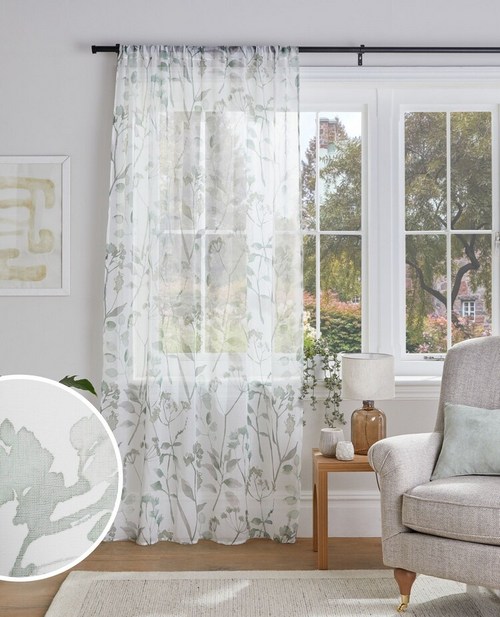
Popular curtain fabrics include chintz, cotton, gingham, lace, organza, and voile. Curtains may be plain, tiered, or ruffled. Short curtains, called café curtains, are often used on half windows in the kitchen or bathroom.
1. Blinds
Blinds are another popular option for window coverings. One of the best features of blinds is that they are available in so many different styles, such as vertical or horizontal, roller, Venetian, blackout, and more. As for the material used, you can choose from plastic, wood, faux wood, fabric, or even metal, which is mainly used in offices.
Generally speaking, blinds are made up of long, separate slats that can be manipulated with the help of a string. Blinds are simple to use, easy to clean, and allow you to control the amount of light that enters a room.
2. Shades
To some extent, shades are also like blinds, especially because they can be manipulated with the help of strings. However, unlike blinds, shades are made of solid material and do not have slats. In other words, shades can only be moved up or down.
You can get shades in a wide range of materials, from polyethylene fabric, which lowers the room temperature while still allowing some light to pass through, to lace, which can brighten up a room and soften harsh daylight.
3. Beaded Curtains
If you are looking for something different in curtains, beaded curtains are an interesting choice. They help create a free, contemporary feel in the overall room décor. The options in which the beads are available are almost unlimited and usually include acrylic, shells, bamboo, gemstones, glass, string, mirror, and other natural materials.
By choosing the right color, type, and design of beads for the curtains, you can complement almost any motif or design theme in the home. They are moisture-resistant and can also be used in bathrooms.
4. Voiles
Voiles are one of the most common types of curtains and are characterized by the lightweight material, most often cotton, used to make them. They suit home décor in tropical countries particularly well.
One of the main advantages of using these curtains is that they can be washed easily and require low maintenance in terms of time, effort, and cost. At the same time, they can be hung easily on rods and poles, lending an artistic quality to the home, along with elegance and class.
5. French Pleat Curtains
The French pleat curtain has triple-pleat sections that are pinched together at the bottom so they spread out at the top. You will need a special curtain rod that is made to keep the pleats together correctly so they do not pull apart. French pleats have a formal appearance when used in living rooms and master bedrooms.
6. Sheers
Sheer curtains can add a very romantic feel to any room. The curtain is see-through, very light, and airy. Sheer curtains also work well when added behind another set of curtains.
7. Tab Top Curtains
Tab top curtains are straight and have tabs at the top that you slide over the curtain rod. The curtain rod shows through the spaces between the tabs. Tab tops are a very casual curtain style, yet they are also versatile.
8. Panel Curtains
Panel curtains are also called rod pocket, pole top, or casement curtains. The panel curtain is a straight curtain that has one or two pockets at the top, and the curtain pole slides through one of the pockets. Panel curtains work well on windows that are not opened often.
9. Café Curtains
Café curtains are commonly used in kitchens where you want to add some color and also create a bit of privacy. They are placed on the inside of the window frame through the mid-section of a window, and a valance can be added to the top.
10. Grommet Curtains
Grommets are holes rimmed with metal or wood that are cut into a flat panel drape. The finish on the grommets, together with the architectural details of a decorative rod, defines the style. These drapes are used without toppers and are most suitable for casual and contemporary décor.
11. Lined and Insulated Drapes
Lining creates fabric stabilization and keeps sunlight from fading the fabric. The amount of light in the room can be controlled by the type of lining. Some drapes use a blackout material as a lining, which allows no light to come through.
Thermal insulated drapes are used in climates that experience severe weather temperatures. An insulated backing acts as a thermal barrier to help buffer extreme temperatures. Sound-insulated drapes are lined with a fabric that inhibits the transference of sound waves, thereby reducing street noise.
How to Measure Curtains Correctly
Measuring up for window treatments should be one of the first steps. For curtains outside the recess, the track or pole needs to be wider than the window frame by 4 in. to 6 in. to allow for stack back. It should be fixed about 4 in. above the top of the window frame and should be horizontal.
Measuring Curtain Width Outside the Window Recess
Measure the width of the track or pole and add any extra for center overlapping, normally about 6 in.
Multiply the track width by 1.5, 2, or 2.5 depending on the heading to be used.
Divide that by the width of the fabric, normally 48 in. or 54 in., and round up to the next whole number to give the number of widths required. If an odd number results, then one width can be cut in half and added to the outside edge of each curtain.
Measuring Curtain Width Inside the Window Recess
Measure the width of the window recess and multiply by 1.5, 2, or 2.5 depending on the heading to be used.
Divide that by the width of the fabric, normally 48 in. or 54 in., and round up to the next whole number to give the number of widths required. If an odd number results, then one width can be cut in half and added to the outside edge of each curtain.
Measuring Curtain Length Outside the Window Recess
For a pole, measure from the bottom of the ring to wherever you wish the curtains to fall.
For a track, measure from the top of the track to wherever you wish the curtain to fall.
For tab top curtains, measure from the top of the pole to the required finished length. Deduct the length of the tabs, approximately 3 in., as the top of the curtain must come above the top of the window frame.
To this measurement add 8 in. to the finished length: 2 in. for the top seam allowance and 6 in. for the bottom hem for lined and unlined curtains with attached heading tape or tab tops.
For lined and unlined curtains with cased headings, add 10 in. to the finished length: 4 in. for the top seam allowance and 6 in. for the bottom hem.
Short curtains should finish 0.5 in. above the sill or radiator, and full-length curtains should fall within 1 in. of the floor.
If patterned material is to be used, then each length has to be a full pattern repeat. For example, with a pattern repeat of 25 in. and a curtain finished length of 54 in., you will need 75 in. for each drop. That is, 54 in. plus 8 in. for hems = 62 in., rounded up to the next multiple of 25 in. (the pattern repeat). Multiply this amount by the number of widths required, and you have the length of fabric required.
To calculate the amount of lining required, if used, multiply the finished length plus hem allowance by the number of widths required. Hem allowance is usually 6 in.: 2 in. for the top seam allowance and 4 in. for the bottom hem. Ignore any adjustments for pattern matching.
Measuring Curtain Length Inside the Window Recess
Measure the length of the window recess. Curtains should finish 0.5 in. above the window sill so they fall correctly.
To this measurement add 8 in. to the finished length: 2 in. for the top seam allowance and 6 in. for the bottom hem for lined and unlined curtains with attached heading tape or tab tops.
For lined and unlined curtains with cased headings, add 10 in. to the finished length: 4 in. for the top seam allowance and 6 in. for the bottom hem.
If patterned material is to be used, then each length has to be a full pattern repeat. For example, with a pattern repeat of 25 in. and a curtain finished length of 54 in., you will need 75 in. for each drop. That is, 54 in. plus 8 in. for hems = 62 in., rounded up to the next multiple of 25 in. (the pattern repeat). Multiply this amount by the number of widths required, and you have the length of fabric required.
For curtains with heading tape or tab tops, calculate the amount of lining required, if used, by multiplying the finished length plus hem allowance by the number of widths required. Hem allowance is usually 6 in.: 2 in. for the top seam allowance and 4 in. for the bottom hem. Ignore any adjustments for pattern matching.
For curtains with cased headings, calculate the amount of lining required by multiplying the finished length plus hem allowance by the number of widths required. Hem allowance is usually 8 in.: 4 in. for the top seam allowance and 4 in. for the bottom hem. Ignore any adjustments for pattern matching.
Popular Drapery Styles
Draperies are window treatments constructed of heavy fabrics that hang straight down, often in the role of a curtain. They may be lined or unlined and are often found in a traditional range of fabrics including chenille, damask, moiré, satin, tapestry, and velvet.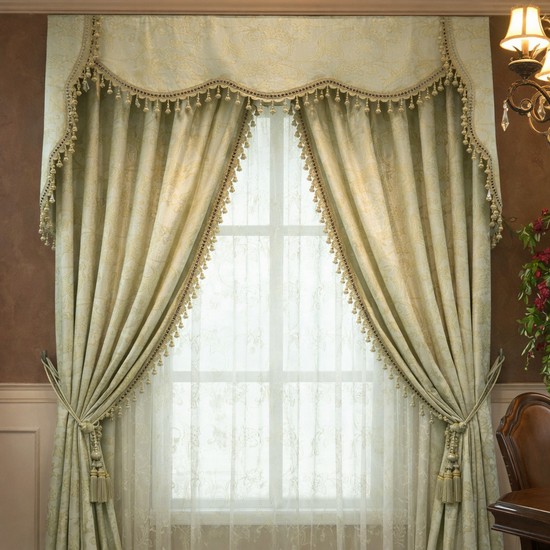
Draperies are often made to hang on a traverse rod, which allows them to open and shut. They can be ready-made in standard lengths or custom-made. A variety of pleating styles is available, including barrel, goblet, pencil, pinch, reverse, and tack pleats.
The word drapery is also a general term. It may refer to cloth used for decorative purposes, such as around windows, or to the retail trade in cloth, originally mostly for clothing.
a) Valance
A valance is a curtain that only partially covers the window. Traditionally, it hangs down one-third to one-half of the way, depending on the size of the window. A valance is typically lined. The lining may be made from the same fabric, a plain lining fabric, or a coordinating fabric. The style of valance can vary greatly. Some valances have scalloped edges, while others have straight bottom edges and may be held open by decorative tassels, ties, or ribbons.
b) Swags
Swags are a simple long length of curtain fabric that is looped over the curtain rod. The number of times the fabric is looped over the rod depends on how many swags are desired. If four swags are required, the fabric must be looped five times. The number of swags needed depends on the width of the window. Narrower windows may need only one swag.
Use a light- to medium-weight fabric if you want to hang swag curtains. This allows the fabric to flow nicely without being too stiff.
c) Panels
A panel can be either a curtain or a drape. If a lighter weight fabric is used, it is normally a curtain. Panel curtains typically use tiebacks that hold the curtains back and allow light to enter the room.
Drapes are made from heavier fabrics and are sometimes held with tiebacks. Drapes are usually more formal than curtains. Both curtains and drapes can be lined or unlined. Lining helps protect the fabric from the harmful fading rays of the sun and also provides a little added insulation if needed.
d) Pinch Pleat Drapes
Pinch pleat drapes are normally made from a fairly heavy material, such as special decorator fabrics or drapery fabrics. Pinch pleats do not have a rod pocket casing. Instead, the fabric at the pleats holds drapery hooks. These hooks are inserted into the pleats of the fabric and then hung on a rod. Pinch pleat drapes can be either lined or unlined.
Curtain and Drapery Hardware
In this curtains and draperies guide, the hardware below is grouped by common use so it is easier to match the right rod or support to the right type of treatment.
- Continental rods are curtain rods that are deeper to add emphasis at the top of the curtain. They are available in two widths: 2½ in. and 4½ in.
- Sash rods have ¼ in. clearance at the ends and are used for shirred curtains on windows and doors. For an hourglass curtain on a door, use a sash rod at the top and bottom.
- Clear plastic rods for sheer and lace curtains do not show through and do not detract from the fabric.
- Single curtain rods are used for rod pocket curtains and stationary window treatments. These rods are available with 2 in. to 5 in. clearance. A special canopy rod has a clearance of 7½ in.
- Double curtain rods consist of two rods with 1 in. difference in clearance to hang a valance and a curtain on the same mounting.
- Ringless decorator traverse rods for pinch pleated draperies have slides concealed in the rod for a clean, contemporary look. The top of the drapery skims the lower edge of the rod.
- Unfinished wood pole sets, plain or fluted, can be painted to match the curtain fabric for a custom touch.
- Decorative traverse rods are cord-controlled to open and close. Draperies are attached to rings that slide on a hidden track. These rods can also be used for layered treatments with underdraperies, curtains, or shades. Top treatments are not necessary because the brass-finished or wood-finished rod is decorative.
- Café rods are used with clip-on or sew-on rings or with casual tab-top curtains. A choice of finishes is available, including brass, enamel, and wood. Café rods and wood pole sets are used for hand-drawn window treatments.
- Spring tension rods are adjustable for inside mounting. Soft plastic or rubber tips hold the rods securely in place without requiring screws or holes. Use a round rod for shower curtains and café curtains, and flat rods for inside window casings and shower curtain valances.
- Conventional traverse rods are used for draperies that open and close with a cord. They can open from the center or either side. Draperies hide the rods when the panels are closed, but these rods can be used with a stationary valance or cornice so the rod is concealed when the draperies are open. These rods also come in sets designed specifically for layered treatment.
- Support brackets should be placed every 12 in. to 20 in., depending on the weight of the draperies. On multi-paneled windows, align brackets with the frame between panels.
- Tie-back holders fit behind the last fold of draperies to prevent crushing and to hold the folds in clean, graceful lines. The projection of the holder can be adjusted from 5 in. to 8 in.
- Holdbacks have projection arms or stems used to hold draperies back from the window.
Best Fabrics for Curtains and Drapes
The choice of fabric determines the appearance, drape, durability, and maintenance requirements of curtains and draperies.
1. Cotton
A natural, plain-woven fabric. It can have a glazed surface, which makes it very practical, hard-wearing, and easy to work with. Cotton is one of the most commonly used window treatment fabrics, so there is a wide choice of pattern and design. It is also very often used for linings, usually in cream or white.
2. Calico
A firm cotton material. It can be bleached or unbleached.
3. Muslin
A very light, loosely woven cotton. These window treatment fabrics are quite sheer, so they are a very good alternative to nets. White is the most common color, but muslin is now available in many different patterns.
4. Linen
A natural fabric made from flax. Heavy-weight linen is most often used for home furnishings and is a good choice for curtains. Linen usually comes in neutral or natural colors and blends very well with other fabrics. The main disadvantage is that it creases easily.
5. Linen Mix
Also called linen union, this is a mix of linen and cotton, or linen and a man-made material such as viscose or nylon. This blend makes the fabric easier to use and handle, and it works very well for curtains.
6. Jacquard
A type of weave rather than a fabric type in its own right. Jacquard fabrics come in different colors, and the pattern shows in relief on the underside of the fabric. Patterns are usually flowers, foliage, or other swirling designs.
7. Chenille
A fabric commonly used in Victorian times for window treatment fabrics and heavy curtains. It is soft to the touch, with a velvet-like texture or pile and a luxurious feel.
8. Velvet
A very soft fabric, but quite heavy and thick. It has a thick brushed pile and a luxurious look, although it can also be bought quite inexpensively. It is commonly used for curtains, especially full-length curtains.
9. Tapestry
Traditionally, this was a real, hand-worked tapestry. Today, the term refers to heavy-weight fabrics with a textured surface and a pattern similar to old-style tapestries.
10. Chintz
A quality cotton fabric decorated with large floral patterns. It works very well for curtains and drapes nicely. Glazed chintz is also available, but the glazed surface can wear over time and crease easily. It is best used in small amounts, mainly for trims.
11. Gingham
A lightweight cotton woven fabric with a pattern of small checks in white and one other color. Red and white is the most common color combination for gingham fabrics. It is a great fabric for relaxed, country-style decorating, kitchens, and Scandinavian-inspired interior design.
12. Brocade
A medium-weight fabric with a raised pattern woven into the material. It can be one color or more than one color.
13. Crewel Work
A material with a plain background and a raised pattern worked in chain stitch in white or colored wools. This has a handmade, traditional, and “crafty” look and works very well in a rustic or country-style decorating scheme. These days it commonly comes from India and has quite an ethnic look and feel.
14. Damask
A medium-weight woven fabric made of linen, viscose, or other materials. It usually comes in just one color, with the design picked out in relief. It makes a very good choice for curtains and cushions, as well as other upholstery. Care should be taken, as this fabric frays very easily.
15. Silk
Silk has a beautiful shiny sheen and a soft feel. It comes in many different weights. Only the heavier weights are suitable for full curtains, and they can be quite expensive, while lighter weights make excellent drapes. If silk is chosen, care must be taken because it marks very easily and is not very hard-wearing in a room that is used regularly. It is definitely best kept for special use.
16. Moiré
Moiré is actually a finish on the fabric. It is most commonly used on silk, but it can sometimes be seen on other fabrics too. The fabric has a rib running across it and, most importantly, a watermark effect in the fabric. It makes very good window treatment fabrics for luxury, formal-style curtains.
17. Satin
A very similar soft, shiny surface to silk, but at a much more reasonable price. It should still be treated gently because it is not very hard-wearing.
18. Sheers
This refers to any window treatment fabrics that are very lightweight and see-through, such as lace, voiles, muslins, and nets. They look great at windows during the daytime because they allow light through. However, they are completely see-through at night when the lights are on inside, so heavier curtains should also be fitted for privacy. Sheer curtains also look very attractive draped around curtain poles or around beds, giving a soft, romantic look.
Conclusion
Choosing the right curtain or drapery style depends on the room, the level of privacy required, the amount of light needed, and the overall design scheme. This curtains and draperies guide shows that good results come from understanding the basic terms, selecting the right hardware, measuring correctly, and choosing suitable fabrics. With the right combination of style, structure, and material, window treatments can be both practical and visually refined.
References
[1] Babu, V. R., & Sundaresan, S. (2018). Home furnishing. CRC Press.
[2] Baker, W. (2009). The Complete Book of Curtains, Drapes, and Blinds: Design Ideas and Basic Techniques for Window Treatments. Macmillan.
[3] Merrick, C., & Day, R. (2007). The Curtain Design Directory. Merrick & Day.
[4] Merrick, C., & Day, R. (2001). Curtain Inspiration: A Source Book of Pictures and Ideas. Merrick & Day.
[5] Hoppen, S. (2009). Perfect Curtains: Smart Solutions, Fabulous Fabrics, and Inspiring Designs. Jacqui Small.
[6] Toʻxtayeva, Z. S., & Odinayeva, N. (2026). The Scientific Basis of Choosing Curtain Fabric in Interior Design. Shokh Articles Library.
[7] Merrick, C., & Day, R. (1996). The Encyclopaedia of Curtains: The Complete Curtain Maker. Merrick & Day.