Introduction
When you shop for shirts, linings, upholstery, or evening wear, the weave often tells you as much as the fiber itself. Woven fabrics are commonly named by features such as weight, fiber type, yarn type, yarn count, fabric count, and color or pattern, so names like denim, velvet, or batiste can quickly signal useful fabric properties. The three basic weaves, plain weave, twill weave, and satin weave, are simple enough to be made on looms with twelve or fewer harnesses, yet they also form the base of many more complex constructions. In weave diagrams, warp yarns are usually shown in black and filling yarns in white, while graph paper can also be used to show which yarns appear on the face of the fabric.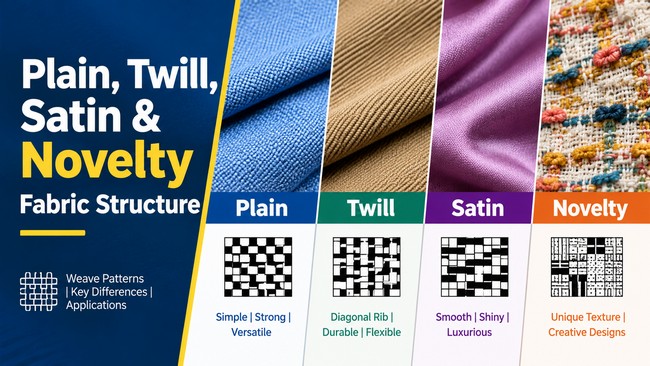
Basic Weaves in Fabric Construction
Plain weave, twill weave, and satin weave are the foundation of woven fabric structure. Each one creates a different balance of appearance, strength, drape, and surface texture. Once these three are understood, many familiar fabric names become much easier to interpret.
Plain Weave Fabrics
Plain weave is the simplest and most common weave. It uses an over one and under one interlacing of warp and filling yarns. If the filling yarn moves over the first warp yarn, under the second, over the third, under the fourth, and so on, the next row begins in the opposite way. The third row then repeats the first, so the structure stays consistent across the cloth.
Plain weave can be made with any type of yarn. When tightly twisted single yarns are placed closely together in both the warp and filling, and the same number of yarns is used in both directions, the result is a durable, simple, serviceable fabric. If the warp is made from a single yarn and the filling from a colorful bouclé yarn, the same basic weave produces a much more decorative cloth.
Plain-weave fabrics can be made from many fibers and in weights ranging from light to heavy. They may be balanced or unbalanced, and decorative effects can come from novelty yarns or yarns of different colors. Many standard fabric types are made in plain weave, and suitable manufactured fibers are now used in many of these familiar constructions.
Lightweight Plain Weave Fabrics
Lightweight plain-weave fabrics may be light because they have a low fabric count or because they are made from fine yarns, and they are usually sheer. Cheesecloth is an open-weave, soft fabric that was originally used in cheese making, where it served as a wrapper or strainer for curds. Crinoline and buckram are heavily sized so they can serve as stiffening fabrics. Gauze has a higher count than cheesecloth and is used in theatrical costumes, medical dressings, blouses, and dresses.
The following high-count balanced plain weaves are made with fine yarns. Chiffon is made from fine, highly twisted filament yarns. Because of the tightly twisted crepe yarns, chiffon has excellent drape, and although it looks delicate, it is relatively durable. It is used for sheer evening dresses, blouses, lingerie, and other dressy apparel. Organdy is a sheer cotton fabric that is given a temporarily or permanently stiffened finish. Organza is a stiff, sheer fabric made of filament yarns. Voile is a soft fabric with a somewhat lower fabric count and higher-twist yarns, and it has a distinctive two-ply warp and good drapability.
Medium Weight Plain Weave Fabrics
Medium-weight balanced plain weaves usually have fairly high fabric counts, contain medium-weight yarns, and are opaque. Their distinguishing features may be design, color, finish, or fabric count. Calico is a closely woven fabric with a small printed design. Chambray fabrics have colored warp yarns and white filling yarns that create a heather appearance, although some contemporary chambrays use warp and filling yarns of different colors. Chintz is printed with large designs and is often given a polished or glazed finish. Solid-color glazed fabrics are called polished cotton.
Gingham is a woven check or plaid design made with yarns of different colors. Muslin, usually woven from cotton or cotton blends, can be sold as bleached or unbleached goods and is normally designated as such. Higher grades are used for sheets and pillow cases. Muslin sheets are made with yarns that are carded only and have a lower thread count, about 125 to 140 total yarns per inch, than percale sheets. Percale is a closely woven plain weave of cotton or blended fibers made from yarns of moderate twist. Percale sheets, made with fine combed yarns and thread counts ranging from 200 to 300 yarns per inch, have a more luxurious feel than muslin sheets.
Heavy Plain Weave Fabrics
Common heavyweight plain-weave fabrics include butcher linen, crash, homespun, and osnaburg. Butcher linen is a plain, stiff, white fabric made from heavy yarn. Crash is made from thick and thin yarns, which gives the cloth a nubby look. Homespun is a furnishing fabric made with irregular yarns to resemble hand-spun and hand-woven fabrics. Osnaburg is made of low-quality cotton for industrial use and for interior fabrics such as curtains and upholstered furniture.
Rib Weave Fabrics
Ribbed fabrics have an unbalanced weave with many small yarns crossing over fewer large yarns. Most unbalanced weaves have a larger number of warp yarns than filling yarns, which forms a crosswise rib. The ribs may be fairly small or quite pronounced. Corded fabrics can be created by grouping yarns together in one direction before they are crossed by yarns in the other direction, or by using large yarns at intervals.
Bengaline and ottoman are heavyweight fabrics with large ribs and are used mostly in upholstery and other home furnishings. Broadcloth is a medium-weight unbalanced plain weave with fine ribs. The rib weave makes it crisper than medium-weight balanced weaves. It is often made from cotton or cotton blends and is seen in shirts and blouses. Poplin is a heavier-weight rib weave than broadcloth and is usually made from cotton or cotton blends. Faille has a prominent rib and is made with fine filament yarns in the warp and heavy spun yarns in the filling. It is usually heavyweight, although lighter-weight tissue failles are also made.
Grosgrain has very prominent ribs and is usually woven in narrow widths for ribbons. Shantung has a nubby, irregular rib in the filling. It was formerly made almost exclusively of silk, but it is now made from a variety of manufactured fibers as well. Taffeta is a medium-weight weave made from filament yarns and is often used for evening wear. Bedford cord is a sturdy fabric with a pronounced lengthwise cord. Dimity is a sheer cotton fabric that is often made with a lengthwise cord effect, and some dimity fabrics use larger yarns in both the warp and filling directions to create a checked, or barred, effect.
Basket Weave Fabrics
The basket weave is a variation of the plain weave that uses two or more warp yarns and or two or more filling yarns side by side as one yarn. The resulting cloth is fairly loose in weave. Basket weaves are not as durable as regular plain weaves because the yarns are easier to pull out of the structure. At the same time, they are more flexible than other plain weaves because the interlaced structure is not as tight.
Basket weaves are usually designated by the number of yarns that are interlaced side by side. For example, a fabric with two warp yarns interlaced together over and under two filling yarns would be called a 2-2 basket weave. The warp and filling directions can have the same or different numbers of yarns in the interlacing pattern.
Monk’s cloth is a coarse cloth made of large yarns. It uses four or more yarns as one in both directions of the weave, and its main uses are in household textiles such as curtains, spreads, and similar goods. Hopsacking is made of many different fibers. It simulates the fabrics used in bags for gathering hops, has a 2-2 or 3-3 basket weave, and is commonly used in upholstery. Oxford cloth is an uneven basket weave with a 2-1 or 3-2 interlaced structure. It is a soft fabric, often made of cotton or cotton blends, that is used for shirts. It is frequently made with narrow colored stripes in the warp or with a colored warp.
Other Plain Weave Fabrics
Duck and canvas are heavy, tightly woven, and very stiff plain-weave fabrics made of even yarn for industrial use. They usually have an uneven weave pattern. Because of the tight weave, these fabrics are often used for outdoor purposes.
Twill Weave Fabrics
Twill fabrics are easy to recognize because of the diagonal lines that the weave creates on the surface of the cloth. Since there are fewer interlacings, the yarns can be spaced closely together, packed tightly, and held firmly in place. As a result, twill fabrics are usually strong and durable, and they are also supple and drape well. Most twill-weave fabrics are made in bottom weight. Their compact structure helps them shed soil readily, although when they become soiled, they may be difficult to clean. Depending on construction, twill fabrics generally show good resistance to abrasion. They are often used for tailored garments, especially those made of worsted wool yarns.
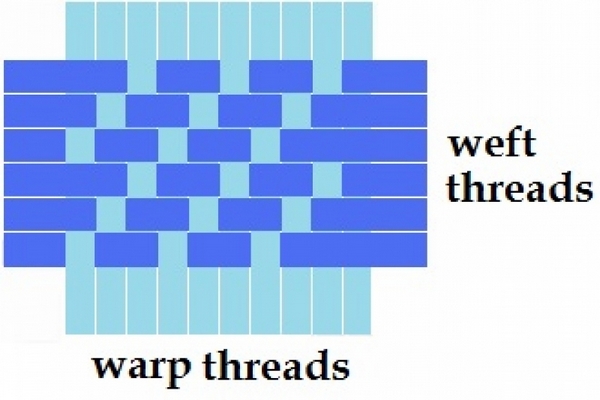
The simplest twill weave is made by having the warp yarn cross over two filling yarns, then under one, over two, under one, and so on. In the next row, the sequence starts one yarn down. The area in which one yarn crosses over several yarns in the opposite direction is called a float. The lines created by this pattern are called wales. When the cloth is held in the position in which it was woven, the wales will run either from the lower left corner to the upper right corner or from the lower right corner to the upper left corner. If the diagonal runs from lower left to upper right, the twill is called a right hand twill. Most twill fabrics are right hand twills. If the diagonal runs from lower right to upper left, the twill is called a left hand twill.
There are several types of twill weave, but all use the same principle of crossing more than one yarn at a regular, even progression. Twills are described by notations such as 2/1, 2/2, or 3/2. The first number refers to the number of filling yarns crossed over by the warp, and the second number refers to the number of filling yarns the warp passes under before returning to cross the filling again. In simpler terms, it shows the sequence of warp up and warp down. When the crossing is over and under the same number of yarns, the fabric is called an even or even sided twill. When the warp passes over a larger or smaller number of filling yarns than it passes under, the fabric is called an uneven twill.
Even Sided Twill Fabrics
The even sided twill has the same number of warp and filling yarns showing on the face of the fabric. Even sided twills are reversible unless they are printed or finished on one side. Serge is a basic twill fabric that was traditionally made of solid-colored worsted wool yarns and was often used for men’s suits. It tailored well, but it tended to become shiny with wear. Surah is an even sided twill made with filament yarns. Silk surah, often printed, is used in scarves, ties, and blouses.
Flannel, if made of wool, is a twill weave with a brushed fuzzy finish. Cotton flannels are also brushed, but they are not usually twill weaves. Plaids or tartan patterns are yarn-dyed even sided twills. In a herringbone twill, the direction of the twill reverses itself to form a broken diagonal that appears like a series of Vs, and herringbone patterns create a decorative effect. Herringbone twills are common in suiting fabrics.
Warp Faced Twill Fabrics
Warp-faced twills have a predominance of warp yarns on the surface of the fabric, with patterns of 2/1, 3/1, 3/2, and so on. Denim is a durable, heavyweight twill with colored warp yarns and white filling yarns. Because it is a warp-faced twill, the colored warp yarns are predominant on the face and the white filling yarns are on the back. Most often the warp yarns are indigo dyed, which creates the familiar blue jeans fabric. Drill is another heavyweight fabric, usually in a solid color. Jean is a lighter-weight twill, usually with colored warp yarns and white filling yarns. Gabardine is durable and closely woven. It is made in a variety of weights from both natural and manufactured fibers and is used in tailored garments, pants, and slacks. Cotton and cotton-blend warp-faced twills are common for men’s and women’s casual pants.
Filling Faced Twill Fabrics
Filling-faced twills have a predominance of filling yarns on the surface of the fabric. Filling yarns are generally weaker than warp yarns, so relatively few filling-faced twills are made.
Twill Angle and Fabric Strength
When the face of a twill fabric is examined, the diagonal of the wales will be seen to move at a more or less steep angle. The steepness of that angle depends on two factors in the construction of the fabric, the number of warp yarns per inch of fabric and the number of steps between movements of the yarns when they interlace. The more warp yarns in the construction, the steeper the angle of the wales will be, provided that the number of filling yarns per inch stays the same. This is because the points of interlacing are closer together, so the diagonal of the wales makes a steeper climb upward. When the steepness comes from close spacing of warp yarns, these steeper angles indicate good strength.
If the angle that the wale makes with the filling yarn is about forty five degrees, the fabric is a regular twill. Fabrics with higher angles are steep twills, while those with smaller angles are reclining twills. Generally, the interlacing of yarns in a twill changes with each filling yarn. However, some fabrics change only every two filling yarns or every three filling yarns. The less often the interlacing changes, the steeper the angle of the twill becomes.
Satin Weave Fabrics
Satin-weave fabrics are made by allowing yarns to float over a number of yarns from the opposite direction. Interlacings are made at intervals such as over four, under one, using five harnesses; over seven, under one, using eight harnesses; or over eleven, under one, using twelve harnesses. Harnesses are also called shafts, so these satin fabrics may be called five shaft satin, eight shaft satin, or twelve shaft satin. Floats in satin fabrics may cross from four to twelve yarns before interlacing with another yarn. No pronounced diagonal line appears on the surface of the fabric because the points of intersection are spaced so that no regular progression forms from one yarn to the next.
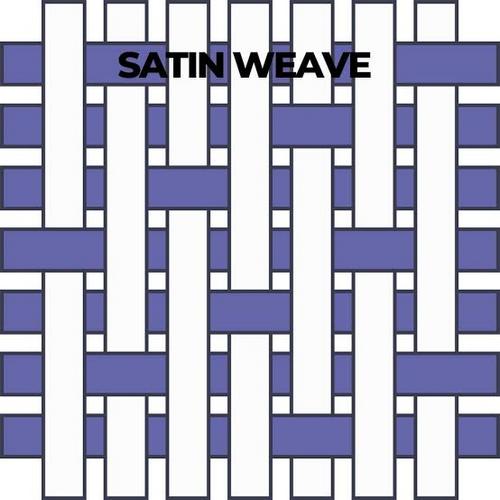
When warp yarns form the floats on the face of the fabric, the cloth is a warp-faced satin. When filling yarns float on the face, the cloth is a filling-faced satin. Satin-weave fabrics made from filament yarns are called satins, while those made from spun yarns are called sateen. Most warp-faced weaves use filament yarns because filament yarns do not require a tight twist to serve as warp yarns. Cotton, being a staple fiber, must be given a fairly high degree of twist if it is to serve as a strong warp yarn. For that reason, sateen fabrics are usually filling faced, although some warp sateens are made.
Satin-weave fabrics are highly decorative. They are usually made from filament yarns with high luster to produce a shiny surface and tend to have high fabric counts. They are smooth and slippery in texture and tend to shed dirt easily. The long floats on the surface are subject to abrasion and snagging, and the longer the float, the greater the chance of snags and pulls. Satins are often used as lining fabrics for coats and suits because they slide easily over other fabrics. The durability of satin-weave fabrics depends on the density of the weave, with closely woven, high-count fabrics showing good durability. Satins made from stronger fibers are, of course, more durable than those made from weaker fibers.
Common satin names include antique satin, peau de soie, slipper satin, and crepe-backed satin. Antique satin is made to imitate silk satin of an earlier period and often uses slubbed filling yarns for decorative effect. It is used for draperies, upholstery, and formal wear. Peau de soie is a soft, closely woven satin with a flat, mellow luster. Slipper satin is a strong, compact satin that is heavy in weight and is often used for evening shoes. In crepe-backed satin, loosely twisted, lustrous warp yarns are combined with tightly twisted, creped filling yarns. The floats on the surface are created by the warp, so the face of the fabric is mostly made up of warp yarns with a satin appearance, while the back of the fabric is made up largely of tightly twisted filling yarns that produce a crepe or rougher surface texture with a flatter, less shiny appearance.
Novelty Fabrics and Fabric Effects
Novelty effects in fabrics are often the result of choosing novelty yarns for use in one of the basic weaves. That simple decision can change the look and feel of a cloth more than people sometimes expect.
Crepe Fabrics
Crepe fabrics are characterized by a crinkled, pebbly surface. Originally, crepe fabrics were made from crepe yarns, meaning yarns with an exceptionally high degree of twist, up to sixty five turns per inch. Most standard crepe fabrics were made in plain weave, some with rib effects, and some in satin weave, as in crepe-backed satin. With the arrival of synthetic fibers, many crepe effects are now achieved through textured yarns or by embossing or stamping a crepe-like texture on the surface of the fabric. Most fabrics made from these newer processes will be durable only if they are made from heat-treated thermoplastic fibers.
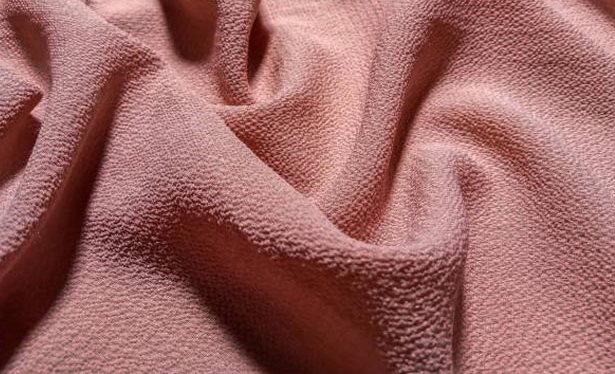
Another common method uses a special crepe weave that breaks up the surface of the cloth into a random sequence of interlacings. Also called momie or granite weaves, these fabrics are popular in many women’s dress fabrics and in table linens.
Seersucker Fabrics
Seersucker is another plain-weave fabric. It is created by holding some warp yarns at tight tension and some at slack tension. When the filling yarns are beaten up, the warp yarns under slack tension puff up to form a kind of blister effect. Seersucker surface effects are permanent. Often the slack and tight yarns are each made from a different-colored yarn to provide a decorative striped effect.
Seersucker should not be confused with fabrics that have puffed effects created by chemical finishes, such as plissé or embossing, which are much less durable.
Conclusion
Plain weave, twill weave, and satin weave form the core of woven fabric structure, and each one creates a different balance of appearance, strength, and hand. Balanced plain weaves cover many everyday uses, while rib and basket variations change the texture and stability of the cloth. Twills add diagonal movement, strength, and drape, and satins bring a smoother, more lustrous surface with longer floats. Crepe fabrics and seersucker show how the same basic foundations can produce very different surface effects. Once you can spot the interlacing, you can start reading woven fabrics with much more confidence.