Introduction
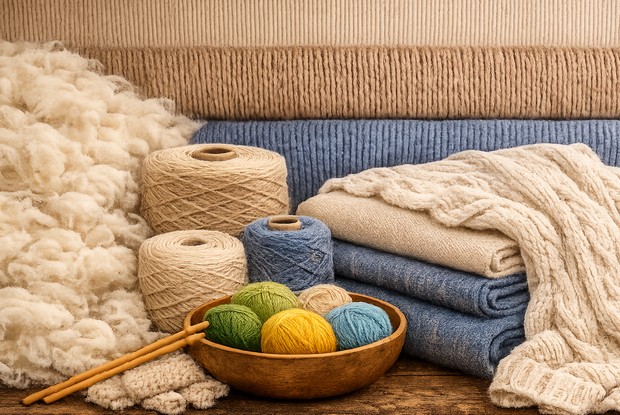
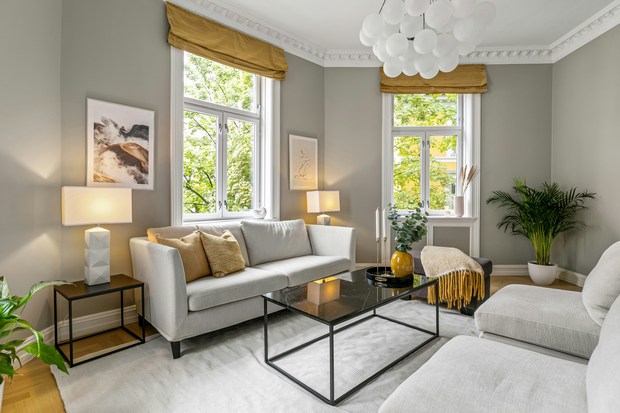
Look around an interior space and textiles are everywhere, from carpets and curtains to coverlets, pillows and decorative pieces. Interior textiles can be made from natural, synthetic, man-made and inorganic fibres, and they appear as yarns, woven fabrics, knitted fabrics and nonwoven fabrics. The chemical structures and properties of these fibres are the same as those used in clothing and technical applications, but in interiors the focus is on wear, light, heat and cleaning performance. The most common synthetic fibres in this field are polyamide, polyester, polypropylene, polyethylene, acrylic and flame-resistant fibres such as meta-aramid and polyamide-imide.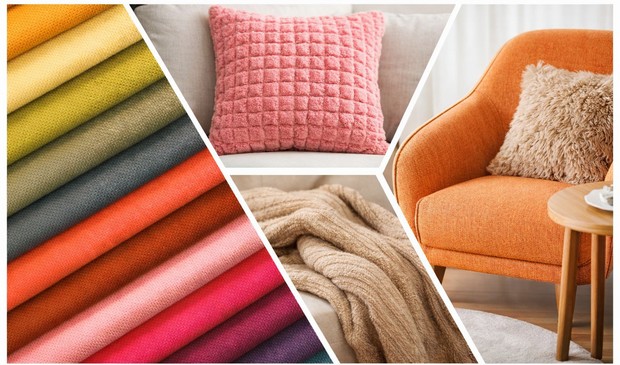
Synthetic fibres for interior textiles are misunderstood, underestimated, and in some cases, genuinely overrated in ways the industry rarely admits. So let’s go through them properly, fibre by fibre, with the honest picture of what each one actually delivers in a real home or commercial interior.
Why Synthetic Fibres Dominate Interior Textiles
Natural fibres have the romance. Linen curtains, wool rugs, cotton throws: they photograph well and sell the dream. Synthetic fibres won their place in interiors for a simple reason: they solve everyday problems well. Besides, synthetic fibres do the heavy lifting. They resist fading, withstand cleaning chemicals, hold their shape through years of use, and cost significantly less to produce at scale. For retailers sourcing across global markets, that reliability matters enormously.
In the USA and Australia, polyester and nylon (polyamide) dominate the residential carpet and upholstery market. In the UK and across northern Europe, there is a stronger lean toward blended fabrics, where synthetic fibres are mixed with wool or cotton to balance performance with the feel of natural materials. Neither approach is wrong. They reflect different priorities: Americans and Australians tend to favour durability and easy maintenance, while European consumers often place more weight on hand feel and sustainability credentials.
The six synthetic fibres that matter most for interior applications are polyamide, polyester, polypropylene, polyethylene, acrylic, and meta-aramid. Each has a defined role, a real set of advantages, and limitations that manufacturers do not always put on the hangtag.
Still, they are not perfect. Some trap heat, some pill, some create static, and some feel less natural than wool or cotton. Most people overlook this early on, and it costs them later.
Main Synthetic Fibre Types and Their Best Uses in Interior Textiles
Polyamides
Polyamide has long been one of the key synthetic fibres in interior textiles. In 1935, W. H. Carothers at DuPont in the USA produced the first polyamide, nylon 6.6. Its first intended use was as a synthetic replacement for natural silk. Use increased sharply during World War II, and during the rest of the 20th century Nylon became the common name for polyamides.
Polyamides are linear macromolecules containing amide groups (–CO–NH–) at regular intervals. The type of polyamide depends on the monomers, which differ by the number of carbon atoms they contain. Common types include PA 4.6, PA 6, PA 6.6, PA 7, PA 11 and PA 12. The most widely used polyamides worldwide are PA 6, known as Kapron in Russia, and PA 6.6.
PA 6 is made by polymerising caprolactam to polycaprolactam. PA 6.6 is made by condensation polymerisation of hexamethylene diamine and adipic acid, through the intermediate PA salt, to poly(hexamethylene adipamide). PA 6 melts at about 215 °C, with a glass transition temperature of 40 °C, while PA 6.6 melts at about 250 °C and has a glass transition temperature of 50 °C. The tensile strength of polyamides is up to approximately 80 cN/tex, and elongation at break is about 25%. They are light, with a density of 1.14 g/cm3, and are abrasion-resistant, which is why they are especially popular in carpet manufacturing.
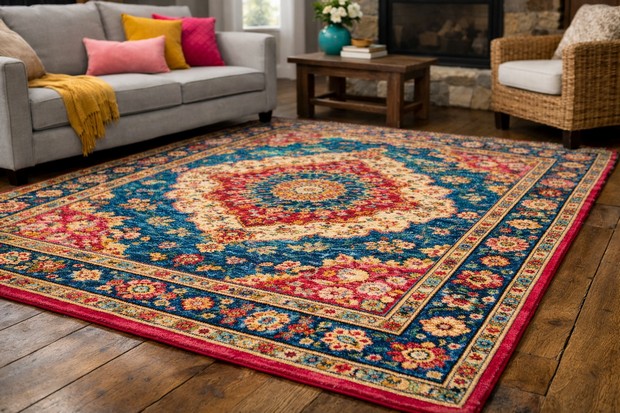
Blended polyamide and wool yarns are also used for carpets, and even up to 20% polyamide in the blend can improve the dynamic properties of woollen yarns and increase carpet durability. Polyamides are less suitable for curtains because they have low resistance to sunlight. They are also not highly resistant to concentrated mineral and organic acids, although they do resist alkalis. Because they are colourless and easy to dye, they are also used for decorative goods, usually as multifilament yarns in woven or knitted fabrics. They can be dyed on the surface or in a molten state, printed easily, and they have excellent wear characteristics, but they tend to stain easily because of the dye sites on the fibre.
Polyester
Polyester followed a different development path and is now one of the most widely used synthetic fibres for clothing and interior textiles. Polyester fibres (PES) are made from polyethylene terephthalate, or PET. PET was first invented as a plastic in W. H. Carothers’ laboratory in the 1930s, but work slowed after the discovery of nylon. In 1939, British scientists J. R. Whinfield, J. T. Dickson, W. K. Birtwhistle and C. G. Ritchie resumed the work and, in 1941, created the first polyester fibres, called Terylene. In 1946 DuPont bought the rights and developed Dacron, and in 1951 polyester entered the textile and clothing market. Later, other polyester fibres appeared, including Kodel, Trevira and Lavsan.
Polyester contains ester –COO– functional groups, which is why it takes its name. A benzene ring with two ester groups makes a terephthalate group, and together with an ethylene group it forms PET. Polyester is not especially light, with a density of 1.38 g/cm3, and its melting temperature is about 250 °C. Different fibres have different properties, but two widely used types are high strength and medium strength polyester. High strength polyester has a breaking force of about 60 cN/tex and an elongation at break of about 10%, while medium strength polyester has a breaking force of about 40 cN/tex and an elongation at break of about 15%.
High strength polyester is sometimes called technical polyester and is widely used for technical applications, though it is also used for interior textiles, usually as multifilament yarns. Medium strength polyester is mainly used for spun and textured yarns and is very widely used in both clothing and interior textiles. Polyester is used in woven, knitted and nonwoven fabrics. It resists acids, alkalis and sunlight, which makes it popular for curtains, coverlets, pillows and decorative interior textiles.
Trevira CS is used for interior textiles that need higher flame resistance. With an LOI of 28%, compared with 20% for other polyesters, it is often called a flame-resistant polyester and is used for curtains and upholstery. Even so, its thermoplastic nature means that it will start to melt at high temperature.
Polypropylene
Polypropylene (PP) belongs to the polyolefin group. Polyolefin fibres were introduced in 1966, and the two widely used fibres in this group are polypropylene and polyethylene. The molecular formula of polypropylene is (C3H6)n. It is a very light polymer with a density of 0.95 g/cm3 and a very low melting temperature of about 160 °C. Its tensile strength is approximately 60 cN/tex and its elongation at break is about 20%.
PP is highly abrasion-resistant, so it is widely used in upholstery. In upholstery, woven polypropylene is used in spun, textured or multifilament yarn form, and microfilament polypropylene is especially popular because it gives fabrics excellent handling properties. It is also used in carpet manufacturing, especially for bump yarns, where multifilament yarns are normally used. Polypropylene is highly resistant to acids and alkalis, but it has very low resistance to sunlight.
Polyethylene
Polyethylene fibres (PE) also belong to the polyolefin family, and their chemical structure, (C2H4)n, is close to that of polypropylene. Like polypropylene, polyethylene is a very light polymer with a density of 0.95 g/cm3 and a low melting temperature of about 150 °C. Two widely used types are high strength and low strength polyethylene. Low strength polyethylene has a tensile strength of about 40 cN/tex and an elongation at break of about 20%, while the properties of high strength polyethylene are very different.
High strength polyethylene is produced by increasing crystallisation and changing the orientation of the molecular chains in the direction of the fibre axis. In theory, it has been possible since the 1930s, but it was first created only in 1979 by DSM in the Netherlands, which has manufactured it under the trade name Dyneema since 1986. Its strength is up to 370 cN/tex, while elongation at break is only 3.5% for Dyneema SK 76. Similar fibres, called Spectra, are produced by Honeywell in the USA; Spectra 2000 has a strength of 340 cN/tex with an elongation at break of less than 3.0%. In interior textiles, polyethylene, like polypropylene, is usually used in carpet manufacturing, especially for bump yarns.
Acrylic Fibres
Acrylic occupies a slightly different place because of its wool-like handle. Acrylic fibres, or polyacrylonitrile (PAN), were first made in 1941 by DuPont in the USA and trademarked Orlon. Just one year later, in 1942, acrylic fibres were also made in Germany, but commercial manufacture started only in 1950. They are produced from acrylonitrile, which was first made in Germany in 1893. Today the trade names include Acrilan, Creslan, Dolan, Filana, Pil-Trol and Inova. The linear chain molecule is built from repeating units of CH2CHCN.
Acrylic fibres have a high crystalline morphology, a very high melting temperature for a thermoplastic fibre of about 320 °C, and a glass transition temperature of 90 °C. They are light, with a density of 1.18 g/cm3, and have a tensile strength of about 40 cN/tex with an elongation at break of about 20%. Their wool-like handle is one of their strongest points: they are soft, warm, and resistant to light and chemicals. For that reason, acrylic is used for drapes, fur imitation, carpets and other decorative interior textiles. Some modified acrylic fibres have high anti-pilling or flame-resistant properties, but their thermoplastic nature can still limit where they can be used.
Flame-Resistant Fibres
When fire performance becomes the priority, the fibre choice changes. Flame-resistant fibres are used in interior textiles for curtains and upholstery, and they also have a place in specialist carpet manufacturing. It is not only synthetic fibres that are used for fire-resistant interiors; natural wool and cotton fabrics with special flame-resistant finishes are also widely used. FR Wool and FR Cotton, where FR stands for flame resistant or flame retardant, are very competitive, especially for interior textile applications. Among synthetic flame-resistant fibres, meta-aramid and polyamide-imide have the largest application.
Meta-aramid
Meta-aramid, or poly(m-phenyleneisophthalamide), was first created by DuPont in the early 1960s and called Nomex. Later, other meta-aramids were developed, including Conex in Japan by Teijin and Fenilon in the Soviet Union. Nomex and Conex remain the most widely used.
Meta-aramid belongs to the aromatic polyamide, or aramid, group. In its structure, the meta-phenylene groups attach to phenyl rings at the 1 and 3 positions. It is a high-temperature-resistant fibre with a decomposition temperature of about 500 °C and very long-term stability at 200 °C. It is not thermoplastic and does not melt, which broadens its field of application compared with flame-resistant polyester or flame-resistant acrylic. The limiting oxygen index is high, at 30 to 32 depending on the modification. Its density is 1.38 g/cm3.
Meta-aramid does not have high tenacity and has a low modulus, although its initial modulus is very close to that of high-strength fibres such as para-aramid, for example Twaron and Kevlar. Its breaking strength is about 40 cN/tex and elongation at break about 20%, but at 20 cN/tex, which is 50% of breaking strength, the elongation is less than 5%. It has high resistance to acids, alkalis and ageing, even in sunlight. Because of this, it is very popular for interior textiles in chemical laboratories and other rooms where chemicals are used. Its main use, however, is in flame-retardant and flame-resistant textiles for interiors.
Polyamide-imide
Polyamide-imide is usually grouped with the meta-aramids, but its chemical structure differs slightly because it has an imide group. Kermel fibres from Rhône Poulenc, France, are the most widely produced in this group. Their properties are very close to those of meta-aramid, and their application in interior textiles is the same.
You may also like: Natural Fibers in Interior Design: Benefits & Uses
Buying Tips from the Trade
If you are choosing fabric for your own home, start with the problem you want the textile to solve. Is it sunlight? Spills? Heavy use? Softness? Safety? Once that is clear, the fibre choice becomes easier.
Look beyond the fibre name and ask how the fabric is constructed. A tightly woven polyester can perform very differently from a loose decorative polyester. The same is true for polypropylene and polyamide. Finish, weave, pile, and backing all affect the final result.
Also, do not buy upholstery by sight alone. Touch it. Sit on it. Scrunch it. A fabric can look elegant on a sample board and behave very differently on a sofa. That is one of the oldest lessons in the trade, and one that still gets ignored.
Conclusion
Synthetic fibres have become central to interior textiles because each type offers a different balance of strength, appearance, durability and heat resistance. Polyamide is valued for abrasion resistance and carpet durability, polyester for easy care and sunlight resistance, polypropylene and polyethylene for carpet and upholstery use, and acrylic for its soft, wool-like handle. When flame resistance is needed, meta-aramid and polyamide-imide extend the options for curtains, upholstery and specialist carpets. As interior textile requirements keep changing, fibre selection will remain a practical balance between performance, appearance and safety.