When a project calls for upholstery, drapery, or carpet, the fiber behind the fabric matters as much as the color or pattern. Each fiber brings its own strengths and weaknesses, so there is rarely one perfect choice for every installation. Designers often have to balance aesthetics, durability, cleaning, code requirements, and cost at the same time. That makes knowledge of interior textile fibers a practical part of interior design work.
Fiber Qualifications for Interior Design
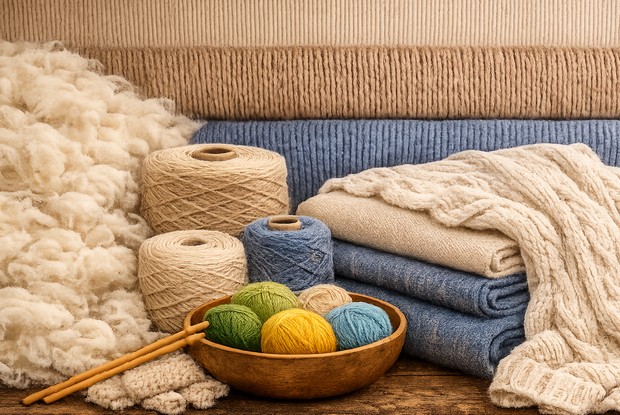
Throughout history, and until the mid-nineteenth century, the only fibers available for interior furnishing fabrics were natural fibers. Of the dozens of tested and usable natural fibers, only a few have proven suitable for decorative fabrics. These are the natural cellulosic fibers, especially cotton and linen, along with some lesser-used textiles, and the natural proteins, silk, wool, and leather. These natural fibers and fabrics have been in use for thousands of years.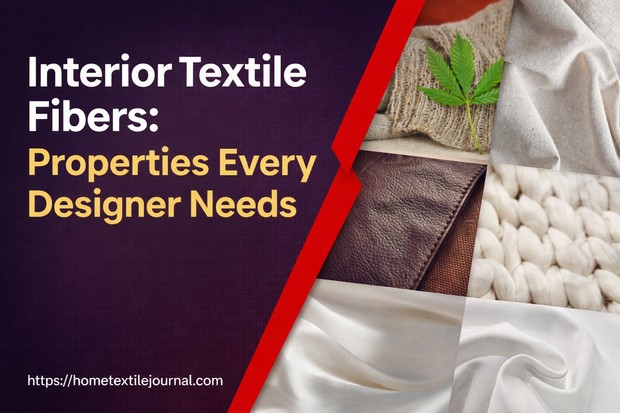
Over the past 150 years, since the beginning of the Industrial Revolution, research and development have opened up an impressive range of engineered or manufactured textiles. Fiber manufacturers now invest millions of dollars annually in research and development for existing and new fibers. The term generation is often used to distinguish a manufactured fiber with a new feature. Chemical and mechanical improvements continue to be made, and the quality of natural fiber production is also deliberately improved.
Textile Science and Why It Matters
Textile science is the chemistry, composition, and manufacture of textiles. Many interior design professionals would rather focus on the visual side of the work, but some understanding of textile science is essential. How deeply a designer uses this knowledge depends on the direction of the career path.
Textile science is often expressed in the language of chemical engineers or in simpler terms that are easier for business and design professionals to use. Since interior designers usually lean toward the second group, a more practical format is often the better fit. That kind of approach is useful when deadlines are tight and fiber selection has to be made quickly.
What Makes a Fiber Usable?
Fibers vary in composition, structure, and inherent characteristics. That matters because the composition of the fiber determines its physical structure, which in turn affects the yarn and the fabric made from it. For interior textile fibers to be viable yarns, six qualities must be present.
- Length-to-width ratio: The fiber must be at least 100 times longer than its width, written as 100:1. In practical terms, fibers must be longer than 1/4 inch, or 1.5 cm, to be usable.
- Uniformity: Fibers must be relatively uniform along their length and from yarn to yarn so they can accept dyes evenly and remain spinnable and flexible.
- Strength or tenacity: Strength is the ability to withstand the pressure of spinning and textile construction. Manufactured fibers are tested and assigned a denier unit, which is a yarn measurement equal to the gram weight of 9,000 meters of yarn. The minimum fiber tenacity is 2.5 grams per denier, although other characteristics, such as resilience or elasticity, may make up for a low gpd and still allow the fiber to function as a textile yarn. Separate count systems are used for natural fibers, and efforts are under way to simplify this situation.
- Pliability or flexibility: Pliability is the ability of fibers to bend without breaking, resist crushing, and drape well.
- Cohesiveness or spinnability: Cohesiveness is a fiber’s ability to be spun into yarn and hold together as the fibers twist and interlock. Fibers with slightly irregular shapes hold together in shorter staple form, while long, smooth filaments are spinnable because of their length.
- Absorption: Absorption is a fiber’s ability to take up water or oil. This quality makes a fiber better suited, or less suited, to a given use. Hydrophilic fibers are water loving and hold water easily, so they respond well to wet cleaning. Hygroscopic fibers absorb significant amounts of moisture without feeling wet. Hydrophobic fibers reject water. Oleophilic fibers are oil loving and readily absorb oil. They respond well to solution or dry cleaning, and sometimes to wet cleaning. If heat is applied before an oil-based stain is removed, the stain may set permanently and become impossible to remove.
Inherent Fiber Characteristics for Interior Textiles
The categories below are often compared when major interior fibers are evaluated. They help designers judge how a textile will perform in use, not just how it looks in the sample.
Durability and Handling
- Abrasion resistance is the ability of a fiber to resist deterioration or thinning of yarns through rubbing or foot traffic.
- Dimensional stability is the ability of a fiber to remain stable. It is the resistance of draped fabric to sagging or hiking as humidity changes, and the resistance to stretching in upholstery.
- Drapability is the ability of a fiber to hang in a gentle, fluid, and workable way.
Color and Surface Appearance
Colorfastness is the resistance of a dyed or printed fiber or textile to fading from prolonged sunlight exposure or artificial light. Colorfastness is measured by a device called a fadometer, which simulates accelerated exposure to sunlight. The results are measurable and are used to meet architectural specifications. Gas fading is the change in dyestuff color caused by impurities in the air. Brighter and darker colors generally fade faster than light colors or neutrals. Colors may also fade inconsistently, which means one part of the dye system fades faster than another. In a blue-green dye, for example, the blue may fade faster so the green becomes dominant. Crocking is the wet or dry transfer of color from a textile, and it matters especially in seating fabrics.
Cleaning and Stain Response
- Absorbency is the ability of a fiber to absorb water without damage to the fabric. A fabric with good absorbency is more likely to release soil during wet cleaning, although it may be less dimensionally stable in humid environments.
- Grease or oil reactivity is the fiber’s ability to resist staining or damage from grease or oil substances.
- Moisture reactivity is the level of damage incurred when a fiber is exposed to humidity or water, such as during floods or spills.
- Solvent reactivity is the level of potential damage caused when a fiber is exposed to solvents or cleaning agents.
Resistance to Environmental Exposure
- Acid reactivity is the level of resistance to damage caused by acids.
- Alkali reactivity is the level of resistance to damage caused by alkalis.
- Flame resistance is the inherent resistance to combustion and sustained burning, along with the ability to self-extinguish.
- Heat sensitivity is the level of damage a fiber sustains from prolonged exposure to heat, such as in a heavily sunlit environment or from clothes dryers and irons.
- Microorganism and insect reactivity is the degree to which a fiber supports or resists microorganism or bacteria growth, which can destroy the fabric and create a health and safety issue. It also describes the susceptibility or resistance to insects that eat the fiber.
- Sunlight reactivity is the damage a fiber suffers from deterioration caused by ultraviolet rays and heat together.
Choosing the Right Fiber for the Job
The suitability of a fiber as an interior textile is both simple and complex. In some residential applications, the fabric simply needs the right aesthetics, color, pattern, texture, and price point. Those are fairly direct decisions. In nonresidential or commercial design, many more characteristics must be weighed before a fabric is considered acceptable for a specific use.
When selecting interior textile fibers for commercial spaces, the performance demands become stricter. These decisions often involve code requirements for user safety and product durability. For example, a carpet in a commercial, heavy-use area must meet flammability codes, resist pilling and crushing, and remain aesthetically durable for several years. It must also be affordable. If sustainability is part of the brief, the carpet must be recyclable or biodegradable, or it must be a component carpet whose tiles or squares can be replaced when worn without replacing the entire carpet. Relatively few fibers meet these specific performance standards.
That is why the designer’s task is so demanding. The goal is to find fabrics or carpets that meet performance requirements, cost limits, and aesthetic coordination for the given interior application. Since every natural and manufactured fiber has both unique positive characteristics and inherent limitations, the professional who understands these characteristics can make appropriate selections with confidence.
Conclusion
There is no single fiber that works perfectly in every setting. Natural fibers such as cotton, linen, silk, wool, and leather remain important, while manufactured fibers continue to evolve through ongoing research and development. A clear understanding of interior textile fibers helps designers match fiber properties with the needs of the installation, whether the priority is appearance, durability, cleaning, safety, or sustainability. With that knowledge, better textile choices become much easier to make. As fiber development continues, that understanding will only become more useful in practice.