Introduction
In homes, hotels, public areas, and places of worship, carpets still shape both comfort and appearance. The earliest floor coverings were made from animal skins, and later versions used grass, cotton, jute, wool, mohair, and goat hair. Nearly all fibres that can technically be turned into yarn are now used in handmade and machine-made carpets, while man-made fibres have gradually taken a larger share in machine production. The homemaker has long combined art with function, and carpet is one of the clearest examples of that balance. This guide makes a modest attempt to classify the main types of carpets in a practical way.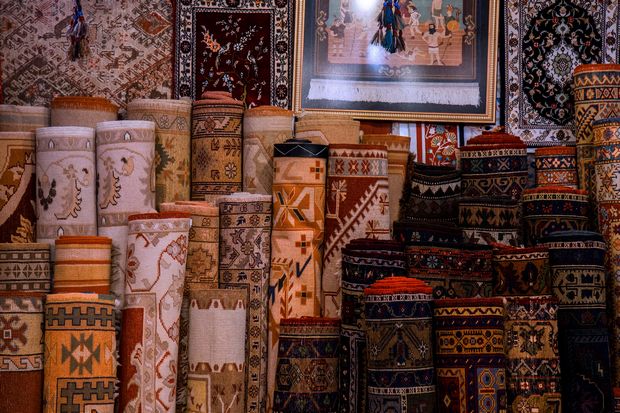
Handmade Carpet Types
What Are Handmade Carpets?
All such carpets are knotted, woven, tufted, hooked, or embroidered by hand. They are made primarily in Asian and European countries and can be categorised into several forms.
Flatweave Rugs
Flatweave is the simplest form of rug weaving, with mostly two dimensions: warp and weft. Such rugs are known as dhurie, kilim, sumac, and nomadic rugs, among others. Different types of horizontal and vertical looms, tools, and weaving methods are used to make them. The basic weaving difference lies in two methods. One uses a shuttle to insert the yarn as weft, and the other inserts yarn with the fingers and then sets it by a manual device called a punja.
Hand-Knotted Rugs
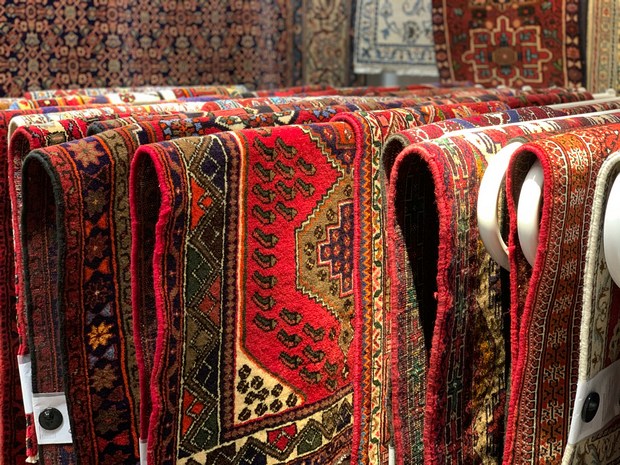
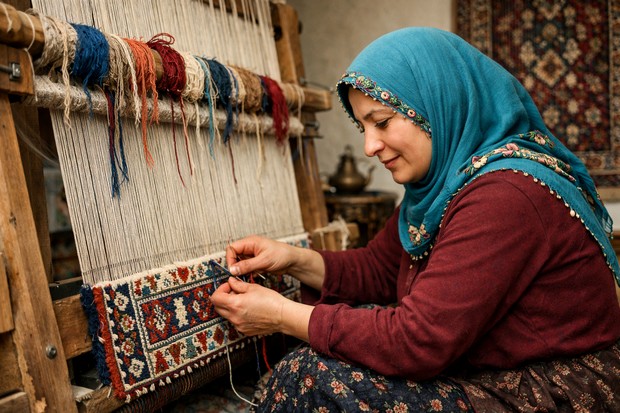
The third dimension, pile, was added a few thousand years after the flatweave rug emerged. Hand-knotted carpet is made on horizontal and vertical looms, using various knotting techniques.
Embroidered Rugs
Such rugs are flatweave pieces created on a fabric surface, and they are known as crewel embroidered, chain stitch, or arraiolos rugs.
Modern Handmade Carpets
Various new kinds of handmade carpet manufacturing emerged with mechanisation. We started using metal in looms, weaving tools, and other processes. Modern techniques require less time than ancient methods, and that change made it possible to introduce other forms of carpet making.
Handloom Carpets
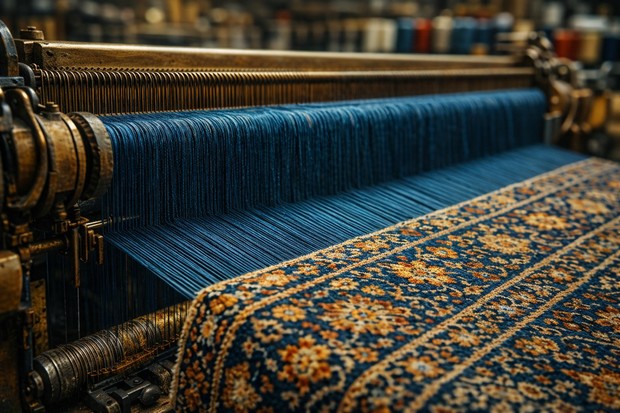
The handloom carpet technique is based on the concept of machine-made carpet. But instead of using electricity for inserting and beating a row of pile, it is done by hand.
Hand-Tufted and Hand-Hooked Carpets
In this technique, pile is created using a tufting device on a fabric. This technique has changed the level of carpet consumption, as it is currently the most sold carpet in the handmade segment. Some people also call hand-tufted carpet hand-hooked if the carpet has loop pile.
Table-Tufted Carpets
With the sewing machine fitted on a table, the pile is formed on a piece of fabric. This technique is especially popular for shags with large pile heights.
Hand-Woven Carpets
The loom used for making hand-knotted or flatweave rugs is used for this type of rug. Instead of making a knot, the yarn is moved straight or through a thin metal rod to create various structures of flat or pile rugs. This technique is popular for structural rugs.
Braided Rugs
The scraps of clothing and excess materials were used initially in creating the braid. Now various kinds of materials are used in making such rugs. Three or five ropes of fabric or yarn are intertwined to make the braid, and the braid is stitched into a rug.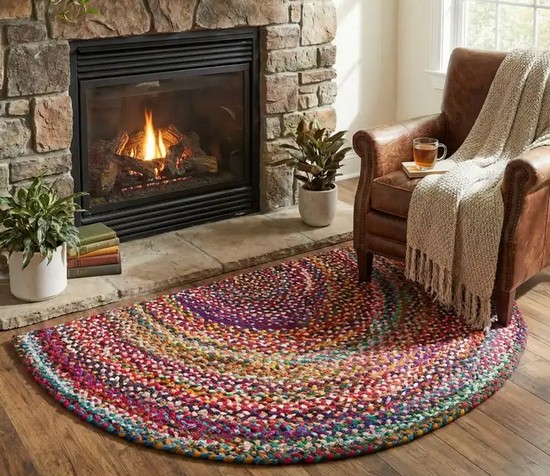
Jacquard Rugs
The Jacquard cards are manually punched to guide the yarn for pattern creation, and the carpet is created with no pile or with pile.
Patchwork Carpets
The parts of old or damaged carpets are restored, and then these patches are stitched together to create a patchwork carpet.
Printed Carpets
Printing on carpet can be done using hand blocks, screens, rotary, and digital printing machines. This technique is available for handmade and machine-made carpets alike, for both flatweave and pile rugs.
Over-Dyed Carpets
An old or new carpet is dipped in a dye bath and over-dyed. The process changes the look of the carpet.
Machine-Made Carpet Types
How Machine-Made Carpets Developed
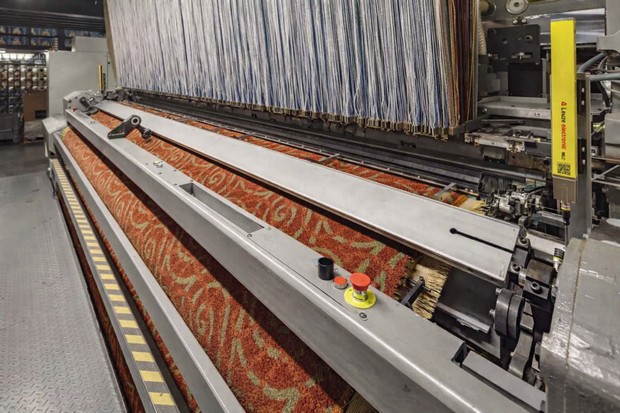
The making of carpets by machinery started in the 18th century. The machine-made carpet looms were initially able to weave only 68 cm (27″) wide carpet, so they were stitched together to cover wider areas. The looms were steam-powered before electric-powered looms with the Jacquard mechanism came into use.
Woven Machine-Made Carpets
Woven on power loom, Wilton, Axminster, and Brussels weave are different types of machine-made carpets. Wilton includes single face, face-to-face, shags, and flatweave, while Axminster has three main types. Axminster and Brussels carpets are named after the places where they were born.
Tufted Carpets
Such carpets started in the United States after a few decades of woven machine-made carpets. They are the most consumed carpets in the world, especially as wall-to-wall broadloom carpet.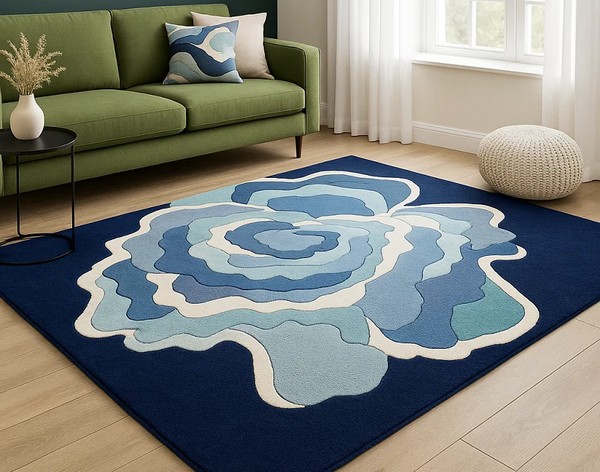
Robot Tufted Carpets
With the introduction of computers into our life and further mechanisation, robots are now used in carpets that otherwise are not economically viable on a machine-made carpet loom. Since such tufted carpet looks and feels like hand-tufted, some manufacturers market them as eTufted and Hand-tufted Robot carpets as well.
CRT Carpets
Wilton technology introduced in the 1990s has drastically changed the face of the machine-made carpet industry. Kara-Loc and Van De Wiele looms are becoming more efficient, resulting in lower production cost and structural variation, albeit at heavy capital investment.
Carpet Materials and Fibres
Carpets can also be classified by the type of fibres and yarns. The colour, length, brilliance, sourcing cost, weather, and quantity of availability of fibres all play an important role in the look, feel, image, and price of the carpet.
Natural Fibres Used in Carpets
Animal Fibres
Wool coming from alpaca, angora rabbit, camel, cashmere, goat, horse, mohair goat, sheep, and yak are in this category. Silk comes from silk moths or worms. Leather is cut in the shape of yarn and then flatweave or shag rugs are made. It is also cut into components and then stitched together to create a rug with or without stencilled motifs. Animal skins with furs are also used in rug making.
Plant Fibres
Such fibres are named by the source.
- Seed: Coir, Cotton, and Kapok
- Bast: Hemp, Jute, Linen, Nettle, Ramie
- Hard: Abaca, Sisal
- Regenerated: Bamboo
Metal and Stone Carpets
Gold and silver have been used in carpets in ancient times. Now metallic fibres such as lurex are used. Precious, semi-precious, and artificial stones are also used in carpet. Such carpets are known as jewel carpets.
Man-Made Fibres
The chemical compounds from which man-made fibres are produced are known as polymers, regenerated cellulose, polycaprolactam, and polyethylene terephthalate. Some such fibres have become common names such as lurex, rayon, and nylon. Man-made fibres used in carpets are:
- Cellulosic: Modal, Rayon, Viscose
- Polyacrylonitrile: Acrylic, Modacrylic
- Polyamide: Nylon
- Polyester
- Polypropylene or Heatsetgarne
Carpet Yarns
Handspun Yarn
The spindle and distaff were used in making hand-spun yarn. Later, spinning wheels were invented for it. A single yarn is multiplied by winding, and yarns are used in parallel in creating carpet.
Millspun Yarn
The modern or powered spinning started with water and steam power, which later moved to electricity in the making of millspun yarn. Ring Spinning, Open End, Felting, Chenille, and Braiding machines are available to make various kinds of yarn.
Carpet Dyeing and Colouring
Natural Dyes
Such dyes are extracted from plants, such as herbs, fruits, and flowers, and from insects. They have medicinal properties and are free of hazardous side effects.
Synthetic Dyes
Various kinds of synthetic dyes are used in printing and dyeing of carpet, that is, acid, basic, cationic, direct (substantive), disperse, metallized, pigment, reactive, sulfur, and vat, etc. New techniques in dyes and dyeing process are also being developed to save energy and water, improve fastness, and reduce dyeing time.
Carpet Sizes and Shapes
Carpet Sizes
The carpets are classified by shape, sizes, and usage. Some standard classification by size is listed below.
- Tile Carpet (Modular): 0.015 and 0.023 m2
- Place mat: <0.16 m2
- Mat: 0.16 to 0.60 m2
- Rug: 0.60 to 5.00 m2
- Carpet: >6.00 m2
- Broadloom: used generally for wall-to-wall
This term is also used for every carpet as an area rug in North America. They generally refer to carpet as wall-to-wall fitting.
Carpet Shapes
The carpets are also known by shape:
- Rectangular
- Circle or Round
- Square
- Oval
- Octagon
- Half-moon
- Triangle
- By name of animal or object, such as fish, tiger, ball, star, etc.
Carpet Uses and Applications
Common Carpet Uses
Apart from use on the floor, carpets have been used for various other purposes, such as wall hanging, bed sheet, bed cover, chair cover, table cover, place mat, door mat, tent, wrapping, curtain, horse and elephant decoration, church, public area, prayer, and yoga, etc. They can be termed with such names. The rugs are also classified by room name or purpose of use, such as kids, lounge, bedroom, family room, kitchen, dining room, lobby, hallways, gallery, runner, stairs, and basements.
Eco-Friendly Carpets
The carpets were originally organic and sustainable. The mass production movement resulted in environmental neglect. Initiatives began to eliminate or reduce hazardous chemicals in carpets, and certain chemical groups were banned. Now organic carpets, which are free from all types of hazardous chemicals and pesticides, are getting momentum. These carpets are audited and certified by accredited organisations.
Carpet Segments by End Use
Aviation or Aeroplane Carpets
Such carpets require very tough standards because of the risk involved. They are lightweight, fire resistant, anti-static, stain-resistant, etc.
Marine or Boat Carpets
These carpets are generally backed with rubber and are water, stain, fade, and ravel resistant.
Commercial Carpets
Such carpets are used in areas having a high amount of foot traffic. They are used at hospitals, schools, airports, etc. This is further categorised based on low, medium, and heavy traffic usage.
Hospitality Carpets
These carpets are used in hotels, casinos, restaurants, etc. They are changed quickly due to heavy foot traffic and style changes.
Residential Carpets
These carpets are used at home. They are more relaxing and comforting.
Carpet Performance Features
Carpets can be classified based on acoustic, antimicrobial, anti-static, durability, ease of maintenance, fire retardant or flame resistant, heavy resistant, heavy, middle or low traffic, seaside, soil resistant, outdoor, and UV resistant criteria.
Conclusion
This classification is useful for the consumer when choosing a carpet according to taste, budget, and living style. It also helps the manufacturer study the trend and produce accordingly. With globalisation and technical upgradation, carpet making and supply will keep changing in future, and additive manufacturing, or 3D printing, may enter the process as well. Carpet may change its colour and pattern according to the user’s mood, it may become cheaper to make, and new fibres and yarn will continue to emerge. Handmade carpet will remain an object of desire for discerning people.