Fabric testing is the backbone of quality control in the textile industry. It helps brands, mills, and buyers confirm how a fabric will perform in daily use. Fabric testing covers durability, appearance, comfort, and overall serviceability, making it easier to match a material to its end use. In this article I will explain how fabric testing determines durability, appearance, and comfort in real use specially in home textiles.
Fabric Durability Testing Methods
Mechanical Properties of fabric
Fabric strength evaluations are made in terms of breaking strength, tearing strength, or bursting strength. Not every test fits every fabric construction, so the method must match the material. Some tests are not suitable for some fabrics; for example, knits do not tear in the same way woven fabrics do. A variety of machines is used to measure strength, and fabric samples are prepared for testing according to ASTM test method procedures.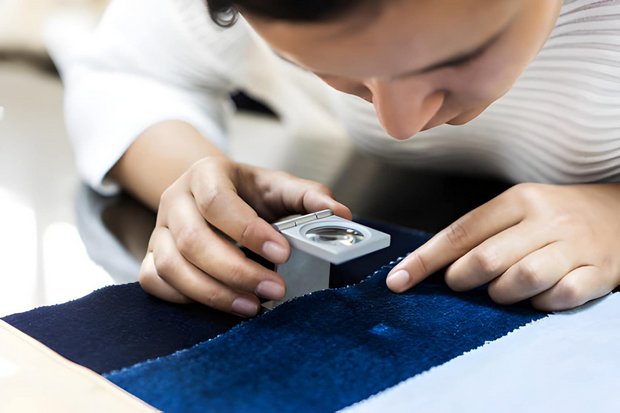
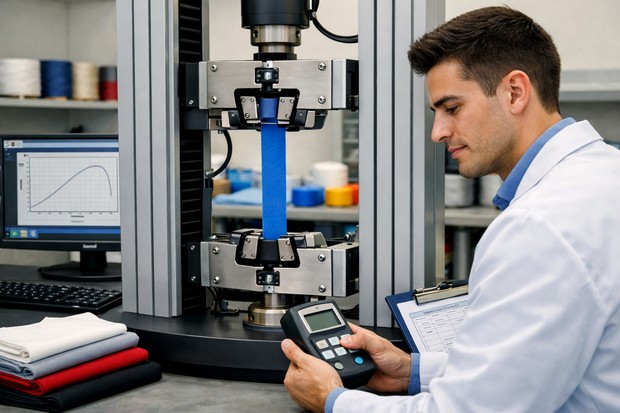
Breaking strength, the force required to break a woven fabric when it is pulled under tension, is measured on a tensile testing machine. The strength is reported in pounds or newtons of force required to break the fabric. At the same time that breaking strength is being tested on a tensile testing machine, the degree of elongation that the fabric undergoes before breaking may also be determined and reported as a percentage of the original length. This can be an important consideration for some uses; you would not want a stretchable fabric for seat belts, for example. Similarly, home textile products like sofa covers and curtains require controlled elongation to maintain shape during use.
Tearing strength of a fabric, expressed in pounds or grams, is the pressure required to continue a tear or rip already begun in a woven fabric. Strength can be measured on a tensile tester by cutting a slit in a fabric specimen and mounting the two parts, or “tongues,” in the clamps of the machine. Other instruments provide alternate methods for holding the two split ends of the sample before tearing.
Bursting strength is the force required to rupture a fabric. In this case the force is applied in many directions at once by either pushing a ball through the tautly held fabric or applying air pressure. Bursting strength tests are commonly used to evaluate the strength of knitted and nonwoven fabrics, where the elongation or resistance to stretch in all directions is important. The ASTM specification standard for men’s and boys’ knitted dress shirt fabrics, in contrast to the specification for woven fabrics, lists a recommended fabric strength of fifty pounds of force, as determined by a bursting strength test rather than a breaking strength test.
Abrasion Resistance and Pilling Test
Abrasion resistance can be determined on several different types of abrasion-testing machines. Because each machine uses a different motion and fabric position, the results cannot be compared directly. The results of tests run on different machines cannot be compared as each machine tests with a different motion and each holds the fabrics in different positions. Some instruments determine only flat abrasion, while others can measure resistance to edge and flex abrasion. Abrasion results depend not only on the type of machine action, but also on the type of abrading surface and the tension on the fabric during abrasion. Results can be reported as the number of rubbing cycles to produce a hole or as the loss in strength, weight, or thickness after a specified number of cycles.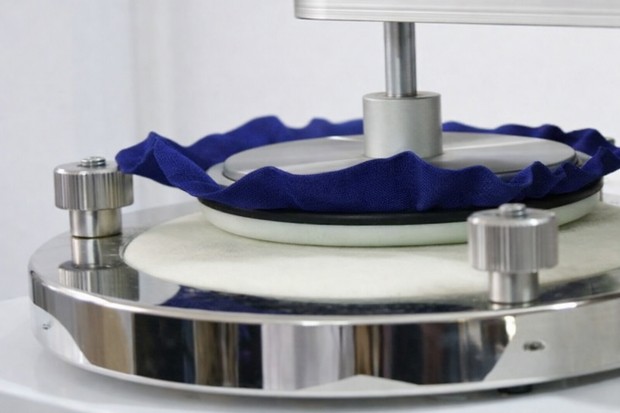
Pilling is a result of abrasion but can also affect the appearance of a fabric. It is often important to determine a fabric’s tendency to pill when evaluating its serviceability. There are several types of instruments to determine relative pilling resistance. The Martindale tester can measure both abrasion and pilling resistance in different operations. After the fabric is rubbed to induce pilling, it can be subjectively rated against photographs representing different pilling levels.
Fabric Appearance Testing
Dimensional Stability
Shrinkage or growth of fabric during wear and care can render an apparel or household textile item both unappealing and unusable. Consequently a required level of dimensional stability is often included in buyer specifications as well as in ASTM specifications for particular product categories. Buyers in markets such as the USA, Canada, and the UK each define their own minimum performance benchmarks for dimensional stability and other physical properties. For a full overview of what those export markets require, see our guide on home textile quality standards for USA, Canada, and Europe. This is especially important for products that must keep their size and shape after repeated washing. It is traditionally determined by placing marks on the fabric; subjecting it to laundering, dry cleaning, or other conditions; then remeasuring the marked area. The shrinkage or growth is reported as a percentage of the original dimensions.
Not only may fabrics shrink, but they may also twist or skew during laundering. Knits and twill weaves are especially susceptible because there are twist stresses built up during the processing of these fabrics. How often have we seen the seams or wales of a T-shirt twist from their vertical position after washing? A test method was developed by the AATCC for determining skewness change in fabrics. The diagonal lines of a marked square are measured and the percent change in their lengths calculated.
Wrinkle Resistance Test
Wrinkle recovery of fabrics is measured by creasing small fabric samples for a specified time, allowing them to recover, and calculating the angle that the two creased ends form. Fabrics with good recovery will result in measured angles that are high, around 150 degrees. Untreated cotton fabrics usually have recovery angles of less than 100 degrees.
Retention of a smooth fabric appearance after laundering can be determined by comparison with standard plastic replicas representing different levels of wrinkling. Fabrics are laundered and visually compared to the replicas. Ratings for smoothness appearance (SA) range from one (poor) to five (very good). Standard test methods also exist for determining the appearance of creases in wrinkle-free items after laundering, an important feature in men’s twill-weave casual pants.
Colorfastness Test Methods
Fabrics may be more or less colorfast to a variety of different substances or conditions, with the importance of each dependent on the use of the fabric. Colorfastness to laundering is important in garments and textiles that undergo frequent laundering. Perspiration may cause some color change and/or color transfer, and some colors may be lost or diminished by heat. Some dyes tend to crock, or rub off on fabrics or other materials with which they come in contact. Others will bleed into water during laundering and may be picked up by lighter-colored fabrics. Chlorine bleaches will remove color from many dyed fabrics, but some dyes are more sensitive to the action of chlorine bleaches than are others. Sunlight causes many dyes to fade over time.
Dye performance labeling is not required by any legislation or regulation, but some manufacturers include colorfastness information on labels. Such labels will generally describe the conditions under which the fabric is colorfast, such as “colorfast to laundering but not to chlorine bleaching” or “colorfast to sunlight.” A few terms may be found on labels that carry an assurance of colorfastness, such as trademarks that have been applied to solution-dyed synthetic fibers. The colorfastness of one class of dyes, the vat dyes, is so consistently good for laundering that the term vat dyed on labels has come to be accepted as an assurance of good colorfastness.
Fastness is assessed via standard tests developed by an independent organization, the AATCC or the ISO, for example. Tests are available to assess fastness to all the agents mentioned above and many others. The test may measure the extent of color change or the degree to which a nearby white material is stained. In each case the result is reported on a one-to-five “Gray Scale” where five is perfect (no color change or no staining). Clear performance specifications help dyers choose the right dyes and apply them correctly. While a dyer may know that the material is to be used for work apparel, bed linens, or curtains and guess the resulting needs, the fastness requirements are better communicated in a specification that lists the fastness tests and the level of performance required on each one. A realistic specification developed at the design stage will allow the dyer to understand what is required and should ensure satisfactory performance of the item when it is ultimately in the hands of the consumer. Dyers achieve the required fastness by choosing the appropriate dyes and applying them correctly to ensure, for example, that any unfixed dye is removed at the end of the dyeing process.
Color change is ascertained by keeping a control, an untreated sample of the fabric being tested. Tested samples are then checked against the original. The AATCC Gray Scale makes it possible to determine the degree of color change that has taken place. Samples of both treated and control samples are compared under standard lighting conditions, and the standard scales and ratings are applied. Although visual evaluation can yield reasonably consistent results, computerized color evaluation instruments are more accurate, and visual evaluations are being superseded by electronic measurement.
Fading from exposure to sunlight is measured in a machine that simulates, at an accelerated rate, the fading action of the sun. Samples can be exposed for varying periods of time and tested samples compared to control samples. Among the machines most often used for such tests are the Fade-Ometer and the Weather-Ometer.
Colorfastness to laundering and dry cleaning is done in machines such as the Launder-Ometer. Fabric samples and detergent solution are placed in small sealed cylinders and rotated in a temperature-controlled water bath for a specified time. The standard test has variations to correspond to hand washing, home laundering, and commercial laundering. These controlled cycles are designed to simulate repeated cleaning in everyday use. After the test, specimens are examined for color loss. If samples of a “multifiber” cloth containing yarns made of a number of different fibers are added to the cylinders along with test specimens, it is possible to determine whether other fabrics are likely to pick up color from the tested fabric during laundering or dry cleaning.
Both wet and dry crocking can be tested on a device called a Crockmeter that rubs the test sample across a white fabric sample. Color transfer from the test sample to the white sample indicates that the test sample is subject to crocking.
A device called the AATCC Perspiration Tester evaluates colorfastness not only to perspiration but also to chlorinated water, seawater, water spotting, and the like. The fabric sample is soaked in one of these liquids and subjected to heat and pressure.
Fabric Hand and Drape Evaluation
Fabric hand is highly subjective, so it is much harder to measure than colorfastness. In contrast to fabric color, where objective judgment is effective and use of color-measuring instrumentation for objective decision making is becoming the norm, the determination of what is or is not a satisfactory fabric hand is extremely difficult. Samples of fabric can be used as reference standards but readily become changed as they are handled. The AATCC has a standard evaluation procedure for fabric hand. Customers and suppliers have a fascinating vocabulary for aspects of hand; beyond simple terms such as soft or stiff, words such as buttery, sleazy, boardy, slick, and papery are used.
Drape and hand of fabrics can be measured objectively by the Drapemeter, the Kawabata Evaluation System for fabrics (KES), and the Fabric Assurance by Simple Testing (FAST) system. These tools are especially useful in research and product development when new finishes may change how a fabric feels or hangs. Literature abounds on the use of these instruments for research purposes such as determining the effects of new finishes on fabric hand and drape, but objective measurement of these properties is not routine for development of most textile products.
Fabric Comfort Testing
Sensorial Comfort
Sensorial comfort is related to surface and softness properties of fabrics. Surface properties can be measured on the Kawabata Surface Tester. Allergies and adverse reactions to abrasion and roughness are really in the realm of medical testing. Stiffness of fabrics affects not only hand, but also comfort and softness. In addition to the Kawabata and FAST systems, there is an ASTM method to determine bending resistance. A strip of fabric is moved off the edge of a platform until it touches the angled side of the platform. The longer the length of fabric it takes to touch the side, the stiffer the fabric is.
Thermal Comfort
Thermophysiological comfort depends largely on heat transfer and moisture vapor transport, as well as the permeability of the fabric. While these properties can be measured physically, such measurements should be related to subjective evaluations of comfort, which can often be specific to individuals. Textile technologists have defined a unit for measurement of thermophysiological comfort. This unit, the clo, represents the insulation or resistance necessary to keep a resting human being, producing heat at a standard rate, comfortable at 70°F (21°C) and air movement of 0.1 meter/second. The clo value is analogous to the R-value used in evaluating home insulation and window coverings.
Conclusion
Strong textile performance depends on careful testing across durability, appearance, and comfort. When fabrics are evaluated for strength, shrinkage, colorfastness, hand, drape, and thermal behavior, brands can choose materials that perform better in real life. Clear specifications and standardized methods also help manufacturers reduce complaints, improve consistency, and deliver products that customers trust.